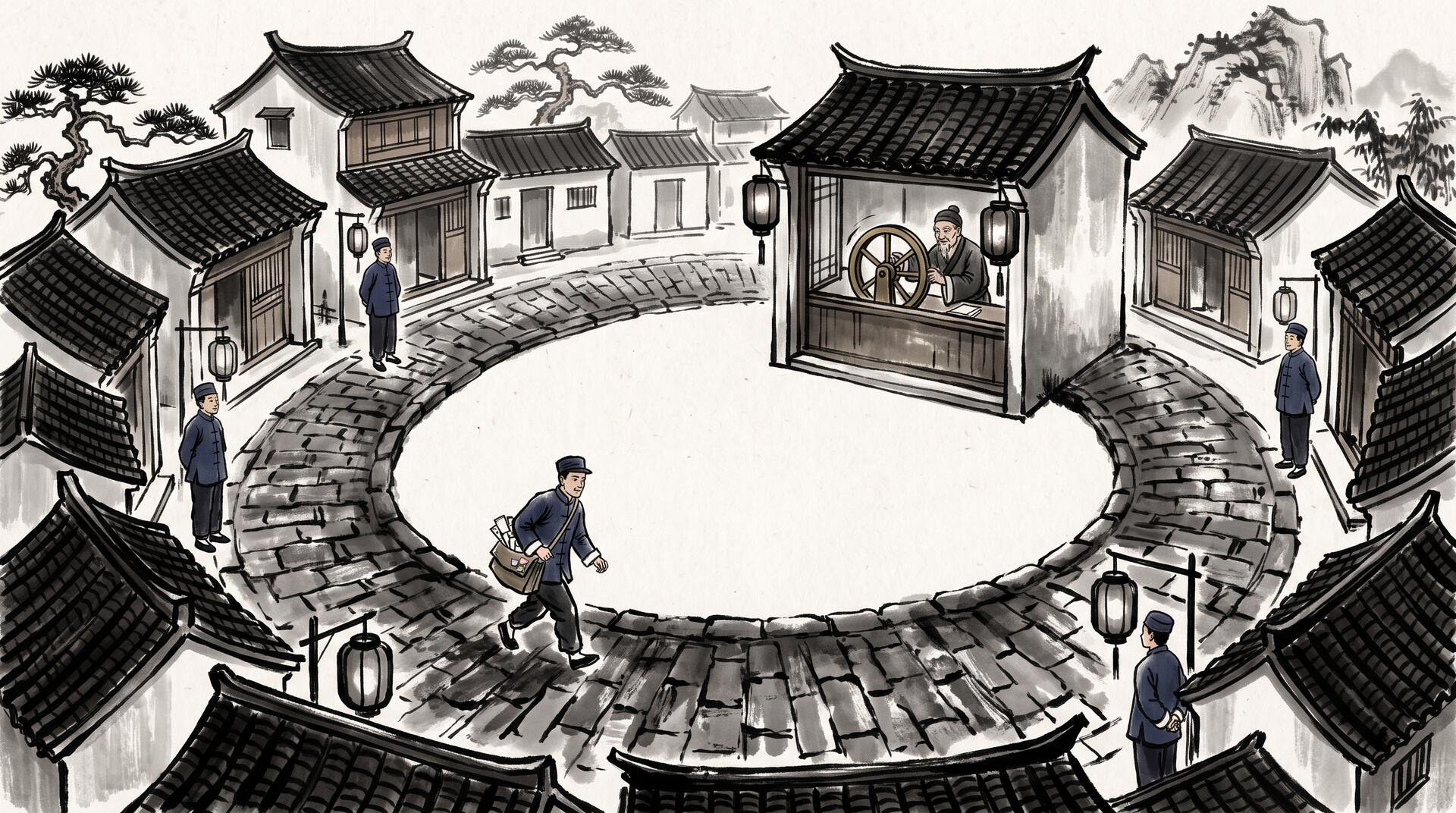
在云脚镇,所有人家都沿着一条环形的石板路住着。这条路绕成一个完整的圆圈,没有起点,也没有终点——从镇口出发一直走,最后总会回到镇口。
镇上有几位邮差,各自守在路边固定的几盏灯笼下。规矩很简单:每当一封信送到邮局,老局长就转动墙上那只刻着无数小格的铜轮盘。轮盘”咔”地停下,指针落在某个刻度上,这个刻度对应着环形路上的某一个点。信不会凭空飞过去,它顺着路_往一个方向走_(永远是顺时针),遇到的第一位邮差,就归他投递。
这套规矩有个好处,镇上人一开始没看出来。
有一年,住在东头的老邮差告老还乡了。换作别的镇子,这种事得把全镇信箱重新分一遍——谁送哪条街,全乱套。可在云脚镇什么都没乱:只有”原本会走到老邮差灯笼下”的那一小段信,现在改由顺时针方向的_下一位_邮差接手。其余每一位邮差手里的活,一封都没变。
后来镇上人多了,新来一位年轻邮差。他也只是往环上某个空位一站,从此_只从他逆时针那位邻居手里_接过一小段信。又是只有一小段易主,全镇其余纹丝不动。
但有个麻烦:灯笼的位置是早年随手定的,有的邮差脚下管着一长段路,累得够味;有的只管巴掌大一块,闲得发慌。老局长想了个法子——不让一位邮差只站一盏灯笼,而是给每人发了_十几个分身_,散布在环的各个角落。这样一来,无论谁退、谁来,受影响的总被均匀摊薄成许多小段,没人会突然被压垮。
——到这儿你大概已经认出来了:这条没有起点终点的环路,就是一致性哈希(consistent hashing)里的那个 ring;铜轮盘是 hash function,邮差是 node,”顺时针遇到的第一个邮差”就是 key 的归属规则;老局长发的那些分身,正是 virtual nodes。
这是什么
一致性哈希是分布式系统里给”哪份数据归哪台机器”做映射的一种办法。把所有 node 和所有 key 都 hash 到同一个环上,key 顺时针找到的第一个 node 就是它的归属。它最关键的性质是:增删一个 node 时,只有相邻的一小段 key 需要搬家,平均只动 1/N,而不是像普通取模 hash(key % N)那样几乎全部重排。Amazon Dynamo、Cassandra、很多分布式 cache 都靠它把扩容、宕机时的数据迁移代价压到最小。virtual nodes 则解决了环上分布不均、负载倾斜的问题。
隐喻对应表
- 环形石板路 → 哈希 ring(环形 key 空间)
- 铜轮盘、指针落点 → hash function,把 key/node 映射到环上的位置
- 每位邮差 → 一个 node(服务器 / 缓存节点)
- 信顺时针走到第一位邮差 → key 的归属规则(clockwise successor)
- 老邮差告老 → node 下线,只有它那段 key 迁给下一位
- 新邮差加入 → node 上线,只从一个邻居接管一小段
- 给每人发十几个分身 → virtual nodes,让负载均匀
- “全镇其余纹丝不动” → 最小化数据迁移(minimal rebalancing)
In the town of Cloudfoot, every household sits along a single ring-shaped cobblestone road. The road bends into one complete circle — no beginning, no end. Set out from the town gate, keep walking, and you always arrive back at the town gate.
The town has a handful of postmen, each stationed beneath a few fixed lanterns along the road. The rule is simple: whenever a letter reaches the post office, the old postmaster spins a brass wheel on the wall etched with countless tiny notches. The wheel clicks to a stop, the needle lands on some notch, and that notch maps to one point on the ring road. The letter doesn’t fly straight there — it travels along the road in one direction (always clockwise), and the first postman it meets is the one who delivers it.
This rule has a hidden virtue the townsfolk didn’t notice at first.
One year, the old postman on the east side retired. In any other town this means re-dividing every mailbox in the whole town — who covers which street descends into chaos. But in Cloudfoot, nothing fell apart: only the small stretch of letters that used to walk up to the retired postman’s lantern now passes to the next postman clockwise. Every other postman’s workload changed by not a single letter.
Later the town grew and a young postman arrived. He merely stood at an empty spot on the ring, and from then on took over only a small stretch from his counter-clockwise neighbor. Again, just one slice changed hands; the rest of the town didn’t stir.
But there was a snag: the lanterns had been placed casually long ago, so some postmen guarded a long stretch and were worked to exhaustion, while others covered a sliver and stood idle. The postmaster found a fix — instead of letting one postman stand at a single lantern, he gave each man a dozen stand-ins scattered around the ring. Now, whoever retires or arrives, the disruption is always thinned out evenly into many small stretches, and no one is suddenly crushed.
— By now you’ve probably recognized it: this beginning-less, end-less loop is the ring of consistent hashing; the brass wheel is the hash function, each postman is a node, and “the first postman met going clockwise” is the key-ownership rule; the postmaster’s stand-ins are virtual nodes.
What it is
Consistent hashing is a way for distributed systems to map “which piece of data belongs to which machine.” You hash every node and every key onto the same ring; a key belongs to the first node it reaches going clockwise. Its crucial property: when you add or remove a node, only a small adjacent stretch of keys has to move — on average just 1/N of them — instead of the near-total reshuffle you’d get from plain modulo hashing (key % N). Amazon Dynamo, Cassandra, and many distributed caches rely on it to keep data-migration cost minimal during scale-ups and outages. Virtual nodes solve the uneven-distribution / load-skew problem on the ring.
Metaphor mapping
- The ring-shaped road → the hash ring (circular key space)
- The brass wheel & where the needle lands → the hash function, mapping keys/nodes to positions on the ring
- Each postman → a node (server / cache instance)
- A letter walking clockwise to the first postman → the key-ownership rule (clockwise successor)
- The old postman retiring → a node leaving; only its stretch of keys migrates to the next one
- The new postman arriving → a node joining; it takes over one small slice from a single neighbor
- Giving each man a dozen stand-ins → virtual nodes for even load
- “The rest of the town didn’t stir” → minimal data migration (minimal rebalancing)