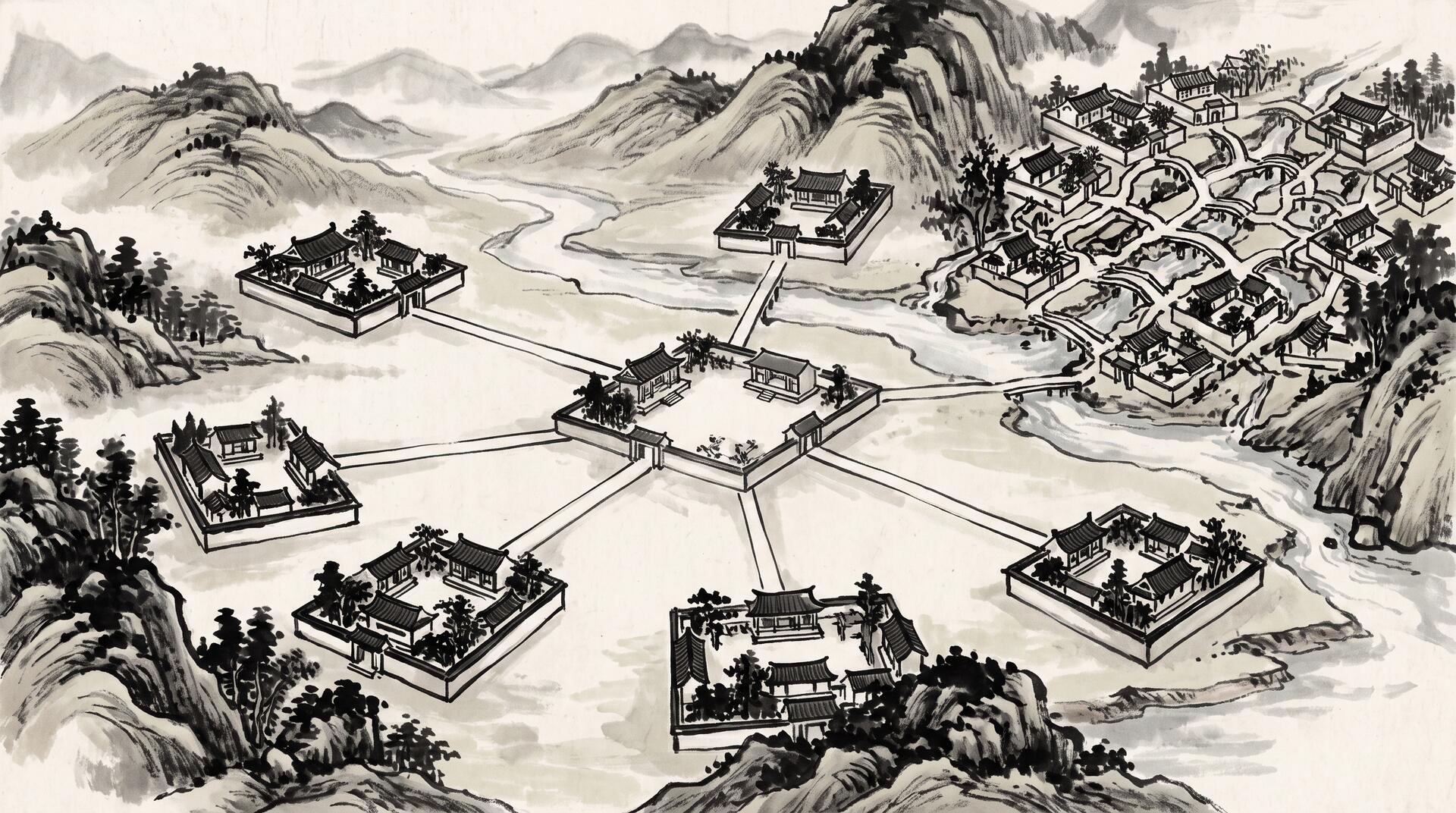
河谷里散落着好几座庄园,每一座都围着高墙,自成一方天地——庄里有自己的道路、货栈、集市,外人进不来,庄里的车也出不去,除非专门为它架一座桥。
起初只有红庄和蓝庄想通商。两家各出工匠,在两庄之间架起一座_私桥_,桥的两头各设一道门,只认这两家的马车。红庄的车能直抵蓝庄的货栈,蓝庄的车也能回访红庄。生意兴隆,两庄都很满意。
后来绿庄也想加入。于是红庄与绿庄之间又架起一座私桥。现在红庄既通蓝庄、又通绿庄,像个小小的枢纽。可有一天,蓝庄的商人要把货送去绿庄,他驾车驶上通往红庄的桥,到了红庄,却被门吏拦下:”我这座桥只认红蓝两家的车。你要去绿庄,自己去和绿庄架一座桥。”——桥是不能_借道接力_的。蓝要到绿,红庄这座现成的桥半点忙帮不上,非得蓝绿之间再单独架一座不可。
庄园越来越多,麻烦也越来越大。四座庄园两两互通,要六座桥;五座要十座;等到十座庄园都想彼此往来,竟要架_四十五_座桥。而且每新来一座庄园,就得同时与现有的每一座各架一座新桥、各开一道门、各记一本账。工匠们疲于奔命,河谷上空私桥密如蛛网,谁也说不清哪座通着哪座。
这时一位老驿丞想了个别的法子。他不再在庄与庄之间架桥,而是在河谷正中的空地上,圈起一座大大的中央_驿场_。规矩全变了:每座庄园只需修_一条_路,通到这座驿场,仅此一条。红庄一条、蓝庄一条、绿庄一条,后来的庄园也都只修这一条。
驿场正中坐着驿丞,案头摊着一本大_账_:哪条路通往哪座庄园,记得清清楚楚。蓝庄的车要去绿庄,只管驶进驿场,报一声”往绿庄”;驿丞翻账、一挥手,指向绿庄那条路,车便借着驿场_转接_过去了。蓝去绿、绿去红、红去橙,全在这一座驿场里周转,再没有哪两家需要单独架桥。
从前十座庄园要四十五座私桥;如今只要十条路,外加河心一座驿场。再来一百座庄园,也不过是各修一条路而已。当然,天下没有白转的车:每一辆进驿场周转的马车,都要在门口交一枚_过路钱_,驿丞靠这个养着驿场。庄主们算过账,都觉得这钱花得值——省下的,是那漫山遍野再也理不清的私桥。
——到这儿你大概已经认出来了:庄与庄之间那种只认两家、不能借道接力的私桥,就是 VPC peering;而河心那座人人只修一条路、却能借它转去任何一家的中央驿场,就是 Transit Gateway。
这是什么、为什么重要。 VPC peering 把两个 VPC 直接对接,是_点对点_且_非传递_(non-transitive)的:A–B 有 peering、B–C 有 peering,并不会让 A 通到 C——每一对要通信的 VPC 都得自己拉一条 peering。于是 N 个 VPC 全互联需要 N(N-1)/2 条连接,随规模 O(N²) 爆炸,每条还要在两边各自维护路由表条目,大规模下几乎无法管理。Transit Gateway 则是一个 region 级的中心路由 hub:每个 VPC 只 attach 一次,TGW 用它自己的 route table 做_传递路由_,于是任意两个挂上来的 VPC 都能互通,连接数从 O(N²) 降到 O(N)。代价是 TGW 有每小时的 attachment 费和每 GB 的数据处理费,而且所有跨 VPC 流量都要经过这个中心点(需要靠多张 route table 做分段隔离、并留意它可能成为瓶颈)。当你有几十上百个 VPC、跨多账户、还要接 VPN / Direct Connect 做混合云时,中央驿场几乎总是比满谷私桥更划算。
隐喻对应表:
- 一座座围墙庄园:一个个 VPC(彼此隔离的私有网段)
- 两庄之间只认两家车的私桥:一条 VPC peering 连接,点对点、只连这两个 VPC
- 门吏不许借红庄的桥去绿庄:peering 的_非传递性_——A–B 与 B–C 不让 A 到 C
- 庄园两两架桥、桥数翻着番爆长:全互联需
N(N-1)/2条 peering,O(N²) 规模爆炸 - 河谷正中的中央驿场:Transit Gateway(region 级中心路由 hub)
- 每庄只修一条通往驿场的路:每个 VPC 只 attach 一次到 TGW,连接数降到 O(N)
- 驿丞案头那本大账:TGW 的 route table(路由表)
- 报一声目的地、驿丞翻账挥手转接:TGW 的_传递路由_,任意两个 attachment 互通
- 进驿场交的过路钱:TGW 的每 GB 数据处理费 + 每小时 attachment 费
- 所有车都从这一座驿场周转:中心 hub 是流量必经点(靠多张 route table 分段,也需防其成瓶颈)
Several estates are scattered across the river valley, each ringed by a high wall, each a world of its own — with its own roads, warehouses, and market inside. No outsider gets in, and no cart gets out, unless a bridge is built for it.
At first only the Red estate and the Blue estate wished to trade. Each sent its masons, and between the two they raised a private bridge, a gate at either end that admitted only these two houses’ carts. Red’s carts could roll straight to Blue’s warehouse, and Blue’s could visit Red in return. Business flourished; both were pleased.
Later the Green estate wanted in. So a second private bridge went up between Red and Green. Now Red reached both Blue and Green, a little hub of sorts. But one day a Blue merchant, carrying goods bound for Green, drove onto the bridge to Red — and at Red’s gate the keeper stopped him: “This bridge admits only Red and Blue carts. If you want Green, go raise your own bridge to Green.” A bridge cannot be borrowed as a relay. Red’s ready-made bridge was of no help at all; Blue and Green had to build one of their very own.
As estates multiplied, so did the trouble. Four estates fully interconnected need six bridges; five need ten; and by the time ten estates all wished to reach one another, it took forty-five bridges. Worse, every new estate had to raise a fresh bridge — a fresh gate, a fresh ledger — to each and every existing one at once. The masons ran themselves ragged; private bridges webbed the sky over the valley, and no one could say anymore which crossed to which.
Then an old post-warden tried something else. He stopped bridging estate to estate. Instead, on the open ground at the very center of the valley, he enclosed one great central yard. The rule changed entirely: each estate need build only one road, running to this yard, and only that. Red built one, Blue one, Green one; every later estate, only that one.
At the heart of the yard sat the warden, a great ledger open before him: which road led to which estate, all set down plainly. When a Blue cart wanted Green, it simply drove into the yard and called out “to Green”; the warden turned a page, waved a hand toward Green’s road, and the cart was relayed onward through the yard. Blue to Green, Green to Red, Red to Amber — all turned about within this one yard, and no two houses ever needed a private bridge again.
Where ten estates had once needed forty-five bridges, now they needed ten roads and one yard in the river. Add a hundred more estates, and it is still just one road apiece. Of course, no cart turns for free: each one that passes through the yard drops a toll at the gate, and on that the warden keeps the yard running. The estate lords did the sums and found it well spent — what they saved was the endless, untraceable thicket of private bridges.
— By now you have probably recognized it: the private bridge between two estates, admitting only those two and refusing to relay, is VPC peering; and the central yard in the river, where everyone builds a single road yet reaches anyone through it, is the Transit Gateway.
What it is, and why it matters. VPC peering connects two VPCs directly, and it is point-to-point and non-transitive: A–B peered and B–C peered does not let A reach C — every pair that must talk needs its own peering. So fully meshing N VPCs takes N(N-1)/2 connections, an O(N²) blow-up, each one requiring route-table entries maintained on both sides — nearly unmanageable at scale. A Transit Gateway is instead a region-level central routing hub: each VPC attaches just once, and the TGW uses its own route table to do transitive routing, so any two attached VPCs can reach each other — dropping the connection count from O(N²) to O(N). The price is that a TGW charges an hourly fee per attachment and a per-GB data-processing fee, and all cross-VPC traffic funnels through this central point (you segment it with multiple route tables and watch that it doesn’t become a bottleneck). When you run dozens or hundreds of VPCs across many accounts, plus VPN / Direct Connect for hybrid cloud, the central yard almost always beats a valley full of private bridges.
Metaphor mapping:
- The walled estates: individual VPCs (isolated private networks)
- A private bridge admitting only two houses: one VPC peering connection — point-to-point, just those two VPCs
- The keeper refusing to relay through Red’s bridge to Green: peering’s non-transitivity — A–B and B–C don’t give A→C
- Bridges multiplying pair by pair: full mesh needs
N(N-1)/2peerings, an O(N²) blow-up - The great yard at the valley’s center: the Transit Gateway (region-level central routing hub)
- Each estate building a single road to the yard: each VPC attaches once to the TGW — connections fall to O(N)
- The warden’s open ledger: the TGW route table
- Calling a destination, the warden relaying you onward: TGW transitive routing — any two attachments interconnect
- The toll dropped on entering the yard: TGW’s per-GB data-processing fee + hourly attachment fee
- Every cart turning through this one yard: the central hub is on every path (segmented via multiple route tables, and a potential bottleneck)