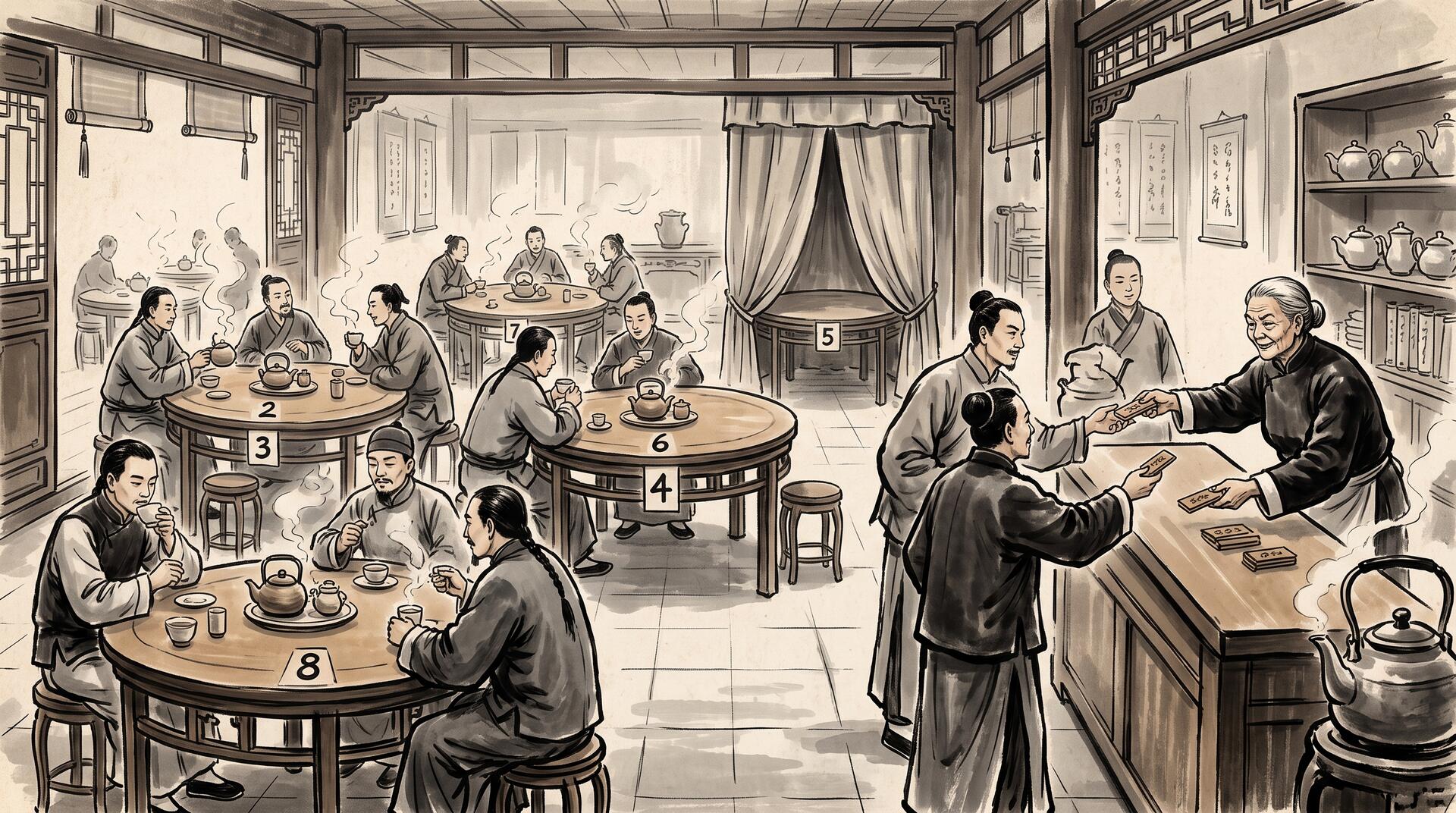
镇口有间老茶馆,堂里摆着八张桌子。老板娘有个规矩:每位常客头一回进门,她都在柜台后摸出两枚刻了记号的小木牌,递过去说——”往后你就认这两张桌子,别的桌子满不满,都跟你不相干。”她发牌从不照着顺序来:张裁缝拿到三号和七号,李郎中拿到一号和五号,赶车的王二拿到三号和六号。八张桌子两两一搭,能配出好些不一样的组合,于是几乎没有哪两位客人的两张桌子完全一样。
那年秋天,来了个背着药篓的远客,偏巧他那天带着一身风寒,咳个不停。他手里的木牌是三号和七号。到晌午,坐三号、七号的客人也陆续染上了咳嗽,那两张桌子只好挂上布帘,歇了。
要是按老法子——谁进门就往人堆里最空的地方一坐——这身风寒怕是要顺着满堂传个遍。可老板娘的规矩救了场:那远客的病气,只落在他名下的三号、七号两桌上。张裁缝也占着三号,偏他那另一张又是七号,两张全和远客撞上了,于是只有他一个人跟着遭殃。而李郎中的一、五,王二的三、六,至多和病桌沾着一张,另一张始终干净,照样有地方坐。整个茶馆里,真正被彻底挤得无处可去的,也就那么一两个”两张桌子全和病人重合”的倒霉蛋;其余人各自都还留着一张好桌。
老板娘常说:桌子拢共就八张,看着不多,可两张两张地搭,花样多得很。正因为花样多,随你哪位客人惹出乱子,也很难连累别人两张桌子一齐塌了。
——到这儿你大概已经认出来了:这位老板娘发的不是木牌,是 shuffle sharding(洗牌分片)。
这是什么。 shuffle sharding 是一种把故障”爆炸半径”压到最小的分片技巧。传统做法是把 N 个后端节点切成几个固定分片,一个分片坏了,落在它上面的所有租户一起完蛋。shuffle sharding 换了个思路:给每个租户随机挑 k 个节点(比如 8 选 2)当它专属的虚拟分片。因为组合数 C(N, k) 远大于租户数量,任意两个租户的节点集合几乎不可能完全重叠。于是当某个租户发出”毒丸”请求、或变成 noisy neighbor 拖垮它那 k 个节点时,别的租户至少还有一个节点没被波及,服务不至于全断。AWS 正是用它来隔离多租户服务(如 Route 53、ELB)的故障——用很小的节点池,就能给成千上万租户做出近乎独立的隔离。
隐喻对应:
- 八张桌子 → N 个后端节点组成的资源池
- 老板娘发的两枚木牌 → 随机分给每个租户的 k 个节点(它的虚拟分片 / shard)
- 发牌从不照顺序、两两组合各不相同 → shuffle:让任意两租户的节点集合尽量不重叠,组合数 C(N,k) 远大于租户数
- 背着药篓、一身风寒的远客 → 发出毒丸请求、或拖垮节点的 noisy neighbor
- 只有三号、七号两桌歇业 → 故障只落在该租户自己的 k 个节点上(爆炸半径受限)
- 两张桌子全和病人撞上的倒霉蛋 → 极少数节点集与故障租户完全重合、被一起拖垮的租户
- 各自还留着一张干净桌子的客人 → 大多数租户至少有一个健康节点,服务照常
There was an old teahouse at the edge of town, eight tables in its hall. The mistress who ran it kept a peculiar rule. The first time a regular walked in, she would reach behind the counter, pull out two small wooden chits carved with marks, and press them into his hand: “From now on these two tables are yours. Whether the others are full or empty is no concern of yours.” She never dealt the chits in order — Zhang the tailor drew tables three and seven, Li the herbalist drew one and five, Wang the carter drew three and six. Eight tables, paired two at a time, make a surprising number of different combinations, so it was rare for any two guests to hold exactly the same pair.
That autumn a traveler arrived with an herb-basket on his back, and as luck would have it he had caught a bad chill that day and could not stop coughing. His chits were tables three and seven. By midday the guests at three and seven had started coughing too, and those two tables had to be curtained off and closed.
Under the old way — whoever comes in drops into the emptiest seat in the crowd — that chill would have spread clean across the whole hall. But the mistress’s rule saved the day. The traveler’s sickness settled only on the two tables in his name, three and seven. Zhang the tailor held three as well, and his other table happened to be seven, so both of his tables collided with the traveler’s, and he alone had to suffer along. But Li’s one-and-five and Wang’s three-and-six overlapped with a sick table by at most one; their other table stayed clean, and they always had somewhere to sit. In the whole teahouse, the only ones truly squeezed out with nowhere to go were the odd one or two whose both tables happened to coincide with the sick man’s. Everyone else still had one good table to themselves.
The mistress liked to say: there are only eight tables, which does not sound like many — but pair them two at a time and the arrangements grow plentiful. And precisely because the arrangements are so many, no single troublesome guest can easily bring down two of anyone else’s tables at once.
— By now you have probably recognized her: the chits she hands out are not wooden tokens at all — they are shuffle sharding.
What it is. Shuffle sharding is a sharding trick for shrinking the blast radius of a failure. The traditional approach splits N backend nodes into a few fixed shards; when one shard breaks, every tenant assigned to it goes down together. Shuffle sharding flips this: each tenant is given a random subset of k nodes (say, 2 out of 8) as its own virtual shard. Because the number of combinations, C(N, k), is far larger than the number of tenants, almost no two tenants share exactly the same set of nodes. So when one tenant sends a poison-pill request or turns into a noisy neighbor that saturates its k nodes, other tenants still have at least one untouched node and stay up. AWS uses this to isolate faults in multi-tenant services (like Route 53 and ELB) — a small pool of nodes gives thousands of tenants nearly independent isolation.
The mapping:
- Eight tables → a pool of N backend nodes
- The two wooden chits she hands out → the k nodes randomly assigned to each tenant (its virtual shard)
- Never dealing in order, every pair different → the shuffle: any two tenants’ node sets barely overlap, since C(N,k) far exceeds the tenant count
- The chilled traveler with the herb-basket → a poison-pill request or noisy neighbor that drags its nodes down
- Only tables three and seven closing → the fault lands only on that tenant’s own k nodes (bounded blast radius)
- The unlucky guest whose both tables collided → the rare tenant whose node set fully overlaps the faulty one, dragged down too
- Guests who still had one clean table → most tenants keep at least one healthy node and stay in service