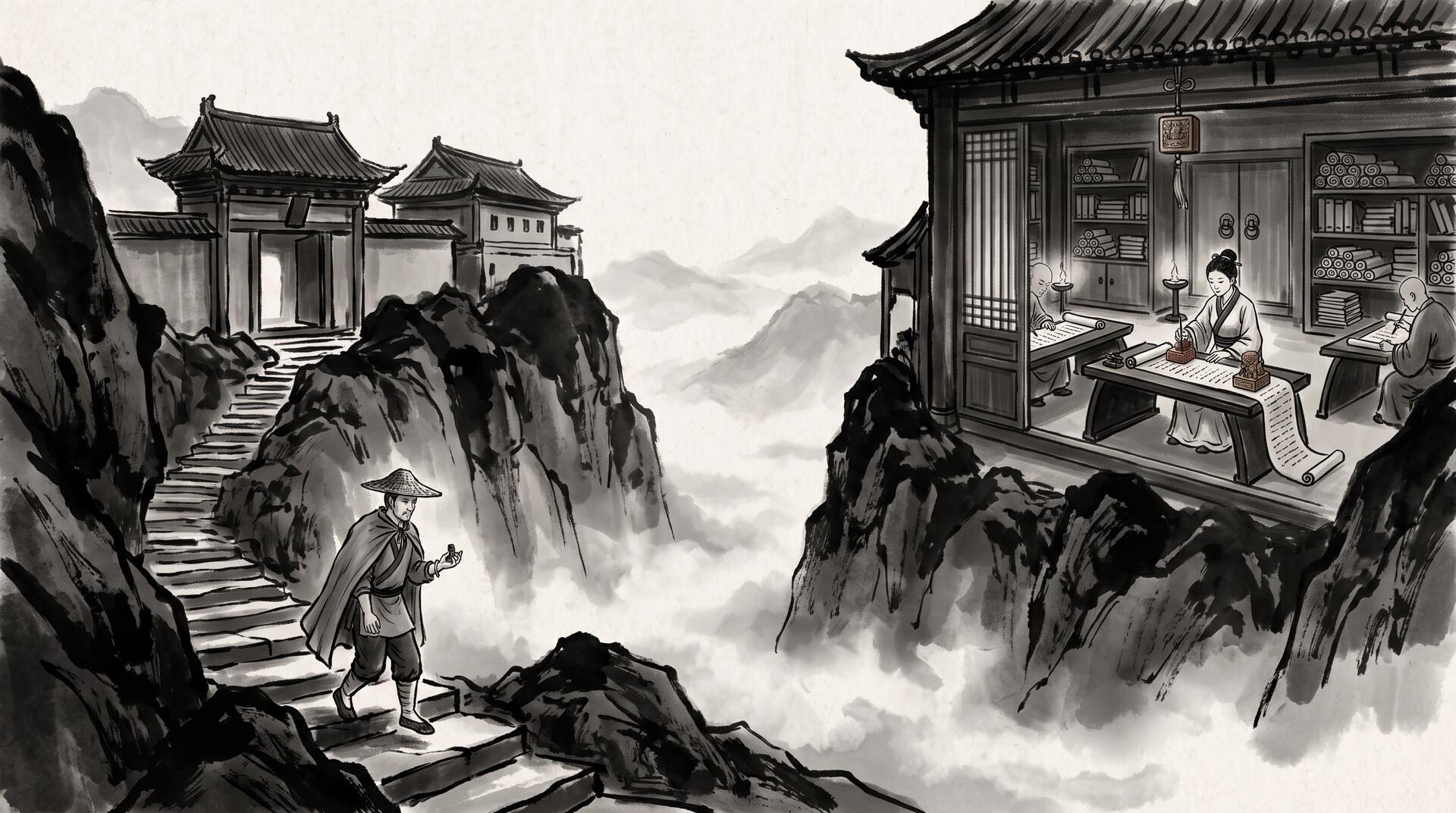
隔着一道雾谷,两座山头上各有一间抄经院。南院和北院抄的是同一部书——一万卷,一字不差,这是三百年前立下的规矩。
可是纸会烂,人会困。潮气顺着墙根爬进第三排书架,晕开半页字;某个抄经士打了个盹,把”辰”抄成了”晨”;山南今春新收了一卷补遗,山北还不知道。年复一年,两院慢慢地就不一样了。
早年的办法是笨办法:每年开春,两院各派十个人,抱着卷轴在谷底的石亭里对坐,一卷一卷念、一句一句校。一万卷,念到入夏也念不完。校完的那几个人,眼睛都花了。
后来北院来了位年轻的司印。她定了一条新规矩。
每抄完一卷,抄经士要在卷尾按一枚印。印不是随手盖的:她传下一套繁琐的手法,要把整卷的字句依次揉进印泥的纹路里。同样的字句,揉出来的纹一定一样;改动一个字,哪怕只把一个墨点挪了半分,揉出来的纹就面目全非,跟原来那枚看不出半点亲戚关系。而且这手法只能往前走——盯着纹路看一辈子,也倒推不出卷上写的是什么。
一卷有一卷的印。再往上是架:把一架十卷的印按次序排好,照同样的手法再揉一次,得到一枚架印,挂在架头。一间屋十架,十枚架印再揉一次,成屋印,钉在门楣上。最后,全院十二枚屋印揉成一枚总印,就那么一小块,挂在院门口的钉子上。
从那年起,对账只需要一个人。
信使清早从北院出发,怀里只揣着一小块蜡——总印的拓片。他走下雾谷,走上南院的台阶,把拓片往门口那枚印边上一比。
多数年份,两枚严丝合缝。他连门都不进,转身就回。一万卷书,一次比对,一天来回。
有一年不合。他这才推门进院。院里十二间屋,十二枚屋印,一枚一枚比过去——十一枚都对得上,第七间不对。他就只进第七间。屋里十架,比架印,第三架不对。他就只翻第三架,比那十枚卷印——第六卷。
抽出来一看:南院这一卷的第九行,被虫蛀掉了三个字。
一万卷里藏着一处错,他前后打开了不到二十卷。
他下山、上山、再下山,只把北院那一卷的抄本送了来。南院补好这一卷,重新揉了它的印;这一卷的印一变,第三架的架印跟着要重揉,第七间的屋印要重揉,院门口的总印也要重揉。只有从这一卷到院门这一条路上的印动了过——别的架、别的屋,一枚都不用碰。
还有一桩好处,是他们后来才发现的。有位远道来的客商,手里持着一卷,说是三十年前从南院请出去的正本,要人作证。从前作证得把一万卷搬来对;如今南院只给了他四枚印:同架另外九卷的印、同屋另外九架的印、全院另外十一间屋的印,还有院门口那枚总印的拓片。客商自己在客栈里按那套手法揉了三回,揉出来的正好是总印。谁也没看过他那一卷写的是什么,可谁都认了。
只出过一次岔子。那年南院新来的执事嫌书架太挤,把每架十卷改成了每架八卷。信使照旧来比印——总印不合,屋印全不合,架印也全不合,他一路追到底,一卷一卷摊开对,字字相同,一个错都没有。他在石亭里坐了半天才想明白:两院的书还是一样的书,只是分架的规矩不一样了。印是照着”这一架有哪几卷、什么次序”揉出来的;架一改,印全变,可书一个字都没变。第二年,南院把书架改了回去。
——到这儿你大概已经认出来了:那枚层层往上揉的印,就是 Merkle tree(hash tree);信使每年走的这一趟,就是 anti-entropy repair。
概念解释。 Merkle tree 是把一份数据切成块,对每块算一次密码学 hash 作为 leaf;相邻节点的 hash 拼接后再 hash,逐层向上收敛,最终得到唯一一个 root hash。它依赖 hash 函数的两条性质:确定性加雪崩效应(改一个 bit,root 就全变)、以及单向性(拿到 hash 推不回原文)。于是比对两份副本时,先比 root:相同就意味着整棵树、整份数据逐 bit 相同,代价是 O(1)、零数据传输;不同就沿树下降,每层只追那个 hash 不匹配的子树,O(log n) 次比对定位到具体的坏块,最后只传这一块。修完之后,也只需重算从这个 leaf 到 root 这条路径上的 O(log n) 个节点。
为什么重要。 第一,它把”两份副本是否一致”从一次全量扫描降成一次指纹比对,这正是 Cassandra、DynamoDB、Riak 这类最终一致系统里 anti-entropy repair 的做法:副本之间定期交换 Merkle tree,只修真正分叉的 range,而不是互相灌一遍全量数据。第二,它能查出沉默的损坏——bit rot、坏道、半截写入这类没有报错的数据腐烂,ZFS、Btrfs 的块校验树就是干这个的。第三,root hash 是整份数据的身份证:git 的 commit → tree → blob 就是一棵 Merkle 树,所以一个 commit hash 能钉死整个仓库的历史;容器镜像的 manifest digest、IPFS 的 CID、区块链的 block 也都是同一个套路。第四,它能做局部证明:只要拿到从某个 leaf 到 root 一路上的兄弟 hash(audit path,共 log n 个),任何人就能独立验证”这一块确实属于那份数据”,而不必持有全量——Certificate Transparency 的 inclusion proof、Sigstore/TUF 的签名链都建在这上面。最后,注意那个唯一的前提:两边的分块边界和顺序必须一致。同样的内容按不同的 chunk 大小或不同的 token range 切开,root 必然不同,比对会一路失败到底却找不出任何差异——分布式数据库做 repair 前必须先对齐 partition range,正是这个道理。
隐喻对应表:
- 卷尾那枚印 → leaf hash(每个数据块的 hash)
- 那套揉印的手法 → 密码学 hash 函数(确定、雪崩、单向)
- 架印、屋印 → 树的中间节点 hash
- 院门口的总印 → root hash
- 信使一年一趟 → 周期性的 anti-entropy repair
- 印相同就转身回去 → root 相同即整份一致,O(1) 判等、零传输
- 屋 → 架 → 卷 一路追下去 → O(log n) 逐层定位差异子树
- 只送来那一卷的抄本 → 只传输真正分叉的数据块
- 只重揉一条路上的印 → 更新一个 leaf 只需重算路径上 log n 个节点
- 客商拿几枚印自证正本 → Merkle inclusion proof / audit path
- 虫蛀掉的三个字 → bit rot、静默数据损坏
- 南院把每架十卷改成八卷 → 分块边界 / partition range 不一致,root 全不同却定位不到差异
Across a valley of morning fog, two scriptoria sit on facing hilltops. The north house and the south house copy the same book — ten thousand scrolls, not one character apart. That rule was set three hundred years ago.
But paper rots and scribes get sleepy. Damp creeps up the wall into the third shelf and blurs half a page. A copyist nods off and writes dawn where the text said morning. The south house takes in a newly recovered scroll this spring, and the north house has not heard of it. Year by year, the two houses drift apart.
The old remedy was brute force. Every spring each house sent ten people down to the stone pavilion in the valley, and they sat facing one another reading scroll against scroll, line against line. Ten thousand scrolls. They were still reading when summer came, and the readers walked home half blind.
Then a young keeper of seals arrived at the north house, and she set a new rule.
When a scroll is finished, the copyist presses a seal at its end. Not any seal: she taught an elaborate technique for kneading the whole text of the scroll, character by character, into the grain of the wax. The same text always yields the same grain. Change one character — nudge a single ink dot half a hair’s width — and the grain comes out unrecognizable, with no visible kinship to the old one. And the technique runs one way only: you may stare at the grain your whole life and never read back what the scroll said.
Every scroll has its seal. Above that, the shelf: line up the ten seals of one shelf in order, knead them once more the same way, and you get a shelf seal that hangs at the shelf’s end. Ten shelves to a room, ten shelf seals kneaded once more into a room seal, nailed above the door. And finally the twelve room seals of the whole house, kneaded into a single house seal — a small block of wax, hanging on a nail by the front gate.
From that year on, the reconciliation took one person.
The courier leaves the north house at dawn carrying nothing but a small wax block: a rubbing of the house seal. He crosses the fog, climbs the south steps, and holds his rubbing up beside the seal on the gate.
Most years the two match exactly. He does not even go inside. He turns around and walks home. Ten thousand scrolls, one comparison, one day.
One year they did not match. Only then did he push the gate open. Twelve rooms, twelve room seals, checked one by one — eleven agreed, the seventh did not. So he entered only the seventh room. Ten shelves; he compared shelf seals; the third disagreed. So he pulled only the third shelf and compared its ten scroll seals — the sixth.
He unrolled it. In the ninth line of the south house’s copy, worms had eaten three characters away.
One flaw hidden among ten thousand scrolls, and he had opened fewer than twenty.
He went down the hill, up the other, and down again, carrying only a fresh copy of that one scroll. The south house mended it and kneaded its seal anew. Because that seal changed, the third shelf’s seal had to be kneaded again, and the seventh room’s seal, and the house seal at the gate. Only the seals along the path from that one scroll to the front gate ever moved. No other shelf, no other room, was touched.
There was another benefit, which they discovered later. A merchant arrived from far away holding a scroll he claimed had been issued by the south house thirty years earlier, and he wanted it attested. In the old days attesting meant hauling out ten thousand scrolls. Now the south house handed him four things: the seals of the other nine scrolls on its shelf, the seals of the other nine shelves in its room, the seals of the other eleven rooms, and a rubbing of the house seal. Back at the inn the merchant kneaded them himself, three rounds, in order — and what came out was exactly the house seal. Nobody had read a word of his scroll, and everybody accepted it.
Only once did the scheme misfire. A new steward at the south house thought the shelves were crowded and reorganized them from ten scrolls per shelf to eight. The courier came as usual. The house seals disagreed; every room seal disagreed; every shelf seal disagreed. He chased it all the way down, unrolled scroll against scroll — identical, every character, not one error anywhere. He sat in the stone pavilion half a day before he understood: the books were still the same books; only the rule for dividing them into shelves had changed. A seal is kneaded from which scrolls sit on this shelf, in what order. Change the shelves and every seal changes, though not one word of the text did. The next year, the south house put its shelves back.
— By now you have probably recognized it: that seal, kneaded upward layer by layer, is a Merkle tree (hash tree), and the courier’s yearly walk is anti-entropy repair.
The concept. A Merkle tree splits data into blocks, takes a cryptographic hash of each block as a leaf, concatenates sibling hashes and hashes them again, and converges upward to a single root hash. It leans on two properties of the hash function: determinism plus the avalanche effect (flip one bit and the root changes completely), and one-wayness (a hash reveals nothing about the content). So when comparing two replicas you compare roots first. Equal roots mean the entire dataset is bit-for-bit identical — O(1), zero data transferred. Unequal roots mean you descend, following only the subtree whose hash mismatches at each level, localizing the bad block in O(log n) comparisons, and shipping only that block. After the repair, only the O(log n) nodes on the path from that leaf back to the root need recomputing.
Why it matters. First, it turns “are these two replicas identical?” from a full scan into a fingerprint comparison — exactly how anti-entropy repair works in eventually consistent stores like Cassandra, DynamoDB and Riak, where replicas exchange Merkle trees and repair only the ranges that actually diverged instead of re-streaming everything. Second, it catches silent corruption: bit rot, bad sectors, torn writes — damage that raises no error. That is what the checksum trees in ZFS and Btrfs are for. Third, the root hash is an identity for the whole dataset: git’s commit → tree → blob graph is a Merkle tree, which is why one commit hash pins an entire history; container image manifest digests, IPFS CIDs and blockchain blocks all use the same trick. Fourth, it supports partial proofs: given the sibling hashes along the path from one leaf to the root (the audit path, log n of them), anyone can verify independently that this block belongs to that dataset without holding the dataset — Certificate Transparency inclusion proofs and the Sigstore/TUF signing chains are built on this. Finally, note the one precondition: both sides must split the data on the same boundaries, in the same order. Identical content chunked differently, or partitioned on different token ranges, yields different roots — and the comparison fails all the way down while finding no actual difference. That is why distributed databases align partition ranges before running a repair.
Metaphor mapping:
- The seal at the end of each scroll → leaf hash (the hash of one data block)
- The kneading technique → the cryptographic hash function (deterministic, avalanche, one-way)
- Shelf seals and room seals → intermediate node hashes
- The house seal at the gate → the root hash
- The courier’s yearly walk → periodic anti-entropy repair
- Turning back when the seals match → equal roots mean full equality: O(1), nothing transferred
- Room → shelf → scroll descent → O(log n) localization of the divergent subtree
- Carrying back only that one scroll → shipping only the blocks that actually diverged
- Re-kneading only the seals on one path → updating a leaf costs log n recomputations
- The merchant proving his scroll with a handful of seals → Merkle inclusion proof / audit path
- The three characters eaten by worms → bit rot, silent data corruption
- Eight scrolls per shelf instead of ten → mismatched chunk boundaries / partition ranges: different roots, no locatable difference