▶ Cinematic fable · Watch on YouTube ▶ 影片版寓言 · 在 YouTube 观看
大漠古道八百里,流沙蔽日。朝廷在古道沿途依水草设立了许多驿站,专管替往来商队转运贵重的贡茶、细绢与官银。
为了防备盗匪冒领与驿丞私吞,官道定下了一道铁打的交割法度:商队沿途的每一批货物,都指定归属于某三个相连的石驿——比如红柳驿、白石驿与碧泉驿。
规矩写在羊皮告示上:“三驿取其二,方得落印。” 商队存货时,必须同时送进其中任意两座石驿验看,拿到两枚红印铜牌,存契才算生效;日后取货时,凭两驿的印牌互相对照,只要两处对得上,便准予发货。三座石驿里只要有任意两座知情,存与取就绝不会同时落在不知情的外人手里。几十年间,客商走在荒漠里,心里极踏实。
可规矩是死的,大漠是活的。
有一年七月,流沙暴狂卷三天三夜。狂风把通往碧泉驿的戈壁峡谷彻底封死,山石坍塌,连飞鸟都落不下去;几乎在同一时辰,白石驿的地窖水井塌方,驿丞自顾不暇,挂出了免进的黑旗。
恰在此时,一支从江南运送蜀锦的大商队跌跌撞撞赶到了风暴边沿。数十峰骆驼口吐白沫,饮水断绝。领队的大掌柜望着被风沙阻隔的碧泉驿和挂着黑旗的白石驿,急得直跺脚。
随行的年轻书吏捧着法典苦劝:“大掌柜,官法严如泰山。这批蜀锦归红柳、白石、碧泉三驿专管,如今只有红柳一处能进。按法度,三缺其二不能成席,咱们只能在沙丘里扎营,等碧泉驿的风沙退了再说!”
大掌柜破口大骂:“等沙退?!骆驼撑不过今晚,连人带货都得喂了沙狼!法度是保货的,不是杀人的!”
商队陷入死局时,镇守古道的总巡官策马赶到了。
老总巡看了一眼奄奄一息的驼队,又看了一眼手足无措的书吏,猛地拔出腰刀插在沙丘上:“沙暴不讲人情,骆驼等不得勘验。红柳驿照常接货;至于第二份印信,由邻近的黄沙驿代收!”
书吏大惊失色:“大人不可!黄沙驿不是这批锦缎的指定驿站,若它接了货,日后客人拿着印牌去碧泉驿核验,两下对不上,岂不是要闹出弥天大祸?!”
“谁说是让黄沙驿据为己有?”老总巡冷笑一声。
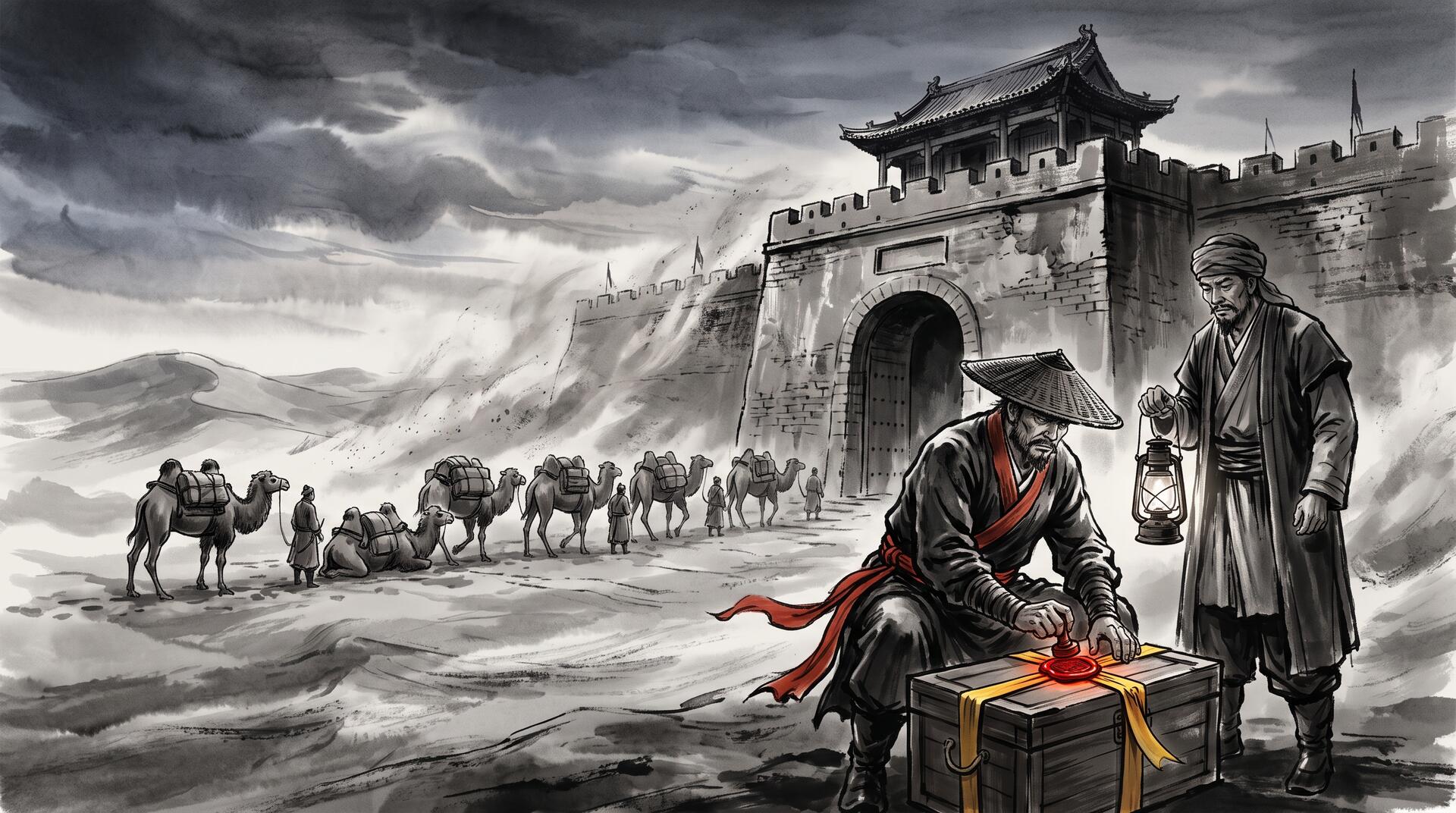
他命黄沙驿的掌柜搬出一盒特制的朱砂封泥,在每一口代收的锦缎箱上狠狠按下一枚带尾羽的火漆借印。借印下附着一张黄绫短折,上书一行朱字:“黄沙暂寄,原主碧泉;沙止之日,如数奉还。”
总巡官环视众人:“这叫‘借驿代收’。客商拿到红柳与黄沙的两枚铜牌,货物便算交割稳妥,即刻放行领水进城!黄沙驿不许私拆此箱,只管将它锁在偏库;它手里的那张折子,就是给碧泉驿的信托借契。”
五天后,狂风停歇,沙尘散尽。
碧泉驿清扫了门前乱石,重新在绿洲升起青旗。消息刚传出半个时辰,黄沙驿的驮马队便扬尘而至。十名轻骑护送着那批贴着朱砂借印的蜀锦箱,原原本本抬进了碧泉驿的大库,并当面销毁了黄绫短折,换上了碧泉驿的正印。
远在关内的大贾如期收到了蜀锦,关外的驼队保住了性命,而那批曾在风暴中被“代收”的箱笼,在账册上没有留下一丝缺漏。
——到这儿你大概已经认出来了:老总巡在大漠里定下的变通法度,正是分布式存储系统(如 Dynamo 与 Cassandra)中的 Sloppy Quorum and Hinted Handoff。
这是什么
在无主分布式存储架构(如 Amazon Dynamo、Apache Cassandra)中,通常采用一致性哈希环来组织数据节点。一条数据根据其 Key 的哈希值,被指定由环上的连续 $N$ 个节点(首选列表 Preference List)共同存储。
为了保证数据的强一致性,系统采用严格法定人数(Strict Quorum):
- 写入时必须成功写入至少 $W$ 个副本;
- 读取时必须从至少 $R$ 个副本读取;
- 只要满足 $W + R > N$,读写集合必定存在交集(抽屉原理),读取者一定能读到最新写入的数据。
然而,在真实的大规模网络中,瞬时网络抖动、机房断网或节点崩溃(如大漠沙暴)时常发生。若严格执行 $W+R>N$,只要首选列表中的存活节点数低于 $W$,整个写操作就会被彻底拒绝,系统可用性(Availability)骤降。
为了实现“永不拒绝写入”的极致高可用,系统引入了 宽松法定人数(Sloppy Quorum) 与 提示移交(Hinted Handoff):
- Sloppy Quorum(宽松法定人数): 当首选列表(Preference List)中的某个节点因网络分区或故障无法连通时,协调节点并不会拒绝写请求,而是将请求发送给哈希环上顺延的健康邻近节点(如同让黄沙驿代收)。只要任意存活的 $W$ 个节点(即便包含了外援节点)确认写入,写操作即宣告成功。
- Hinted Handoff(提示移交): 外援节点在代收数据时,会在本地将这部分数据打上特殊标记(Hint),明确记录“本数据的真正归属节点是谁,因其暂时离线由我代管”。外援节点不将此数据合并进常规读取视图,而是存放在专用的 Hint 队列中。
- 故障恢复移交(Handoff Execution): 外援节点通过心跳或 Gossip 协议持续探测目标节点的状态。一旦目标节点从故障中恢复(沙暴停歇),外援节点立即通过后台任务将暂存的数据全部回传给目标节点,并删除本地的 Hint。数据最终归位。
为什么重要
CAP 定理表明,在面对网络分区($P$)时,系统必须在一致性($C$)与可用性($A$)之间做出取舍:
- 亚马逊电商购物车的诞生场景:2007 年 Werner Vogels 在经典论文《Dynamo: Amazon’s Highly Available Key-value Store》中指出:顾客将商品放进购物车时,系统绝不能因为哪怕一台机器死机而弹窗报错“加入失败”。即使后台副本节点暂时失联,购物车也必须通过 Sloppy Quorum 允许用户写成功。
- 高吞吐日志与指标写入:在 Cassandra 等时序或物联网写入场景中,单点故障不应阻塞海量写入流。临时借用邻近节点缓冲突发写请求,极大平滑了集群负载。
架构权衡与工程陷阱:
- 一致性窗口弱化:在数据尚未完成 Handoff 移交的短暂窗口内,如果客户端发起一次严格 Quorum 读,可能会因为读取到的未更新节点而产生暂时性的陈旧读(Stale Read)。因此采用 Sloppy Quorum 意味着系统退守到了最终一致性(Eventual Consistency)。
- 回传雪崩(Hint Storm):当一个长期离线的故障节点重新上线时,环上所有代存数据的邻居节点可能会同时向它发起海量数据推送,导致刚苏醒的节点瞬间被网络和 I/O 压垮并再次崩溃。因此成熟系统(如 Cassandra)必须对 Hinted Handoff 施加严格的速率限制(Rate Limiting)与最大暂存期(TTL)。
隐喻对应表
- 官道指定的相连三座石驿($N=3$) → 一致性哈希环上的首选副本列表(Preference List)
- 必须取得两家收执($W=2, R=2$) → 仲裁读写 Quorum($W + R > N$)
- 沙暴封路与水井塌方导致两驿失联 → 网络分区或副本节点临时宕机
- 邻近的黄沙驿代收蜀锦 → 宽松法定人数(Sloppy Quorum)写入外援节点
- 箱笼上的火漆借印与黄绫短折 → 带有目标节点元数据的 Hinted Handoff
- 商队拿到两枚铜牌得以进城领水 → 优先保障写入可用性(Availability)
- 沙暴停歇后黄沙驿将蜀锦运交碧泉驿 → 故障恢复后的后台回传(Handoff Delivery)
- 销毁短折换上正印 → 移交完成并清理本地暂存 Hint
- 短暂借管期间关内核验的陈旧风险 → 最终一致性与短时间内的读弱化
Across eight hundred leagues of desert highway, blowing sand blotted out the midday sun. Along the ancient caravan route, the imperial court had established stone waystations near desert springs, tasked specifically with the custody and transit of tribute silk, tea, and silver bullion.
To guard against desert bandits or corrupt stationmasters forging receipts, the highway operated under an iron law: every consignment was assigned to a triad of consecutive stone stations—such as Red Willow, White Stone, and Blue Spring.
The law was carved onto sheepskin notices at every gate: “Two seals of the three shall seal the covenant.” When depositing cargo, the merchant caravan had to deliver goods for inspection at any two of the three assigned stations, securing two stamped bronze tablets. When claiming the cargo at the end of the journey, matching slips from both stations had to be presented. So long as two of the three stations held the record, no imposter could slip between them. For decades, merchants crossed the howling sands with complete peace of mind.
Yet laws are rigid, while the desert is alive.
One blistering July, a savage sandstorm raged for three days and three nights. Howling gales collapsed the defiles leading into Blue Spring waystation, sealing the gorge with boulders and choking the oasis with dust. At nearly the exact same hour, the underground cistern at White Stone collapsed, and its besieged stationmaster hoisted the black flag of closure.
It was into this very tempest that a caravan carrying thousands of bolts of imperial Shu brocade stumbled. Dozens of camels collapsed from heat exhaustion, their water bladders dry. The master merchant stared in agony at the impassable gorge to Blue Spring and the black flag over White Stone.
A young traveling magistrate pleaded, “Sir, imperial law is absolute! This shipment is assigned to Red Willow, White Stone, and Blue Spring alone. Only Red Willow is reachable. If two of the three cannot verify the cargo, we must pitch our tents in the dunes and wait for the sands to clear!”
The merchant roared, “Wait for the storm to clear?! The camels will be dead by sunset, and our men devoured by sand wolves! The law was written to protect wealth, not slaughter the living!”
Just as despair gripped the camp, the Inspector General of the Border Marches galloped into the dunes with his retinue.
The seasoned commander took in the dying camels and the trembling magistrate. He drew his scimitar and plunged it into the sand: “The storm knows no mercy, and the beasts cannot wait. Red Willow shall receive its share. As for the second seal, let the neighboring Yellow Sand Outpost take custody!”
The magistrate cried out in horror, “Excellency, you cannot! Yellow Sand is outside the assigned triad! If they take the brocade, and tomorrow the merchant seeks redemption at Blue Spring, the records will not match, and chaos will reign!”
“Who said Yellow Sand shall claim ownership?” the commander countered coldly.
He ordered the master of Yellow Sand to bring forth a box of vermillion sealing wax. Upon every crate of brocade, they pressed a distinctive feathered fire-seal. Beneath the wax, they attached a yellow silk tag bearing bold crimson ink: “Held in custody by Yellow Sand on behalf of Blue Spring. To be returned in full once the storm abates.”
The commander turned to the caravan: “This is the law of borrowed custody. You hold receipts from Red Willow and Yellow Sand—your covenant is complete. Pass forward into the citadel for water! Yellow Sand may not unbind these crates; they shall lock them in their side vault. The silk tag in their hands is a deed of trust owed to Blue Spring.”
Five days later, the gales ceased and the desert grew still.
Blue Spring cleared its boulder-strewn defile and raised its azure banners once more. Within an hour, a troop of light cavalry from Yellow Sand trotted through the pass. Ten riders escorted the vermillion-sealed crates directly into Blue Spring’s grand warehouse, destroying the temporary silk tags and recording the permanent seals into the master register.
The imperial merchants in the capital received their silk without delay; the caravan beasts were spared; and the goods that had found temporary shelter in the storm left not a single contradiction upon the imperial ledgers.
By now, you have probably recognized the commander’s desert wisdom: this is Sloppy Quorum and Hinted Handoff in leaderless distributed storage systems like Dynamo and Cassandra.
What it is
In leaderless distributed databases (such as Amazon Dynamo, Apache Cassandra, and ScyllaDB), data nodes are arranged in a consistent hashing ring. A piece of data, based on the hash of its key, is assigned to $N$ consecutive nodes on the ring, known as its Preference List.
To guarantee strong data consistency, the system uses a Strict Quorum:
- A write must be acknowledged by at least $W$ replicas;
- A read must query at least $R$ replicas;
- So long as $W + R > N$, the pigeonhole principle guarantees that the read set and write set overlap, ensuring readers always observe the latest write.
However, in massive production networks, temporary partitions, link drops, or hardware hiccups (the desert sandstorms) are inevitable. Under Strict Quorum, if failures leave fewer than $W$ healthy nodes in the preference list, the entire write operation is rejected, causing availability to plummet.
To achieve continuous, write-anywhere availability, distributed architects devised Sloppy Quorum and Hinted Handoff:
- Sloppy Quorum: If the assigned nodes in the preference list cannot be reached, the coordinator does not reject the write. Instead, it routes the request to healthy surrogate nodes located just outside the preference list on the hash ring (like Yellow Sand Outpost). As long as any $W$ healthy nodes acknowledge the write—even if they are surrogates—the write succeeds.
- Hinted Handoff: The surrogate node accepts the data and stores it with a special tag called a Hint. The hint explicitly records: “This mutation belongs to primary node $X$, which was unreachable at write time.” The surrogate does not serve this data for normal read queries; it isolates it within a dedicated hint storage buffer.
- Recovery and Handoff Delivery: The surrogate node continually monitors the failed primary node via heartbeat or Gossip protocols. As soon as the primary recovers, the surrogate streams the buffered hinted writes back to the primary and deletes the local hint records. The data is now safely in its permanent home.
Why it matters
The CAP theorem dictates that during a network partition ($P$), an architecture must balance consistency ($C$) and availability ($A$):
- The Amazon Shopping Cart Principle: Werner Vogels articulated in the 2007 Dynamo paper that an e-commerce platform should never present a customer with an error when clicking “Add to Cart”. Even if the primary database replicas are undergoing rolling restarts or network flaps, the mutation must be accepted via Sloppy Quorum.
- High-Throughput Ingestion: In IoT telemetry, time-series metrics, and clickstream logging, bursts of network unreliability should not choke incoming writes. Surrogates absorb the spikes and hand them off smoothly once connectivity stabilizes.
Architectural Tradeoffs & Engineering Pitfalls:
- Weakened Consistency Window: While hints are waiting to be delivered, a strict quorum read directed at the primary nodes may miss the write, returning stale data. Sloppy Quorum explicitly trades away immediate consistency for eventual consistency.
- Hint Storms on Recovery: If a primary node was offline for an extended duration, all neighboring surrogates may attempt to flush their accumulated hints simultaneously the instant it boots up. This sudden barrage of network traffic and disk writes can overwhelm the recovering node, sending it right back into failure. Robust systems implement strict rate limiting, exponential backoff, and TTL thresholds for hinted handoff queues.
Metaphor mapping
- The three assigned stone waystations ($N=3$) → The preference list of replica nodes on the hash ring
- Requiring receipts from two stations ($W=2, R=2$) → Quorum consensus ($W + R > N$)
- Sandstorm and dry cistern blocking two stations → Network partition or replica node downtime
- Yellow Sand Outpost taking temporary custody → Sloppy Quorum with surrogate nodes
- Feathered fire-seal and yellow silk tag → Hinted handoff payload with recipient metadata
- Caravan receiving receipts and passing safely → High availability prioritizing write success
- Cavalry delivering brocade to Blue Spring after the storm → Background handoff delivery upon node recovery
- Destroying the yellow tag and stamping master seals → Hint cleanup and normal state reconciliation
- Risk of conflicting slips before delivery → The window of eventual consistency and stale reads