▶ Cinematic fable · Watch on YouTube ▶ 影片版寓言 · 在 YouTube 观看
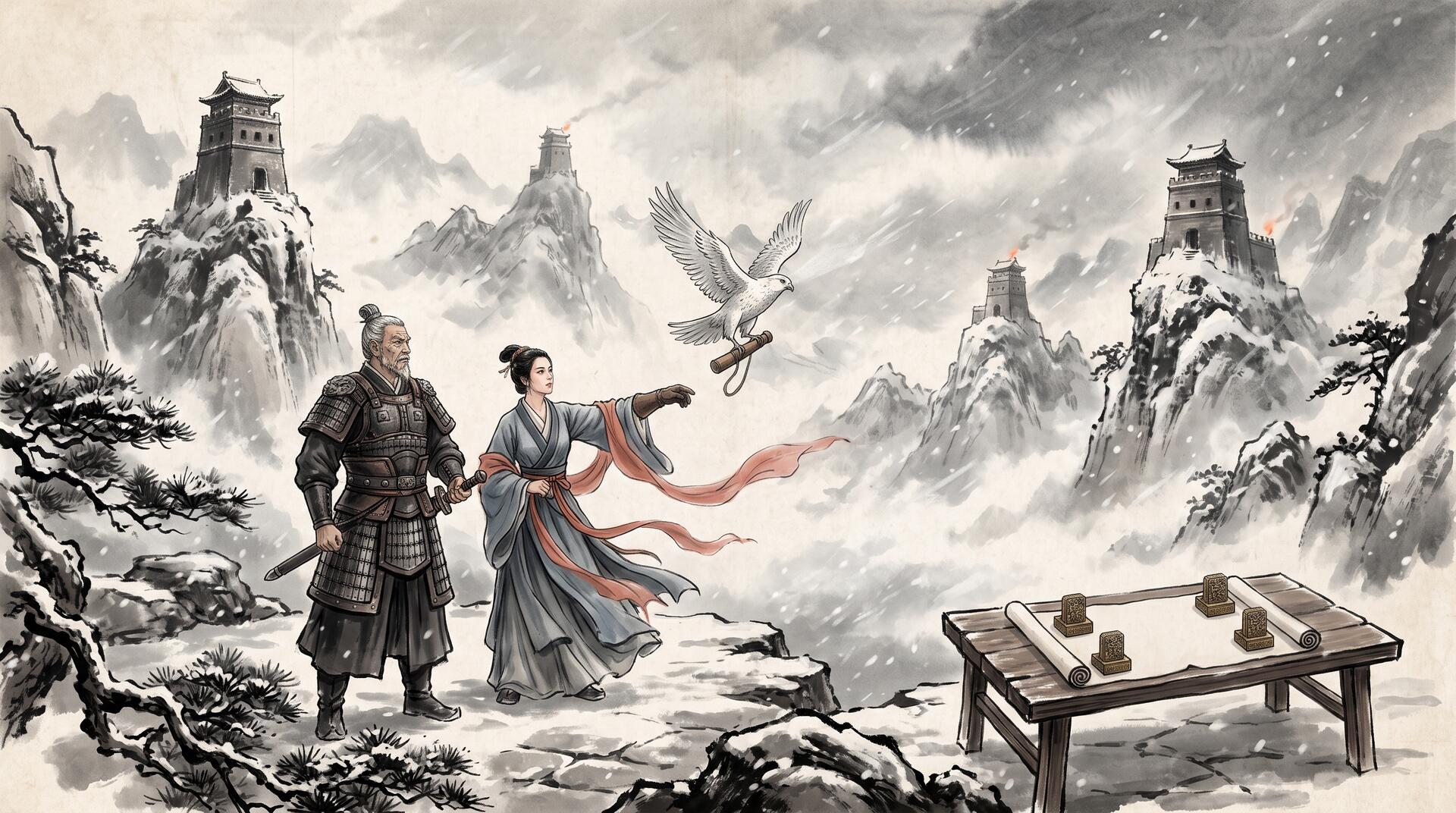
塞北天堑之巅,雁门古道被风雪与断崖隔绝成四座孤峰堡垒:青岚关、丹霞关、白虎关与玄冥关。 四关守将身披玄甲战袍,各自扼守一座险峰,受中军大营的节制,互以神雕灵隼穿云传信。
昔日大军防守,最怕的是暴雪摧折信隼、烽火湮灭在浓雾之中。倘若只是风雪阻道或关隘陷落,众将只需清点残余回信:四座烽火台若有三座报安,便知大势未定,各按军纪行事。这本是寻常的“风雪阻绝,过半则行”。
然而这一年深秋,塞外修罗异族暗中布下了极其阴毒的摄魂咒。 咒力侵染之下,四关之中最多可能有一座守将被暗中控制。被操控的将领并不会点燃求救烽火,也不会如暴雪摧折般悄无声息地失联;相反,他表面上神色如常,暗地里却在信隼腿上绑上截然相反的伪令—— 他向青岚关送去“右翼出击,全歼伏兵”的朱漆锦囊;同一刻,却向丹霞关送去“右翼按兵,左翼回撤”的调令。两座孤峰信以为真,各自拔刀,结果只能在峡谷中自相践踏,落入万劫不复的陷阱。
“一人倒戈不可怕,可怕的是倒戈者当面说人话、背后行鬼道。”中军大营的陆沉老将军按着腰间墨玉剑,望着风雪漫天的四座孤峰,“倘若执掌帅印的先锋关将领被策反,两端弄险、伪造军律,四关将领当如何自保,又如何能如同一人般齐整挥刀?”
军师沈青鸾拂开案上羊皮军图,展开四枚玄铁所铸的三面军符,立下名震千古的三重铁符定盟法。
“其一,四关方能容一叛。”沈青鸾凝视诸将,“四座烽火台,即便最多有一人叛变行诡道,暴风雪中亦最多容许一人因严寒迟缓失联。我等在风雪呼啸的峰顶绝不可苦等全员,只要拿到三座关隘的信函,便必须决断!然而在这三封信里,极可能潜藏着那一封叛将的淬毒伪信。三减其一,唯有两封信出自赤胆忠心之士。二大于一,忠义之音方能稳稳压倒奸邪的诡语!若全山仅有三座烽燧,三去其一得二,二中藏一叛则仅余一忠,忠奸各半,死局难解!”
“其二,帅令初下,不可轻动。”沈青鸾取出一枚主将令符,“每季由一关轮值为主帅关。中军大营每有一道军令降下,主帅关必须将其装入封魔铜筒,烙上当值期号与独一无二的连环军策序号,放隼传檄其余三关。这便是‘领关初告’。但诸关听闻帅令,切不可草率拔剑!主帅亦可能是被魔咒附身之人,若他向东关发‘进军’、向西关发‘退兵’,听之即亡。”
“其三,同袍交契,互验军谋。”沈青鸾竖起第二根手指,“各关收到主帅初告,必须验其封泥笔迹与序号。验明无误后,绝不直接遵行,而是将该军令抄录三份,加盖本关特有的血色狼头铁印,散放信隼分送其余所有关隘!每位守将必须屏息凝神,静候群隼穿云。只有当你亲手集齐了三枚完全相合的狼头铁印(包括你自己的一枚与友邻的两枚),方可判定:在此轮主帅麾下,全军对‘第某号军令当执行何事’达成了天地不移的铁律共识!因为全山只有四关,纵有叛徒在暗中翻云覆雨,他也绝无可能拼凑出两个互斥军令的三枚铁印!”
老将军陆沉微微颔首,目光如炬:“集齐三枚验策印信,固然知晓此令为真。但守将仍不能擅动——因为青岚关集齐了三印,安知玄冥关是否正被暴雪阻断、一印未收?若一人先行杀出重围,岂非仍被孤立诛杀?”
“将军明见!”沈青鸾清喝一声,掌心重重拍落一枚朱砂符节,“这便是最精妙的第三重关隘——歃血决誓!凡是已集齐三枚验策铁印的将领,方有资格放出第二批戴着玄铁信筒的雄鹰,传达‘决誓铁符’,向全山庄严宣告:‘我关已验明大同,誓与诸袍泽同进退!’ 每一座关隘,必须再次静待,直到案头真真切切摆满了三枚决誓铁符,方能引燃冲天狼烟,推开玄铁千斤闸,全军下山合围!”
就在腊月除夕之夜,风雪骤急,浓雾遮天。 值守主帅的玄冥关守将果然已被心魔吞噬。他阴笑着在密室中向青岚关传出“夜袭黑水滩”的伪密卷,却向丹霞关送出“回防冷龙岭”的绝密折。 然而,当信隼穿过暴风雪抵达青岚关时,陆沉老将冷笑一声,未曾妄动半步。他依照沈青鸾之法令,拓印、盖印、传檄四方。 丹霞关与白虎关的铁印信隼破风而至,三关互验之下,众人骇然发现:玄冥关送来的两份密卷序号完全相同,字迹却南辕北辙! 两套军令各自在三关之间对撞,玄冥关的叛将被死死锁在迷局之中——他妄图凑齐三枚支持夜袭的铁印,却只拿到了自己的一份;妄图凑齐三枚支持回防的铁印,丹霞关与青岚关早已互相对质,双双扣下印信! 未等日出,青岚、丹霞、白虎三关守将吹响了震动千山的紫金更旗螺,三关联名盖下罢黜血书,剥夺玄冥关帅权,顺位推举青岚关为主帅,军心如磐石归一。
黎明破晓,三道粗壮的赤红狼烟同时冲破四峰之间的阴霾。 中军大营的陆沉帅帐中,老将军展平三份从天而降、字句与印泥完全一致的捷报,大笑道:“忠奸莫测何须惧?三环相扣,铁印如山!”
— — —
这是什么
——到这儿你大概已经认出来了:这正是分布式系统与高可靠容错计算领域如雷贯耳、开创了拜占庭容错实用化纪元的里程碑方案——实用拜占庭容错算法(Practical Byzantine Fault Tolerance, PBFT)。
在经典的分布式共识体系中,故障通常被划分为两类:
- 崩溃故障(Crash-Stop / Fail-Silent):节点要么正常运转,要么因断电、死机、网络分区而彻底停摆失联,但从不撒谎、不伪造消息(如 Raft、Multi-Paxos、ZooKeeper ZAB 所针对的模型);
- 拜占庭故障(Byzantine Fault / Arbitrary Failure):节点不仅可能失联停机,更可能因受到黑客劫持、硬件内存位翻转(Bit flip)、软件逻辑 Bug 或恶意蓄意破坏,向网络中的不同节点发送互相矛盾、伪造或篡改的消息(即所谓的两端下注 / 模棱两可,Equivocation)。
由 Barbara Liskov 与 Miguel Castro 于 1999 年在 OSDI 峰会上提出的 PBFT,首次将拜占庭容错的状态机复制(SMR)算法复杂度从指数级直接降低到了工程可用的多项式级($O(R^2)$ 消息复杂度),其核心精髓由三个关键数学支柱与三阶段提交协议铸就:
- 容错极限的数学铁律:为什么必须是 $3f + 1$ 个节点?
若一个分布式系统允许最多 $f$ 个拜占庭故障节点:
- 全网总共有 $N$ 个节点。在最坏的异步网络环境下,可能有 $f$ 个诚实无害的节点因为网络高延迟或物理拥堵而迟迟无法回复。为了避免整个系统陷入无限期的死锁,任何节点在推进协议时,最多只能等待 $N - f$ 个节点的响应就必须做出决断。
- 然而,在率先抵达的这 $N - f$ 条消息中,极端情况下可能正好包含了全部 $f$ 个拜占庭叛徒发来的恶毒伪证!
- 因此,真正能够保证来自诚实可信节点的有效消息数量,仅剩 $(N - f) - f = N - 2f$ 条。
- 为了确保真理能够压倒谎言,诚实节点的消息数必须严格大于叛徒的消息数,即: \(N - 2f > f \implies N > 3f \implies N \ge 3f + 1\) 这便是为什么抵御 $1$ 个拜占庭节点至少需要 $4$ 个节点(Quorum 法定人数为 $2f+1 = 3$);抵御 $2$ 个叛徒至少需要 $7$ 个节点(Quorum 为 $5$)。
- 两两相交的法定人数原则(Quorum Intersection): 在 $N = 3f + 1$ 的系统里,任何一个裁决必须获得至少 $2f + 1$ 个节点的背书。 根据抽屉原理,任意两个大小为 $2f + 1$ 的仲裁集合 $Q_1$ 与 $Q_2$,其交集大小至少为: \(|Q_1 \cap Q_2| = (2f + 1) + (2f + 1) - (3f + 1) = f + 1\) 由于全网最多只有 $f$ 个叛徒,因此这个交集 $f + 1$ 中至少必定包含 1 个诚实善良的节点!这一条数学性质直接杜绝了任何两个冲突的提案同时被通过的可能。
- 三阶段提交的精巧闭环(Three-Phase Agreement Protocol):
PBFT 在一个被称为“视图(View)”的任期内运行,由一个主节点(Primary)提议,其余节点作为从节点(Backups):
- 预准备阶段(Pre-Prepare):客户端向主节点发送请求 $m$。主节点为请求分配视图号 $v$ 与全局单调递增的序列号 $n$,计算消息摘要 $d$,广播 $\langle\text{PRE-PREPARE}, v, n, d\rangle$。这标志着主节点对该请求在当前视图内的排序提议。
- 准备阶段(Prepare):从节点收到预准备消息后,核验签名、视图有效性及序号范围。若验证通过,节点向全网多播 $\langle\text{PREPARE}, v, n, d, i\rangle$。每个节点都在本地收集准备消息;当一个节点收集到来自不同节点的、包含自己与主节点在内的 $2f$ 个相互匹配的 Prepare 消息(加上 Pre-prepare 共计 $2f + 1$ 条),该节点便进入 Prepared 状态。
- 作用:确保在当前视图 $v$ 内,所有诚实节点就请求的全局序列号 $n$ 达成全序(Total Order)一致。由于 Quorum 交集性质,叛徒主节点无法在同一个序号上为两个不同请求凑齐 Prepared 凭据。
- 提交阶段(Commit):进入 Prepared 状态仅仅意味着“我知道这个顺序合法”,但我无法确定“其他兄弟节点是否也已经集齐了 Prepare 凭据”——若主节点突然崩溃触发换主(View Change),未达成全网确认的状态将被冲刷。因此,所有进入 Prepared 的节点向全网多播 $\langle\text{COMMIT}, v, n, d, i\rangle$。当一个节点收集到来自不同节点的 $2f + 1$ 条 Commit 消息时,便进入 Committed-Local 状态,并在本地状态机上严格按序执行该操作,将执行结果返回客户端。
- 作用:确保在跨视图切换(View Change)时,已经提交的操作具备不可磨灭的持久性。
- 客户端确认(Client Reply):客户端等待接收 $f + 1$ 个具有有效签名的相同回复。由于至多有 $f$ 个拜占庭叛徒,只要有 $f + 1$ 个回复完全一致,就必定至少有 1 个诚实节点执行了该结果,客户端即可确认操作成功。
- 视图更迭(View Change): 若主节点宕机、故意延迟发送或被检测出发送冲突提案,其他节点在本地定时器超时后,广播 $\langle\text{VIEW-CHANGE}, v+1, \dots\rangle$ 投票罢黜当前主节点。新主节点收集 $2f + 1$ 个 View-Change 证明后,发布 $\langle\text{NEW-VIEW}\rangle$,将上一任期内已进入 Prepared 的决议原样继承,确保共识的安全与活性(Liveness)。
为什么重要
PBFT 是连接经典理论分布式系统与现代去中心化信任网络的根本桥梁:
- 从“防君子”到“防小人”的范式跃迁: Paxos 与 Raft 假设网络中有恶劣延迟与掉线,但参与者皆为“坦诚君子”(从不伪造数据)。而在跨机房、跨主权组织、联盟链(如 Hyperledger Fabric)、航空航天容错计算机以及金融清算网络中,系统必须防备内部叛徒、软硬件物理故障与恶意渗透。PBFT 提供了首个在弱同步网络中保证安全(Safety)与活性(Liveness)的实用框架。
- 现代区块链与联盟链共识的理论祖师: 从以太坊 POS 的 Casper FFG、Tendermint(Cosmos)的 BFT 引擎,到各大央行数字货币(CBDC)底层结算框架,几乎所有现代 BFT 共识协议(如 HotStuff、DiemBFT、Raft-BFT)都是在 PBFT 三阶段与视图更迭范式上的演进与流水线优化。
- 安全与性能的终极权衡: PBFT 换取极高安全性的代价是 $O(N^2)$ 的多播网络通信量。理解 PBFT 的法定人数边界与阶段设计,是每一位设计高可用架构、微服务零信任网络、多活多方安全计算(MPC)的资深工程师洞悉“分布式共识成本”的试金石。
隐喻对应表
- 四座孤立险峰上的烽燧守将 → 拜占庭容错系统中的复制节点(Replicas,此处 $N=4, f=1$)
- 暗中被心魔操控、向两方传递互斥密令的叛徒 → 发起恶意分叉与双签两端下注的拜占庭节点(Byzantine / Equivocating Node)
- 严寒暴雪中最多只等三关信函便必须决断 → 异步网络下防止死锁必须满足的响应阈值($N - f = 2f + 1$)
- 至少需要四座关隘方能防范一名叛将的算理 → 拜占庭容错的节点底线公理($N \ge 3f + 1$)
- 当季轮值主帅关受中军大营军令初次传檄 → 预准备阶段(Pre-Prepare,Primary 分配序列号并广播)
- 各关将帅令拓印三份加盖血印相互对质交契 → 准备阶段(Prepare 阶段的全互联多播,锁定视图内全序)
- 亲手集齐三枚狼头印信方得立誓的“验策”状态 → 节点收集 $2f+1$ 个 Prepare 达成的 Prepared 状态
- 盖下血印、昭告天下誓与三关共进退的“决誓铁符” → 提交阶段(Commit 阶段,确保状态跨视图持久性)
- 案头集齐三枚决誓铁符后推闸引烟出关合围 → 节点达成 Committed-Local 并向本地状态机执行操作
- 客户端等候两份完全一致的信函方验明军捷 → 客户端必须等待 $f + 1$ 个相同回复以确认结果无讹
- 吹响紫金螺、三关联名废黜心魔主帅 → 视图更迭协议(View Change 机制)
High upon the jagged peaks of the northern frontier, the ancient Yanmen Gorge was sundered by roaring blizzards and bottomless chasms into four isolated bastions: Qinglan Pass, Danxia Pass, Baihu Pass, and Xuanming Pass. Four garrison commanders, clad in dark iron armor and wind-whipped battle cloaks, guarded their respective precipices under the strategic authority of the Grand Marshal’s valley encampment. Between these lonely heights, communication relied solely upon iron-taloned mountain falcons cutting through the snow-choked clouds.
In the old days of frontier defense, the greatest hazard was the bitter wind: a carrier falcon frozen in flight, or a smoke signal swallowed whole by winter fog. If a fortress merely fell silent in the cold, the rules of war were simple: as long as three of the four towers returned consistent news, the garrison knew that order endured and marched according to the majority. It was the familiar code of benign misfortune: “When blizzards strike, let the unhindered majority lead.”
Yet in the late autumn of this fateful year, a sinister shadow sorcery crept out of the northern wilderness. Under its quiet enchantment, up to one commander among the four could be corrupted from within. The compromised commander did not raise a distress banner, nor did he fall silent like a casualty of the freezing wind; to the eye, he remained composed, his reports prompt and solemn. In secret, however, he bound conflicting deceptions to the talons of his falcons. To Qinglan Pass on the east cliff, he dispatched a crimson silk scroll: “The valley ambush is sprung; charge immediately with the right flank!” At that very instant, he sent to Danxia Pass on the south cliff an opposing decree: “Hold the right flank fast; withdraw the left wing to the pass.” Believing their orders authentic, both mountain garrisons drew their blades and charged into the gorge—only to butcher each other in the blinding mist, delivering the passes to the enemy.
“A warrior who falls silent in battle is an inconvenience,” Grand Marshal Lu Chen muttered, his hand resting on the hilt of his ink-jade broadsword as he surveyed the snow-shrouded crags. “A traitor who speaks with two tongues in secret is total doom. If the lead commander holding the master baton is poisoned by deceit, sending divergent commands to divide our forces, how can the four garrisons stand united as a single blade?”
Strategist Shen Qingluan swept aside the snow on the strategy table and laid out four bronze seals chiseled with three interlocking rings, declaring the Covenant of the Triple Iron Seal.
“First: Four fortresses are required to endure a single traitor,” Shen Qingluan spoke, her voice cutting through the wind. “Out of four garrisons, even if one is corrupted by shadow and actively lies, the howling blizzard may simultaneously delay or freeze the falcon of an honest comrade. We on these frozen pinnacles cannot wait forever in the cold; we must make our stand the moment we hold dispatches from three fortresses! Yet among those three dispatches, one may well be the poison-tipped forgery of the traitor. Subtract that traitor’s voice, and only two dispatches are guaranteed to flow from honest hearts. Two strictly outnumbers one; the voice of loyalty triumphs over deceit! Had we only three fortresses, three minus one would leave two; if one of those two were a traitor, honest and corrupt would stand evenly divided, locking the realm in paralysis!”
“Second: When the lead fortress speaks, no man draws his sword,” Shen Qingluan raised a bronze commander’s tally. “Each season, one garrison takes the turn as the lead fortress. Whenever a battle decree descends from the Grand Marshal, the lead commander must seal the mandate within a bronze cylinder, carve upon it the current term number and a strictly increasing sequence tally, and loose his falcons to the other three. This is the Primary Proposal. But let no commander plunge into battle upon that decree alone! The lead commander himself may harbor the shadow curse. If he whispers ‘advance’ to the east and ‘retreat’ to the west, obeying him blindly is suicide.”
“Third: Cross-verify the covenant among all brethren,” she raised a second finger. “Every commander who receives the lead proposal must inspect its wax seal and sequence number. Once verified, he must not execute it! Instead, he must scribe three identical copies, impress upon each his own fortress’s crimson wolf-head seal, and cast falcons across the chasm to every other bastion. Each commander must hold his ground and wait. Only when you hold in your hands three matching wolf-head seals—your own, plus two from your frontier brothers—may you declare that this decree’s sequence and content are unalterably forged in consensus! Across four peaks, no traitor can ever gather three matching seals for two contradictory decrees!”
The veteran Marshal Lu Chen nodded slowly, his gaze sharp: “Gathering three verified seals proves that this order is the true consensus of the pass. Yet a commander still cannot leap into the fray—for though Qinglan Pass holds three seals, how do I know whether Xuanming Pass across the gorge was caught in an avalanche, holding nothing? If one fortress charges alone, will he not be surrounded and slaughtered?”
“The Marshal sees true!” Shen Qingluan struck the table with a vermillion token. “This is why the third iron gate is vital: The Blood-Vow Commitment! Only those garrisons that have gathered three verified seals are permitted to unleash their second flock of eagles, bearing the ‘Blood-Iron Token’ to proclaim across the sky: ‘My garrison has verified the truth; I swear upon my blood to execute this decree alongside you!’ Every fortress must once more hold its breath, until three matching Blood-Iron Tokens rest upon the commander’s table. Only then may he ignite the crimson beacon, hoist the thousand-pound portcullis, and lead his cavalry down into the valley!”
On the eve of the winter solstice, a torrential blizzard engulfed the passes. The commander of Xuanming Pass, who held the lead baton for that season, had indeed been consumed by the shadow curse. In his darkened sanctum, he dispatched to Qinglan Pass a midnight courier urging “Storm the Black River Basin at dawn,” while secretly commanding Danxia Pass to “Pull back all defenses to Lenglong Ridge.”
Yet when the carrier eagle pierced the snow into Qinglan Pass, the old Marshal Lu Chen sneered. He drew no sword. Faithful to Shen Qingluan’s covenant, he copied, stamped, and cross-broadcast the proposal to his brethren. From Danxia Pass and Baihu Pass, the cross-verification eagles battered through the gale. As the three loyal commanders compared notes across the mountain peaks, the conspiracy collapsed into the light: Xuanming Pass had assigned the exact same sequence tally to two irreconcilable strategies! Because Xuanming Pass could not secure three seals for both contradictory lies, both falsified plans were halted in their tracks. Before the dawn broke, the three honest commanders sounded their bronze war horns across the peaks, exchanged a joint writ of impeachment signed by three seals, stripped Xuanming Pass of the lead baton, and elevated Qinglan Pass to take the lead.
At sunrise, three brilliant vermillion beacon fires simultaneously pierced the mountain mist. In the command tent below, the Grand Marshal unfurled three identical victory dispatches delivered from the heights, laughing aloud: “Why fear the hidden traitor? With three interlocking seals, our covenant stands firmer than the mountains!”
— — —
What it is
By now you have probably recognized it: this is the landmark protocol that solved one of the deepest challenges in distributed systems and fault-tolerant computing—Practical Byzantine Fault Tolerance (PBFT).
In classical distributed systems, failures fall into two fundamental categories:
- Crash-Stop / Fail-Silent Failures: Nodes either operate correctly or crash completely due to power loss, machine death, or network partition. They may fail to respond, but they never lie, forge messages, or send contradictory instructions (the failure model assumed by Raft, Multi-Paxos, and ZooKeeper ZAB).
- Byzantine / Arbitrary Failures: Nodes may not only fail or go silent, but may also behave arbitrarily—corrupted by memory bit-flips, compromised by attackers, suffering from software bugs, or deliberately sending conflicting messages to different peers in the network (known as equivocation).
Introduced in 1999 by Barbara Liskov and Miguel Castro at OSDI, PBFT was the first protocol to bring Byzantine Fault Tolerant State Machine Replication (SMR) from theoretical exponential-time models down to a practical polynomial message complexity of $O(R^2)$. Its architecture rests upon three mathematical and algorithmic pillars:
- The $3f + 1$ Node Boundary: Why Four Nodes for One Traitor?
If a distributed system is designed to tolerate up to $f$ Byzantine (arbitrary) faulty nodes:
- Let $N$ be the total number of nodes. In an asynchronous network, up to $f$ completely honest nodes may be excessively delayed or unreachable due to network congestion or partition. To avoid permanent deadlocks, a node cannot wait for more than $N - f$ responses before making a decision.
- However, in the worst case, among those first $N - f$ messages received, all $f$ Byzantine nodes may have quickly replied with malicious, falsified endorsements!
- Therefore, the number of guaranteed non-faulty responses among those received is at most: \((N - f) - f = N - 2f\)
- To ensure that honest endorsements strictly outvote Byzantine lies within any quorum, the number of honest messages must exceed the number of faulty ones: \(N - 2f > f \implies N > 3f \implies N \ge 3f + 1\) This is why tolerating $1$ traitor requires at least $4$ nodes (with a quorum of $2f+1 = 3$), and tolerating $2$ traitors requires at least $7$ nodes (with a quorum of $5$).
- The Quorum Intersection Guarantee: In any system of $N = 3f + 1$ nodes where decisions require a quorum of $2f + 1$ endorsements, the pigeonhole principle guarantees that any two quorums $Q_1$ and $Q_2$ must intersect by at least: \(|Q_1 \cap Q_2| = (2f + 1) + (2f + 1) - (3f + 1) = f + 1\) Because at most $f$ nodes in the entire network are Byzantine, this intersection of size $f + 1$ is mathematically guaranteed to contain at least one honest, non-faulty node. This property ensures that two conflicting proposals can never simultaneously gather quorum certificates.
- The Three-Phase Agreement Protocol:
PBFT operates across numbered epochs known as “Views,” guided by a Primary node while the remaining nodes act as Backups:
- Pre-Prepare: A client sends a request $m$ to the Primary. The Primary assigns the request a view number $v$ and a monotonically increasing sequence number $n$, calculates digest $d = D(m)$, and multicasts $\langle\text{PRE-PREPARE}, v, n, d\rangle$ alongside $m$ to all backups. This records the Primary’s proposed ordering for the request.
- Prepare: Backups verify the Primary’s signature, view validity, and sequence bounds. If valid, each backup multicasts $\langle\text{PREPARE}, v, n, d, i\rangle$ to all peers. Each node logs incoming Prepare messages; once a node has collected $2f$ matching Prepare messages from distinct nodes (totalling $2f + 1$ matching messages together with the Pre-Prepare), it enters the Prepared state.
- Purpose: Guarantees total order within view $v$. Because of quorum intersection, no malicious Primary can ever assemble valid Prepared certificates for two different requests sharing the same view and sequence number.
- Commit: Being Prepared guarantees that this replica knows the request order is valid, but it cannot know whether other replicas have also collected their certificates before a sudden Primary crash triggers a View Change. Therefore, every Prepared replica multicasts $\langle\text{COMMIT}, v, n, d, i\rangle$. Once a node collects $2f + 1$ matching Commit messages from distinct replicas, it reaches the Committed-Local state, executes the request sequentially on its local state machine, and transmits the reply to the client.
- Purpose: Guarantees consensus across view changes. If any node commits, at least $f+1$ honest replicas prepared the request, ensuring that the committed transaction cannot be erased or superseded during a transition to a new Primary.
- Client Confirmation: The client waits for $f + 1$ identical, validly signed replies from distinct replicas. Because at most $f$ replicas can be Byzantine, $f + 1$ matching replies guarantees that at least one non-faulty replica executed the operation.
- View Change: If the Primary becomes unresponsive, stalls, or attempts to equivocate, backup timers expire. Backups multicast $\langle\text{VIEW-CHANGE}, v+1, \dots\rangle$. The designated new Primary ($p = (v+1) \bmod N$) collects $2f + 1$ valid View-Change messages, constructs a $\langle\text{NEW-VIEW}\rangle$ message carrying cryptographic proof of the prior state, and restarts the consensus engine without losing safety.
Why it matters
PBFT is the intellectual bridge connecting classical distributed systems theory with the modern landscape of decentralized computing:
- The Paradigm Shift from Benign Crashes to Active Hostility: Systems like Paxos and Raft assume that while messages may be delayed or machines may crash, participants remain fundamentally truthful. In sovereign consortiums, cross-cloud financial settlement, aerospace flight control, and zero-trust microservice networks, systems must survive internal compromise, bit-flips, and active deception. PBFT provided the first mathematically grounded, computationally viable blueprint for arbitrary fault tolerance.
- The Theoretical Foundation of Modern Consensus Engines: From Ethereum’s Casper FFG and Tendermint (Cosmos) BFT to enterprise consortium ledgers (Hyperledger Fabric) and central bank digital currency (CBDC) settlement layers, modern BFT engines (such as HotStuff and DiemBFT) are direct descendants of the three-phase quorum and view-change model established by PBFT.
- The Uncompromising Calculus of Security vs. Performance: PBFT achieves bulletproof Byzantine security at the cost of $O(N^2)$ all-to-all communication overhead. Understanding its quorum constraints and phase separation is essential for any distributed systems architect evaluating the real trade-offs between crash-tolerant throughput and Byzantine-hardened resilience.
Metaphor mapping
- Four frontier garrisons on isolated mountain peaks → Replicas in the Byzantine fault-tolerant cluster ($N=4, f=1$)
- The corrupted commander sending contradictory orders to split the army → An equivocating Byzantine node sending conflicting proposals
- Deciding after receiving dispatches from three towers without waiting in the blizzard → Proceeding upon reaching the liveness threshold ($N - f = 2f + 1$)
- The requirement of four fortresses to withstand one corrupted officer → The foundational Byzantine bound ($N \ge 3f + 1$)
- The seasonal lead fortress broadcasting the initial dispatch → The Pre-Prepare phase (Primary assigning view and sequence number)
- Scribing and multicasting wolf-head iron seals across all peaks to cross-verify → The Prepare phase (All-to-all multicast to lock total order within the view)
- Gathering three matching wolf-head seals to confirm the covenant → Reaching the Prepared state ($2f + 1$ matching prepare messages)
- Unleashing the second flock of eagles bearing Blood-Iron Tokens → The Commit phase (Multicast to guarantee cross-view stability)
- Striking the great bell and marching after gathering three Blood-Iron Tokens → Reaching Committed-Local and executing on the state machine
- The Grand Marshal requiring two identical dispatches to celebrate victory → Client waiting for $f + 1$ identical replies to confirm execution
- Sounding the purple horn to impeach the corrupted lead commander → The View Change protocol to replace a faulty Primary