▶ Cinematic fable · Watch on YouTube ▶ 影片版寓言 · 在 YouTube 观看
大梁太府寺的尚宝司,专司天下兵符、官仓提粮铁券与通关牙牌的雕造与注籍。
四方兵马调遣、万石仓粮起运,皆凭这一寸三分沉香木牌上的朱漆与刻痕。若有一字之差,或两道截然相反的兵符同时流入关隘,顷刻间便是血溅城郭的滔天大祸。
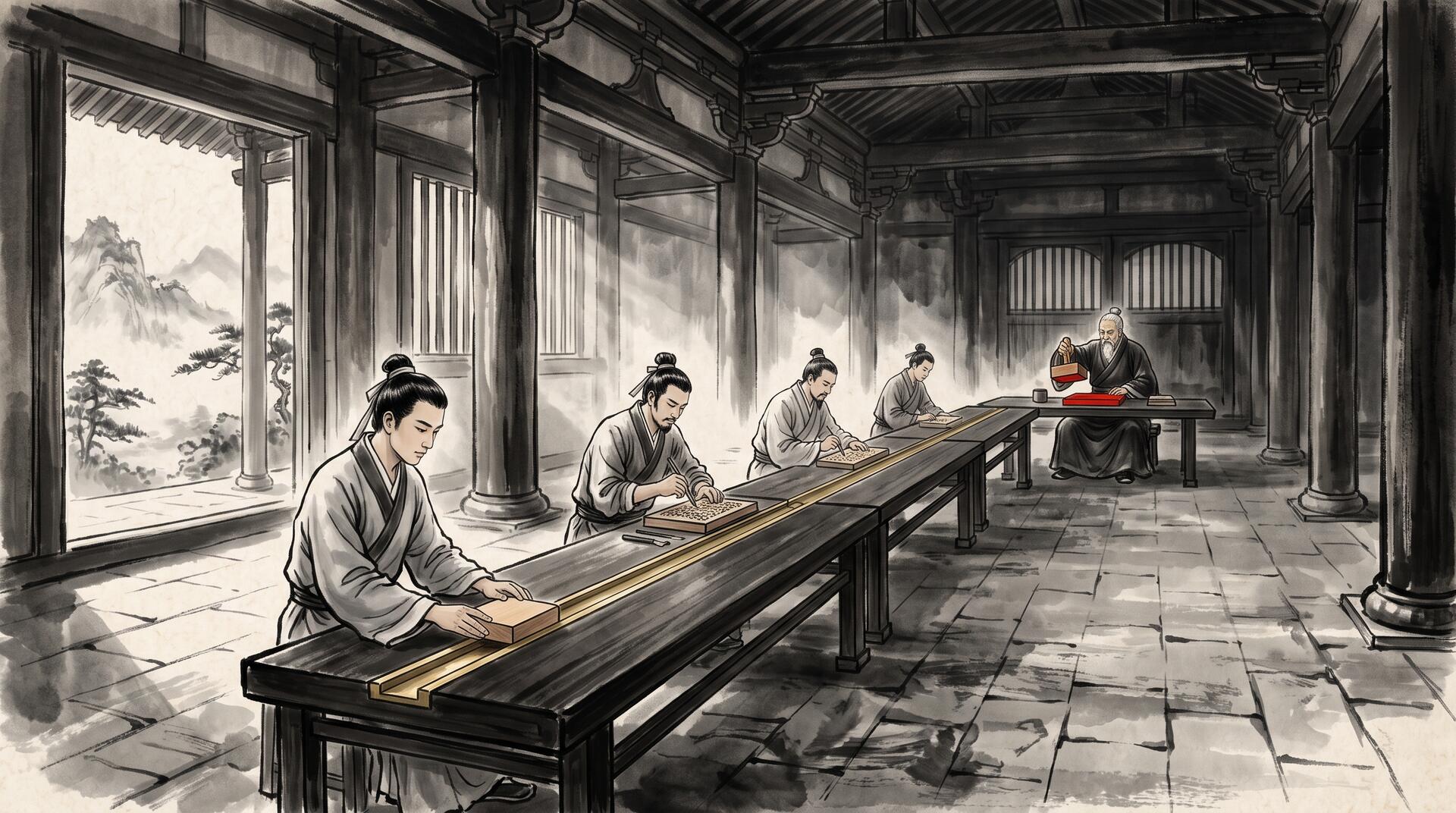
尚宝司正殿之中,横卧着一张极其古怪的三十丈乌木连席长案。
长案贯通内外两堂,自前庭朱门一路笔直延伸至后院秘库铁槛之下。长案两侧不设闲凳,案面上以精铜凿出一道贯通始终的光滑滑槽。案旁自前至后,只坐着五位灰袍老典吏:
第一位,端坐于前门案头的席首; 第二、三、四位,排坐于中堂长案两侧的中席诸匠; 第五位,则是蜷坐于后殿幽深铁窗下的压尾老典官。他身旁压着一枚沉逾三十斤的紫铜伏魔朱砂大印,目光如炬,终日不出一语。
百年以来,尚宝司能在无数次边关军饷交割、藩镇轮换中从不出半点差错,全赖刻在乌木长案背脊上的三道森严祖训。
第一道规矩,叫“入籍必由席首”。
凡天下各路节度使调兵、户部增拨钱粮,来人奉诏递送公文,只许在尚宝司前门大案递予席首。席首查验中枢玺印无误,取出一枚未经雕琢的沉香空白木胎,以快刀刻下卷宗编号与初始规制,记录在自己的首卷上;随即,他将木胎置入铜槽,轻轻一推,木匣便顺着滑槽滑向下首的第二席。
第二席接匣,细加阴刻云纹;转交第三席,嵌填金线以辨真伪;转交第四席,研墨题写期限批注。
每一席典吏皆只与自己的上下邻席交接。无人越席,无人私相授受,亦无人在堂内喧哗穿梭。
第二道规矩,叫“朱印不落,此物非实”。
当木匣一路滑过前四席,最终停在幽深的尾席案头时,压尾老典官会取出一把极细的象牙标尺,逐一核验各席的刀工与印记。直至确认分毫不差,老典官才双手捧起那枚沉重的紫铜朱砂大印,在沉香木牌脊背上“咚”地一声盖下鲜红烙印,并在身后秘库的铁券总簿上画下一道朱笔正字。
唯有这一声重印落地,这道兵符方在天地间真正生效。
而所有奉旨领受符节的武将差官,都必须留在侧庑静候;只有压尾老典官亲手拉开铁窗,将盖讫的木匣与回执凭勘递出窗外,这一趟”录入”才算功德圆满。在此之前,即便前头席位雕得天花乱坠,在朝廷法度里,也权作虚无。
第三道规矩,最为奇特,也最受外界非议——“查勘必问尾席”。
边关探子飞马回京,欲查某路兵符究竟发未发、某仓粮草账目到底改未改,往往火烧眉毛。不少急性子的参将冲入尚宝司,见前门席首手边正放着那道朱卷,便欲凑上前抄录探听。
然而尚宝司卫士拔刀相阻,铁面无私:任何人查阅账目,一概不得窥探席首与中席!所有人必须穿过回廊,绕至最深处的尾席铁窗前排队求询。
有人曾私下抱怨:”前席明明早已落刀,一眼便能看清,何必非要教人跑到后殿深巷,去敲压尾老头的冷板凳?”
早年有位新任户部侍郎不信邪,强令席首提前透漏江南茶税的勘定数额。席首无奈,依手中底稿报了”二十万石”。侍郎大喜,即刻发文调度。
怎料木匣滑至第三席时,匠人摸出木胎内藏蛀孔,依律当即掷入碳炉焚毁!那道公文被迫从头复核,改发为”十五万石”。
而侍郎依假消息调遣的千艘空船,早已堵死大运河口,耗费官帑数十万两。自那之后,再无朝官敢在前席窥探半字。
因为人人终于明白:席首虽早知,但他手中之物未经诸席雕琢,随时可能夭折;唯有压尾老官口中吐出的账目,是历经全案每一位匠人手眼、确凿盖上朱印的铁案。向尾席询问,绝无半点前后矛盾,亦绝无虚妄的蜃景。
然而,人非草木,孰能无病?三十丈长案连贯五人,若当中有人病倒,整条流水岂不断绝?
尚宝司的精妙,恰在此处显露无遗。
某年酷暑,席首偶感风寒,晕倒在案头。副司官只做了一件事:将第二席的矮凳径直挪到前门,由他接任席首!至于前任席首手里刚接过、尚未推入铜槽的那卷公文,因压尾老官从未盖印回执,外客见久未奉旨,自会按例重新向新席首递送一遍。前门自始至终未乱分毫。
又有一回,压尾老官寿尽归山。尚宝司更是不慌不忙:第四席典吏当即起身,接掌紫铜朱砂印,坐上尾席铁窗!凡是已经滑到他眼前的木牌,早已历经前四席之全功;他提印落鉴,立时便能平稳接续,既不落下一桩旧案,亦不曾多盖一件废符。
最凶险的,莫过于中席猝断。
有一日,第三席匠人突发急症暴毙,伏倒案上。铜槽阻塞,木牌登时停滞不前。
此时,第二席与第四席并未慌乱大叫。尚宝司历代相传,每一位中席匠人手边,都备有一只精巧的“未报木屉”——凡是自己已刻完推下、但尚未得到尾席传来朱笔回执的物件,其备用拓本皆整整齐齐码在屉中。
第二席探身越过空位,高声询问第四席:”兄弟,你手边最后接到的木牌是何编号?” 第四席朗声答道:”第七百零四号!”
第二席低头翻看屉中拓本,七百零三、七百零四皆已越过,唯有七百零五号木牌正被死者压在肘下。第二席当即接通铜槽旁预备的伸缩铜舌,将案槽直接跨过第三席空位,搭在第四席案前!随后他从自己屉中重取拓样本料,将七百零五号补雕齐备,长推入槽。
不过半柱香工夫,断案自愈,长案铜槽再次叮咚作响。
至此,五席长案如长龙游水:首进尾出,尾定乾坤;断首易首,断尾续尾,断中连横。虽无合议喧嚣之累,却有金石不移之固。
——到这儿你大概已经认出来了:这套五席连案、首接写而尾应读的规矩,讲的正是分布式存储系统中的经典强一致性协议——Chain Replication(链式复制)。
这是什么
Chain Replication(链式复制)是由 Robbert van Renesse 与 Fred B. Schneider 于 2004 年在 OSDI 上提出的强一致性(linearizability,线性一致性)复制状态机协议。
在传统的多副本共识协议(如 Paxos 或 Raft)中,Leader 节点需要将日志并发广播给所有 Follower,并等待多数派(quorum)确认后才能提交,这会导致 Leader 的网络出向带宽(egress bandwidth)迅速成为瓶颈,且各副本处理与网络延迟的抖动容易引发状态分歧。
Chain Replication 另辟蹊径,将一组副本组织成一条线性的单向链条:
Client (Write) ──> [ Head ] ──> [ Node 2 ] ──> [ Node 3 ] ──> [ Tail ] ──> Client (Ack)
                                                                 ▲
Client (Read)  ──────────────────────────────────────────────────┘
- 写路径(Write Path):所有更新请求必须发往链头(Head)。Head 在本地执行并生成序列号,随后单向流水线式传递给后继节点(Successor)。每个节点依次更新本地状态并推向下游,直到抵达链尾(Tail)。
- 提交与确认(Commit & Ack):当且仅当更新抵达 Tail 时,该写操作才被视为正式提交(committed)。由 Tail 直接向客户端发送成功的确认应答(Ack)。
- 读路径(Read Path):所有读请求仅发往链尾(Tail)。Tail 直接读取本地状态并返回。
- 一致性保证:因为读操作只走 Tail,而 Tail 持有的任何状态都必定已经遍历了链上所有前置节点,所以系统天然满足线性一致性(Strong Consistency / Linearizability)。任何客户端绝不可能读到未完成全链同步的脏数据,也不存在分歧竞态。
- 故障恢复(Failure Recovery):由外部轻量级故障检测协调器(Master / Configuration Manager)监控节点心跳并维护链拓扑:
- Head 故障:其直接后继节点成为新 Head。未传递到新 Head 的写请求未被 Tail 确认,客户端超时重试即可,不影响一致性;
- Tail 故障:其前驱节点(Predecessor)成为新 Tail,已在该节点上的写入全部晋升为有效提交,无任何已提交数据丢失;
- 中间节点故障:前驱节点与后继节点直接相连。前驱节点保留着尚未收到 Tail 确认的历史更新队列(sent list),通过比对后继节点的最新序列号,重传缺失的增量更新,链条即可无缝愈合。
为什么重要
Chain Replication 在分布式存储领域占据着极高的理论与工业地位:
- 写带宽与吞吐量最优化:在 Raft/Paxos 中,Leader 需要向 $N-1$ 个节点广播数据,Leader 的网卡往往是全集群的吞吐瓶颈;而在链式复制中,除首尾外,链上每个节点都只需接收一份、转发一份(入向与出向网络开销各为 1),各节点的网络压力被完全均匀地分散在流水线上,能够最大化榨干网络物理吞吐。
- 免除复杂的多数派选举与日志对齐:链式复制将复杂的共识排序收拢为确定性的 FIFO 单向传递。没有脑裂,没有租期竞选冲突,没有撕裂日志的繁琐截断与修复逻辑,实现极其优雅、可推导且可信赖。
- 工业级云存储的核心基石:微策略的 Windows Azure Storage (WAS) 对象与表存储、开源分布式块存储系统以及各大高性能分布式内存数据库,均广泛采用或借鉴了链式复制作为其副本同步的核心引擎。
- 突破读瓶颈与 CRAQ 演进:基础链式复制的唯一短板在于读请求全压在 Tail 节点。为此,后续的著名改进方案 CRAQ(Chain Replication with Apportioned Queries)引入了多版本标记机制:链上所有节点均可承载读请求。当某条记录处于干净(clean)状态时,任意节点可直接本地返回最新数据;仅当记录处于更新中(dirty)时,节点才向 Tail 快速校验当前已提交的版本号。这使得系统在保持强一致性的同时,将读吞吐量随副本数线性提升。
隐喻对应表
- 尚宝司三十丈乌木连席长案 → 链式复制的线性拓扑(Chain Topology)
- 案头席首老典吏 → 链头节点(Head Node,承接所有写请求)
- 中席雕刻镶嵌金线诸匠 → 中间副本节点(Intermediate Replicas,承接并传递增量日志)
- 幽深铁窗下的压尾老官与紫铜大印 → 链尾节点(Tail Node)与状态提交点(Commit Point)
- 严禁窥探前席、查账必去尾席铁窗 → 读请求只发往链尾(Tail-only Reads)以保证线性一致性
- 席首染疾移凳接任 → 链头故障转移(Head Failure Handling)
- 尾官归山由第四席顶替 → 链尾故障转移(Tail Failure Handling)
- 中席备用的未报木屉与跨席接续 → 故障修复中的未确认更新缓冲重放(Unacknowledged Buffer Replay)
In the Bureau of Imperial Tallies under the Court of Judicature, five master scribes were entrusted with carving, verifying, and registering every imperial talisman, bronze military pass, and granary grain warrant in the realm.
The movement of fifty thousand border troops and the release of grain from imperial silos all hung upon the incisions and vermillion lacquer across a three-inch slip of aromatic cedar. A single mismatched character or a contradictory tally slipping past a gatehouse could bring armies to bloody collision.
Down the center of the Bureau’s main hall lay a curious, continuous thirty-foot table of solid blackwood.
The table pierced straight through the pavilion, stretching uninterrupted from the outer courtyard gates to the heavy iron grating of the inner vault. No stray chairs were permitted along its flanks. Down its polished spine ran a single brass-lined groove. Along the table, from front to back, sat five gray-robed scribes:
At the front entrance sat the Foremost Master at the head of the bench; Flanking the middle hall sat the second, third, and fourth masters—the Intermediate Artisans; And deep in the shadows of the rear hall, seated by the narrow barred window of the vault, sat the Elder at the Tail. By his right elbow rested a thirty-pound cast-bronze seal with vermillion paste. He kept his eyes keen and spoke not a single word from dawn to dusk.
Over the course of a century, while border garrisons rebelled and supply lines tangled elsewhere, the Bureau never recorded a single contradictory warrant. Its unbroken record rested entirely on three ancestral laws carved into the blackwood table.
The first rule was: “Every entry begins at the Head.”
When envoys arrived from regional governors or the Ministry of Revenue bearing imperial decrees, they were permitted to submit them only to the Foremost Master at the front gate. The Foremost Master inspected the emperor’s imperial seal, took an uncarved cedar block from his drawer, carved the unique registry number and initial specifications, and recorded it in his own ledger. Then he set the block into the brass groove and nudged it forward to the Second Master.
The Second Master received the box, incised the cloud watermark, and slid it to the Third. The Third inlaid fine gold wire to prevent forgery and slid it to the Fourth. The Fourth ground fresh ink and inscribed the operational expiry date.
Each master interacted strictly with his immediate neighbors. No one skipped a seat, no one traded work behind another’s back, and no one walked across the hall.
The second rule was: “Until the seal descends, the tally is nothing.”
When the wooden box had slid past the first four stations and finally arrived at the shadowed desk at the end of the table, the Elder at the Tail drew a slender ivory caliper. He inspected every line, notch, and gold inlay. Only when satisfied that every preceding craftsman had completed his work without flaw did the Elder raise the massive bronze seal and bring it down upon the cedar tally with a resounding thud, leaving an indelible crimson crest and marking a stroke in the vault’s master ledger.
Only with that seal strike did the tally legally exist.
The waiting commanders and couriers were confined to the side arcade. Only when the Elder at the Tail pushed open his narrow iron window and handed out the finished tally alongside its signed certificate was the entry considered complete. Until that moment, no matter how exquisitely the upstream masters had carved, the state recognized the tally as nothing more than raw wood.
The third rule was the most peculiar, and the one that drew the most furious complaints from outsiders: “Every inquiry goes only to the Tail.”
Couriers frequently rode into the capital on foaming horses, desperate to know whether a garrison’s grain quota had been modified or whether a border troop tally had been authorized. Hot-headed young officers would burst through the front gate, spot the ledger sitting open right before the Foremost Master, and lean over the bench to demand a glance.
Guards immediately blocked them with drawn sabers: no visitor was ever permitted to inspect the records of the Head or the Intermediate Masters. Every inquiring official was forced to walk the perimeter path, traverse the long outer arcade, and queue outside the iron window of the Elder at the Tail.
Officials grumbled: “The front master has already written the decree with fresh ink! Why force us to walk around the entire complex to knock on an old man’s cold window?”
Years prior, an impatient Vice Minister of Revenue had refused to listen. He coerced the Foremost Master into disclosing the new tea tax quota for the southern provinces. Looking at his fresh intake scroll, the Foremost Master quoted: “Two hundred thousand bushels.” The Vice Minister rushed off and issued deployment orders immediately.
He did not know that when that cedar block reached the Third Master, the artisan discovered a rotten core inside the wood and promptly cast it into the charcoal brazier. The decree had to be rewritten, and the true approved quota was reduced to one hundred and fifty thousand bushels.
The thousands of empty barges dispatched by the Vice Minister clogged the Grand Canal for weeks, squandering tens of thousands of silver taels. From that day on, no official dared solicit an early glance from the head of the table.
For they finally grasped the principle: though the Foremost Master knows early, his work has not traversed the hands of the guild and can be aborted at any moment. Only what issues from the window of the Elder at the Tail represents an irrevocable truth, verified by every station in strict, unbroken succession. Inquiring at the Tail yielded zero phantom data and zero contradictions.
Yet human hands tire and men fall ill. If one of the five craftsmen along a thirty-foot bench collapsed, would the entire river of governance grind to a halt?
Herein lay the true elegance of the Bureau.
One sweltering summer, the Foremost Master took ill and fainted over his desk. The deputy director made a single adjustment: he moved the Second Master’s stool directly to the front entrance to serve as the new Head! As for whatever uncarved decree the old master had held without sliding it down the groove, because the Elder at the Tail had never stamped it, the client would simply timeout and resubmit the decree to the new Head. Not a speck of chaos reached the ledger.
On another occasion, the Elder at the Tail passed away peacefully of old age. The transition was equally tranquil: the Fourth Master rose, crossed the threshold into the rear chamber, took up the bronze seal, and opened the window. Every tally resting at his station had already been fully vetted by the preceding masters; he could immediately apply the seal and resume answering inquiries, losing not a single confirmed entry and creating no invalid tokens.
The trickiest hazard was a failure in the middle.
One afternoon, the Third Master suffered a sudden fit and collapsed. The brass groove choked, and sliding boxes piled up behind him.
Neither the Second nor the Fourth Master panicked. By ancestral design, every intermediate artisan maintained a small wooden tray beside his bench labeled “Dispatched but Unacknowledged”—holding duplicates of every tally he had carved and passed downstream that had not yet been confirmed by a return mark from the Tail.
The Second Master leaned across the empty seat and shouted to the Fourth: “Brother, what was the latest serial number to cross your desk?” The Fourth Master called back: “Number seven hundred and four!”
The Second Master checked his tray: numbers 703 and 704 were safely downstream, but number 705 was pinned beneath the stricken man’s elbow. The Second Master unlatched an extension tongue along the groove, bridged the channel directly across the Third Master’s empty station to the Fourth Master’s bench, took a fresh block from his backup tray, completed the incision, and pushed it across.
Within half an incense stick of time, the severed bench healed itself, and cedar boxes slid along the brass track once more.
Thus the five seats functioned like an undulating dragon: writes entered at the head and exited at the tail; the tail anchored truth; a severed head was replaced by its neighbor, a fallen tail was succeeded by its predecessor, and a broken middle was bridged across. Without the noisy quarreling of voting assemblies, it achieved the unyielding durability of stone.
By now you’ve probably recognized it: this system of a linear table where writes enter at the front and reads are answered at the end is the classic strong consistency protocol in distributed systems known as Chain Replication.
What it is
Chain Replication is a linearizable, fault-tolerant replication state machine protocol introduced by Robbert van Renesse and Fred B. Schneider in their seminal 2004 OSDI paper.
In conventional consensus protocols like Paxos or Raft, a single Leader must broadcast log entries concurrently to all Followers and wait for a majority quorum to acknowledge before committing. This frequently causes the Leader’s egress network bandwidth to become the primary bottleneck, while jitter in individual replica processing or network links introduces tail latencies and state divergence.
Chain Replication takes an entirely different topological approach by organizing replicas into a deterministic linear pipeline:
Client (Write) ──> [ Head ] ──> [ Node 2 ] ──> [ Node 3 ] ──> [ Tail ] ──> Client (Ack)
                                                                 ▲
Client (Read)  ──────────────────────────────────────────────────┘
- Write Path: All update requests are dispatched exclusively to the Head. The Head executes the request locally, assigns a monotonic sequence number, and pipes the update down to its immediate successor. Each intermediate node applies the update and forwards it to the next node until it reaches the Tail.
- Commit Point & Acknowledgment: An update is considered committed if and only if it reaches the Tail. The Tail is the sole node that transmits the completion acknowledgment (Ack) back to the client.
- Read Path: All read requests are directed exclusively to the Tail. The Tail serves queries directly from its local committed state.
- Linearizability Guarantee: Because all reads hit the Tail, and the Tail only observes state that has already traversed every single upstream replica in identical order, the system guarantees linearizability (strong consistency) by construction. No client can ever observe an uncommitted, dirty, or torn write.
- Failure Recovery: A lightweight configuration manager or master monitors node heartbeats and manages chain topology:
- Head Failure: The immediate successor becomes the new Head. Any write in flight that never reached the successor was never acknowledged by the Tail; the client times out and safely retries.
- Tail Failure: The immediate predecessor becomes the new Tail. Any update present on that predecessor is elevated to committed status, ensuring zero loss of acknowledged writes.
- Intermediate Node Failure: The predecessor bridges directly to the successor. The predecessor retains an unacknowledged history list (sent list) of updates dispatched but not yet confirmed by the Tail. By querying the successor for its latest applied sequence number, the predecessor replays the missing updates, healing the pipeline seamlessly.
Why it matters
Chain Replication holds a foundational place in both distributed systems theory and industrial storage architecture:
- Optimal Write Bandwidth & Balanced Load: In Raft or Paxos, the Leader must transmit $N-1$ copies of every log entry over the network, heavily straining its network card. In Chain Replication, every node (except the extremities) has a network fan-in of 1 and a fan-out of 1. Network bandwidth utilization is perfectly balanced across the entire chain, allowing the cluster to saturate physical network throughput.
- No Majority Quorum Elections or Complex Log Reconciliation: By enforcing a strict FIFO linear order, Chain Replication eliminates split-brain risk, leader election collisions, and intricate log truncation/repair algorithms. The state machine logic is simple, elegant, and formally verifiable.
- Foundation of Hyperscale Cloud Storage: Systems like Microsoft’s Windows Azure Storage (WAS) object and table stores, enterprise block storage systems, and high-performance distributed key-value engines have built their high-throughput replication tiers directly atop Chain Replication.
- Overcoming the Read Bottleneck with CRAQ: The principal limitation of vanilla Chain Replication is that read throughput does not scale because all reads converge on the Tail. The landmark extension CRAQ (Chain Replication with Apportioned Queries, Terrace & Freedman, USENIX ATC 2009) solves this by allowing all nodes in the chain to serve reads. Replicas maintain multi-version object state tagged as either clean or dirty. If an object is clean (no pending writes in transit), any node can immediately return its local value; if dirty, the node makes a lightweight metadata inquiry to the Tail for the latest committed version. This retains full linearizability while allowing read throughput to scale linearly with the number of replicas.
Metaphor mapping
- The thirty-foot blackwood table → The linear chain topology (Chain Topology)
- The Foremost Master at the entrance → The Head node (Head, handling all write intakes)
- The intermediate artisans carving and inlaying wire → Intermediate replicas (Intermediate Nodes, applying and forwarding log entries)
- The Elder at the Tail with the cast-bronze seal → The Tail node (Tail) and the commit point (Commit Point)
- Banning front-seat peeking; routing all queries to the rear window → Directing all reads strictly to the Tail to ensure linearizability (Tail-only Reads)
- The Second Master sliding up when the Head falls ill → Head failure failover (Head Failure Recovery)
- The Fourth Master picking up the bronze seal upon the Tail’s retirement → Tail failure failover (Tail Failure Recovery)
- The “Dispatched but Unacknowledged” tray and the extension bridge → The unacknowledged buffer replay across broken links (Sent List Replay)