▶ Cinematic fable · Watch on YouTube ▶ 影片版寓言 · 在 YouTube 观看
在西极无涯的苍茫群山中,横亘着一片被称为“万峰海”的险绝秘境。
数万座孤峰如青刃穿云,壁立万仞。孤峰之间尽是深不见底的惊涛云海,罡风呼啸,深壑难渡。既无法飞架铁索长桥,也无法开辟盘山栈道。天下隐世的名士与修撰古籍的学士,各自在一座座云霄石阁中结庐定居,每座石阁内都珍藏着数卷孤本秘卷与天下农商药典。
凡入山求索古卷的旅人,皆会陷入一种近乎绝望的茫然:在三万座沉浮于云海中的孤绝石阁里,你所求的那一卷《青囊要术》,究竟藏在何方?
在早些年间,山中曾试过建一座“中枢总经阁”。
众人在入山口的大平原上修筑了一座九层高楼,命数十名主簿昼夜不停地记录全山三万座石阁的名册与藏书位置。天下求书之人,皆先入总阁翻阅总账。
可好景不长。有一年盛夏,一道天雷劈中总阁斗拱,烈火三日不熄,厚达千卷的藏书总册刹那化作飞灰;每逢春秋求学大潮,更有数万人同时涌入大殿,门槛被踩塌,主簿们口吐白沫、昏死案头。总阁一瘫,整座万峰海便沦为了与世隔绝的哑巴群山。
后来,各峰学士又效仿古法,试过“环峰结绳传信”:
三万座孤峰按东南西北围成一个巨大的环形,每座石阁只与相邻的左右两峰挂绳通信。求书的信筒沿着巨环挨个传递:“此卷可在你处?”“不在,传下一峰!”
这规矩听来井然,跑起来却是一场浩劫。一封书信在三万座山峰构成的长环里往往要漂流大半年;更致命的是,山间常有滚石雷暴,一旦环上某座石阁被狂风掀翻,整条环索便彻底断裂。信筒悬于深渊,求索之路立刻陷入无休止的原地打转与死局。
群山的大师们聚于断崖之上,长吁短叹:“天下之阁,越多则越难索;各阁皆孤,相接则如蛛丝,轻碰即碎。难道这三万峰海,竟容不下一套永不瘫塌的寻经之法?”
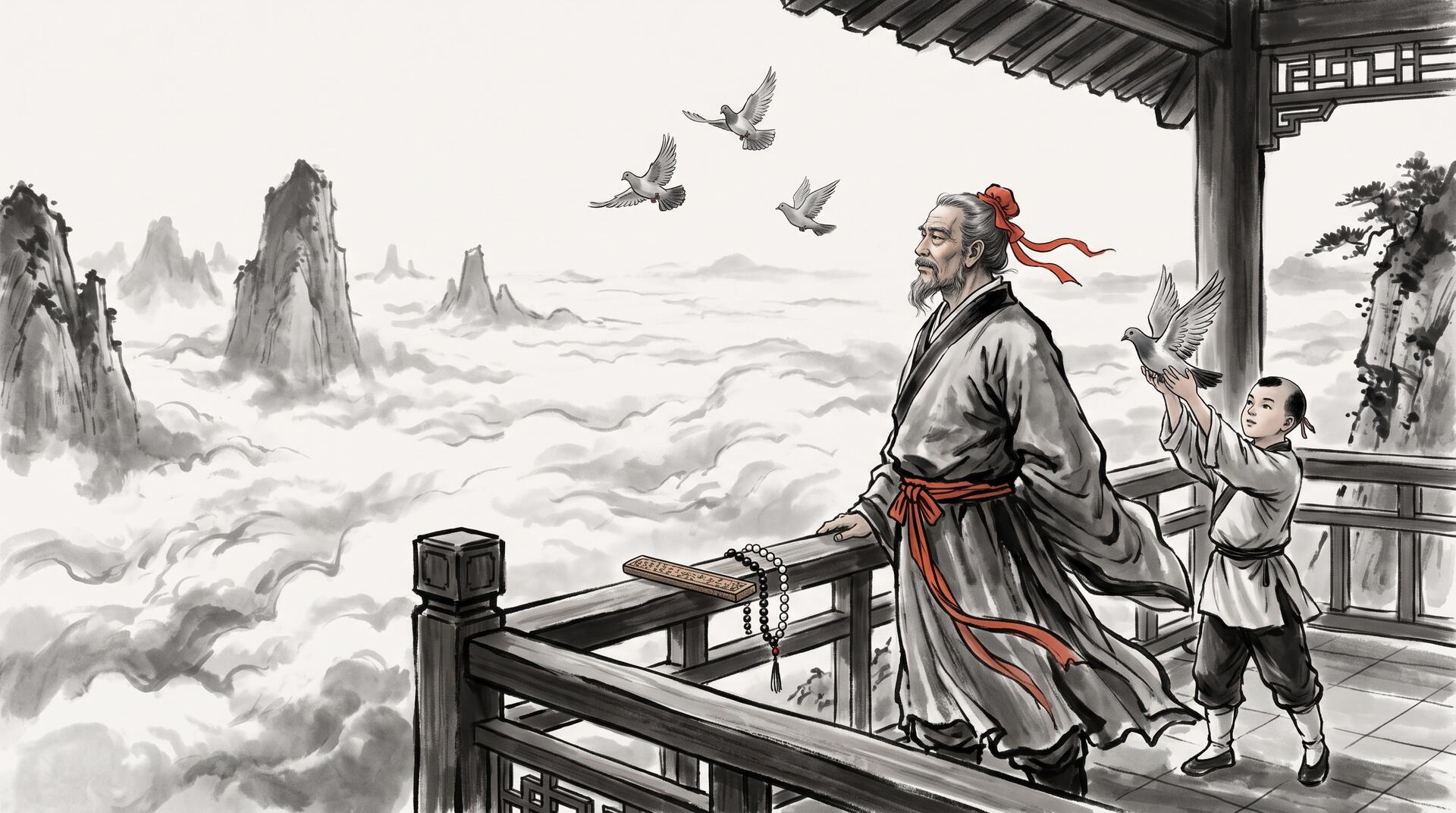
直到一位隐居天柱峰的算学宿老“玄爻翁”出山,才以一把木尺与数个鸟架,彻底解开了这千古死结。
玄爻翁召集各峰代表,立于绝壁风口,朗声道:
“世人皆以为寻书之难,在于山峰之远近。山川之远近受阻于云海与风势,朝生暮变,岂可作凭? 从今往后,不论山水远近,但凭爻木定距;不建中枢总楼,只借折半引灯!”
老人命各峰阁主遵循三条全新制规:
其一,天地齐画,爻骨同规。 老人在石桌上摆开一方由黑白两色骨珠串成的排签。无论是三万座孤峰中的石阁,还是全山所藏的每一卷典籍,自落成之日起,皆由天干地支与阴阳爻象,演算成一串长短划一的黑白骨签(统一标识 ID)。 石阁有阁签,典籍有书签,二者皆在同一片阴阳爻象中各占一位。
其二,爻差之尺,阴阳相较。 众人最感困惑的是:既然山道不通,如何知晓哪座石阁离目标秘籍更近? 玄爻翁微微一笑,取出一把特制的“爻差木尺”。 他将两枚骨签并排平放,从最左侧的第一枚骨珠逐位向右比对:若两枚骨珠颜色相同,木尺便记为平;凡遇第一处黑白相异之位,两签之‘爻差’便立时决断! 相异之位越靠左,说明两签相差如隔天渊;相异之位越靠右,则说明二者近在咫尺。 “这爻尺有通天彻地之妙:甲看乙有多远,乙看甲便同样有多远;且这天地之间,距你某一爻差之处,在同一个方向上永远只有一处所在!”
其三,折半鸟架,只记寥寥数羽。 玄爻翁要求每一座石阁之内,无须记录三万峰的全部行踪,只需在廊下钉上一座“折半鸟架”。 鸟架仅分十余格(k-bucket 路由表): 第一格,只养两三只(k 只)飞往“仅在最末一位相差”的极近石阁的信鸽; 第二格,养两三只“在倒数第二位相差”的石阁信鸽; …… 以此类推,每往上一格,所涵盖的爻差疆域便翻倍扩张,但该格中栖息的联络信鸽,却永远只留两三只! 全阁上下,哪怕面对三万座峰峦,每个书阁的鸟架上也仅需豢养区区百余只信鸽!
一日,一位来自江南的年轻学者登上第七峰,急求一卷骨签为“黑黑白黑……”的《百草九章》。
守峰的青衣童子展开求书签,取爻差木尺与本阁签一比,便知相差悬殊。但他不慌不忙,走到廊下,从鸟架对应的那一格中,顺手抽出了三只($\alpha=3$)与目标骨签爻差最近的信鸽,缚上信筒,振臂齐飞(并行迭代查询)!
三只信鸽穿透云海,分别落入三处相隔甚远的石阁。那三处的阁主见信,虽未藏此书,却同样从自家的鸟架中,挑出三只比他们更为接近目标签的信鸽回传。
由于爻差木尺每次指引,都直取最高相异位的下一程,每一次信鸽往返,搜索的爻差距离便被严丝合缝地折半削减($O(\log N)$)! 从三万座峰,到一万五千座,再到七千座、三千座…… 不过四五次鸽起鸽落,短短几个时辰之内,求书的信筒便精准落在了正正藏有那卷《百草九章》的绝顶石阁之案头! 整个过程,没有惊动中枢,更无环形栈道的寸步难行!
在此法推行数月后,还发生过一桩极为精妙的插曲。
有一日,第七峰的年轻童子见鸟架第七格已满,恰好有一只来自陌生新峰的矫健新鸽飞来投宿。童子喜新厌旧,正欲将笼中一只风雨栖息了五年的老旧信鸽掷出换新。
玄爻翁适时按住了童子的手腕,严厉制止:
“慢着!放飞信筒去老鸽的峰头探一探(Ping 探测)。若老阁主依然健在,则留老鸽于笼内,将新鸽暂且弃于备用筐外! 你可知晓,在这万峰风暴之中,凡能熬过五年风雪依然回巢的石阁,必定根基沉稳、百年不倾;而今早乘着微风初来的新石阁,或许明日一场山雨便会弃庐而逃!信老不信新,方是万峰永续不乱的定海神针!”
童子幡然顿悟。
自那以后,万峰海任凭雷雨肆虐、石阁生灭更迭,云海之上信鸽穿梭,千峰默契照应,再无一书湮灭,再无一路断绝。
——到这儿你大概已经认出来了:这正是现代对等网络(P2P)与去中心化存储世界中,支撑起千亿级流量与千万节点拓扑寻址的最伟大的分布式哈希表协议——Kademlia DHT(基于异或度量衡与 k-桶拓扑)。
由 Petar Maymounkov 与 David Mazières 于 2002 年在微观系统学术界联合提出的 Kademlia,彻底终结了 Napster(集中目录服务器)的单点脆弱,也碾压了 Chord(环形拓扑)与 Pastry/Tapestry(前缀树路由)在网络流失(Churn)下的高昂维护开销。它凭借其惊世骇俗的数学对称性,构筑了四大不可撼动的核心支柱:
这是什么
- 异或度量衡(The XOR Metric):
Kademlia 将节点 ID(Node ID)与数据键(Key)映射至同一个完全统一的 160 位大整数二进制空间(通常由 SHA-1 或 Keccak 散列生成)。
它以按位异或运算(Bitwise XOR)作为逻辑网络中两点间的“距离”定义:
\(d(x, y) = x \oplus y\)
这个度量衡在数学上完美满足几何空间的全部公理:
- 非负与同一性:$d(x, y) \ge 0$,且 $d(x, y) = 0 \iff x = y$;
- 绝对对称性(Symmetry):$d(x, y) = d(y, x)$。在 Chord 等单向环中,A 到 B 的距离不等于 B 到 A 的距离,节点无法仅凭收到的请求顺带更新自身的反向路由;而在 Kademlia 中,任何两个节点互看彼此的逻辑距离完全相同,节点在被动接收查询时便可顺带“免费”学习并刷新发送者的路由信息;
- 单向性(Unidirectionality):对于任意固定节点 $x$ 和任意距离 $\Delta$,全宇宙中有且仅有一个点 $y$ 满足 $x \oplus y = \Delta$。这保证了无论查询从网络的哪一个角落发起,沿着距离收敛的路径在逻辑树上都会单调聚焦于同一局部,绝不会出现多路径发散循环;
- 三角不等式:$d(x, z) \le d(x, y) \oplus d(y, z)$。
-
k-桶路由表(k-Buckets Routing Table): 节点无需感知全网数以百万计的节点,每个节点仅维护一张按异或距离分层切分的紧凑路由表。 第 $i$ 个桶(k-bucket)记录异或距离落在 $[2^i, 2^{i+1})$ 范围内的已知活跃节点信息。 每个桶的大小固定设为常数 $k$(工程中通常取 $k=20$)。 这意味着:离本节点越近的局部,划分越细致;离本节点越远的广袤空间,划分越粗犷,但仍保有具有代表性的哨兵节点。整张表仅需维护约 $\log_2 N$ 个桶,常驻内存仅需数百个节点记录,路由开销极低。
-
并发迭代收敛寻址(Iterative Parallel Node Lookup): 当节点需要寻觅某个 Key 时,它从自身距离该 Key 最近的 $k$-桶中挑选出 $\alpha$ 个节点(并发参数,通常 $\alpha=3$),并行发出
FIND_NODE请求。 接收方如果持有目标数据则直接返回,若无,则返回其自身所知距离目标最近的 $k$ 个邻居节点。查询发起方不断用更近的候选者更新自己的候选集,并在每轮递归中向更近的节点发起探测。因为异或树的二叉前缀每前进一步便将搜索范围缩减一半,寻址路径在 $O(\log N)$ 跳内必定以指数级收敛命中目标。 - 崇尚长寿节点的替换策略(Least-Recently Seen Eviction Policy):
在 P2P 开放网络中,节点频繁上下线(Churn)是吞吐与拓扑的最大杀手。学术测量表明:在线时间越长的节点,其继续存活的概率呈重尾分布(Heavy-tailed distribution),远高于刚上线的新节点。
当一个 $k$-桶满载且收到新节点发现时,Kademlia 不会直接淘汰老节点,而是主动向桶内最久未联系的尾部节点发送
PING:若老节点存活,则继续保留老节点,将新节点压入备用替换列表(Replacement Cache);仅当老节点失联超时,才将其摘除换入新节点。这一法则赋予了 Kademlia 抵御女巫攻击(Sybil Attack)洪泛挤占与高频网络颠簸的天然免疫力。
为什么重要
Kademlia 是整个现代互联网去中心化基础设施的基石灵魂:
-
BitTorrent Mainline DHT 的中流砥柱: 全球最大的去中心化文件分发网络 BitTorrent,早已摆脱了传统的中心化 Tracker 服务器。其底层支撑起亿级无服务器种子寻址的 Mainline DHT(BEP 5),正是标准 Kademlia 的工业实现,使得任意磁力链接(Magnet Link)能在几秒钟内全球穿透解析。
-
以太坊与 Web3 P2P 发现协议(devp2p)的核心引擎: 从以太坊 1.0 的节点发现机制 Node Discovery v4,到以太坊 2.0 信标链与分片网络广泛采用的 Discovery v5,底层完全构建在基于 UDP 的改进版 Kademlia 之上,承载着数万个验证者节点在全球复杂公网环境下的拓扑穿透与近邻广播。
-
星际文件系统(IPFS / libp2p)的寻址总线: 在分布式内容寻址网络 IPFS 中,数据块的存储位置宣告(Provider Records)与内容路由,全部由模块化的 libp2p Kademlia DHT(go-libp2p-kad-dht) 担当。它让哈希寻址(Content Identifier, CID)在广域网具备高并发的路由解析能力。
-
拓扑自愈与极低网络开销的最佳典范: 相比其他 DHT 协议,Kademlia 的异或对称性允许节点借由日常所有的查询流量(甚至被动接收到的请求)自动刷新路由表,几乎无须专门运行昂贵的周期性拓扑自愈探测包。理解 Kademlia,是理解去中心化路由、分布式哈希映射与大规模弱同步网络拓扑设计的必修内功。
隐喻对应表
- 万峰海中的孤立石阁与学者 → 遵循去中心化对等网络拓扑的对等节点(Peers / Nodes)
- 石阁藏书与求书目标(如《青囊要术》) → 分布式哈希表存储的数据与键(Key / Value)
- 统一长短的黑白骨签 → 映射在 160 位统一数值空间的二进制标识(160-bit Key & Node ID)
- 玄爻翁的爻差木尺 → 按位异或距离度量衡(Bitwise XOR Metric, $d(x,y) = x \oplus y$)
- 走廊下的折半鸟架(只分十余格) → 存储邻居节点信息的路由表与 k-桶(k-Buckets, $[2^i, 2^{i+1})$)
- 鸟架每格仅养两三只鸽子 → 每个 $k$-桶的固定容量上限(Bucket Size $k$, 常取 20)
- 抽调三只信鸽并行穿透云海 → 并发寻址参数(Concurrency Parameter $\alpha$, 常取 3)
- 每次探查搜索距离折半递减 → 二进制前缀树搜索以对数跳步指数收敛($O(\log N)$ Lookup Convergence)
- 优先保留历经风霜的老信鸽并发送试探信筒 → 优先保留长寿节点并在淘汰前执行保活探测(Least-Recently Seen Eviction with Ping)
In the boundless wilderness of the western horizons lies a perilous realm known as the Sea of Ten Thousand Peaks.
Tens of thousands of solitary crags pierce the clouds like jade blades rising from the abyss. Between the precipices churn bottomless cataracts of mist, swept by howling mountain gales. Across these vertiginous chasms, neither iron cableways nor plank roads could ever be strung. Here, hermits, wandering scholars, and masters of antiquity dwelt in isolated stone pavilions perched upon the summits, each guarding rare medical scrolls, agricultural treatises, and ancient philosophies.
Yet any traveler who ventured into this mountain labyrinth in search of lost wisdom was cast into utter despair: among thirty thousand stone towers floating above the mist, in which solitary eyrie was the legendary Treatise of the Green Capsule hidden?
In earlier years, the scholars attempted to build a Grand Imperial Pavilion on the plains at the mountain gate.
They erected a nine-story pagoda and appointed dozens of clerks to log every pavilion’s name, peak, and collection in an exhaustive master dossier. Every traveler seeking a scroll had to queue before this central pagoda to consult the register.
The prosperity was fleeting. One summer, lightning struck the grand eaves; the pagoda was engulfed in flames for three days, reducing the master registry to white ash in a heartbeat. Worse, during the autumn academic tides, tens of thousands of scholars swarmed the gates simultaneously; thresholds splintered, and exhausted clerks collapsed face-down over their desks. Whenever the central registry collapsed, the entire Sea of Ten Thousand Peaks was struck blind and deaf.
Later, the mountain masters tried a different ancient design: The Great Mountain Ring.
Thirty thousand peaks were organized into a colossal circle, where each pavilion communicated only with its immediate left and right neighbors. Inquiries drifted along the ring one by one: “Is this scroll with you?” “No, pass it forward!”
It sounded tidy on paper, but proved disastrous in practice. A bamboo cylinder carrying an inquiry could drift for half a year along the thirty-thousand-station perimeter. Worse, boulders and mountain squalls frequently smashed pavilions along the ridge; the moment a single station failed, the communication thread snapped. Message tubes plummeted into the abyss, and inquiries spun in hopeless, broken loops.
The masters gathered upon a wind-scoured cliff, sighing in lament: “The more sanctuaries we erect, the harder it is to locate a single word. Each peak is an island; linking them as a single strand leaves us as fragile as a spider’s silk. Can thirty thousand peaks truly never support an indestructible system of finding?”
It was not until an aged hermit from the Pillar of Heaven, known as the Elder of Differing Lines, descended with a carved wooden ruler and a set of pigeon coops that the riddle of the mountains was solved forever.
Standing at the edge of the abyss before the assembled delegates, the elder spoke:
“Men believe the difficulty of finding scrolls lies in physical leagues and mountain valleys. Yet mountain paths shift with storm and flood; they cannot be trusted! From this day forth: Measure distance not by rocks and rivers, but by the divergence of tallies; build no central tower, but let the lanterns halve the horizon at every flight!”
The elder established three unbreakable precepts:
First: Unified Tallies Across Heaven and Earth. Upon a slate table, the elder laid strings woven with black and white bone beads. From that hour onward, every stone pavilion upon every peak, and every sacred parchment housed within them, was assigned an identical, fixed-length sequence of dark and pale beads (Unified 160-bit Identifier). A mountain tower possessed its own tally; a medical treatise possessed its own tally; both shared the very same uniform space of alternating stones.
Second: The Ruler of Differing Marks. How could one know which stone pavilion stood closest to a desired scroll without crossing the chasms? The elder smiled and drew a notched wooden compass known as the Ruler of Differing Marks. He laid two bead tallies side by side and examined them from the leftmost bead toward the right. Wherever beads shared the same color, the ruler marked harmony; at the very first position where black met white, the divergence was fixed forever! The further to the left this divergence occurred, the further apart the tallies were; the further to the right, the closer their kinship. “This compass possesses a divine truth: the divergence from Peak A to Peak B is identical to the divergence from Peak B to Peak A. Moreover, across all heavens, at any given divergence distance, there is only ever one solitary point!”
Third: The Halving Pigeon Rack. The elder decreed that no pavilion needed to remember the locations of thirty thousand peaks. Each keeper needed only nail a modest wooden frame to their corridor: The Halving Pigeon Rack (k-bucket routing table). The rack contained barely a dozen compartments: The lowest slot held two or three (k) carrier pigeons flying to pavilions whose tallies differed only at the very final bead (the closest kin); The next slot held two or three pigeons differing at the second-to-last bead; … With each ascending slot, the span of divergence doubled in size, yet the number of carrier pigeons kept within that slot remained strictly fixed at two or three! Even across thirty thousand peaks, a keeper’s entire corridor required scarcely a hundred roosting birds!
One autumn morning, a young pilgrim climbed the Seventh Peak seeking a treatise whose tally began with “Black-Black-White-Black…”
The youthful gatekeeper unfurled the requested tally, aligned it with his own peak’s tally using the Ruler of Differing Marks, and realized it was far from home. Undaunted, he walked to the corridor rack, drew three pigeons ($\alpha = 3$) from the slot closest to the target’s divergence, bound the request to their talons, and cast them into the dawn winds (Iterative Parallel Lookup)!
The three pigeons pierced the cloud sea, landing upon three widely separated peaks. The masters of those three peaks did not hold the scroll either; yet each immediately selected three pigeons from their own racks that were substantially closer to the target tally.
Because each inquiry halved the remaining divergence, with every flight of pigeons, the search space shrank by half ($O(\log N)$)! From thirty thousand peaks down to fifteen thousand, then seven thousand, three thousand, eight hundred… In scarcely four or five relays, within a matter of hours, the messenger tube landed with unerring precision upon the very desk of the solitary peak where the treatise lay entombed! No central registry had been summoned; no fragile circular ring had been traversed!
Months later, an illuminating incident occurred.
The Seventh Peak’s young apprentice noticed that the seventh slot of the pigeon rack was completely filled. Just then, a spirited young carrier pigeon from a newly discovered peak fluttered onto the windowsill. Coveting the vigorous newcomer, the apprentice reached into the coop to discard a five-year-old, weather-beaten pigeon.
The Elder caught his wrist with a grip of iron:
“Hold! Dispatch an inquiry to the veteran pigeon’s home roost first (Ping probe). If the old pavilion still answers, keep the veteran within the cage and set the newcomer in the spare basket! Know this: across these mist-strewn gorges, a mountain sanctuary that has weathered five winters of frost possesses deep roots; it will likely stand for a century. But this sprightly newcomer that blew in on a morning breeze may abandon its perch with tonight’s gale! Honor the weathered over the fleeting; that is the anchor of resilience in a chaotic world!”
The apprentice bowed in profound realization.
From that hour, though gales battered the peaks and stone pavilions came and went with the seasons, carrier pigeons wove a silent fabric of trust above the mist. Across thirty thousand summits, knowledge remained perpetual, unseverable, and immortal.
——By now you’ve probably recognized it: this is the celebrated protocol that underpins modern peer-to-peer (P2P) file sharing and decentralized storage across hundreds of millions of nodes—Kademlia Distributed Hash Table (XOR Metric and k-Buckets).
Introduced in 2002 by Petar Maymounkov and David Mazières, Kademlia triumphed over the single-point fragility of Napster (centralized index servers) and the high maintenance overhead of Chord (rigid ring topologies) and Pastry/Tapestry (prefix-based routing) under churn. Through its remarkable mathematical symmetry, Kademlia established four foundational pillars:
What it is
- The XOR Metric:
Kademlia projects node identifiers (Node IDs) and data keys into an identical, flat 160-bit binary space (typically generated by SHA-1 or Keccak hashing).
Distance between any two points is defined simply as their bitwise XOR:
\(d(x, y) = x \oplus y\)
This elegant metric satisfies all mathematical axioms of a geometric distance:
- Identity and Positivity: $d(x, y) \ge 0$, and $d(x, y) = 0 \iff x = y$;
- Absolute Symmetry: $d(x, y) = d(y, x)$. In unidirectional ring topologies like Chord, the distance from A to B is not equal to the distance from B to A, preventing nodes from learning about their senders for free; in Kademlia, the distance is strictly symmetric, allowing nodes to update their routing tables lazily from incoming traffic;
- Unidirectionality: For any given node $x$ and distance $\Delta$, there exists exactly one node $y$ such that $x \oplus y = \Delta$. This guarantees that all lookups for a given key converge monotonically along the same binary tree branch regardless of where the query originated, preventing routing loops;
- Triangle Inequality: $d(x, z) \le d(x, y) \oplus d(y, z)$.
-
k-Buckets Routing Table: Nodes do not track the millions of participants in the network. Instead, each node maintains a compact routing table organized into logarithmic distance bins known as $k$-buckets. The $i$-th bucket stores contacts with an XOR distance in the range $[2^i, 2^{i+1})$. Each bucket has a fixed capacity $k$ (empirically set to $k=20$). Consequently, a node maintains dense knowledge of its immediate logical neighbors and progressively sparser knowledge of distant subspaces. The entire routing table contains roughly $\log_2 N$ buckets, requiring each node to store only a few hundred contacts in memory.
-
Iterative Parallel Lookup: When a node searches for a key, it selects $\alpha$ contacts (concurrency parameter, typically $\alpha = 3$) closest to the target from its own $k$-buckets and sends concurrent
FIND_NODEorFIND_VALUERPCs. Recipients return the requested value or the $k$ closest nodes they know. The initiator continually updates its candidate set and dispatches new probes to closer nodes. Because each hop resolves at least one bit of the XOR prefix, the search space halves at every step, guaranteeing convergence in $O(\log N)$ hops. - Least-Recently Seen Eviction Policy:
In public P2P networks, node churn is the primary cause of routing failure. Empirical network measurement studies (such as Gummadi et al., 2003) show that node uptime follows a heavy-tailed distribution: nodes that have been online the longest are statistically far more likely to remain online.
When a $k$-bucket is full and a new contact is discovered, Kademlia does not evict the oldest entry; instead, it sends a
PINGto the least-recently seen node in the bucket. If the veteran node responds, it is retained, and the newcomer is placed into a replacement cache. Only dead nodes are evicted. This simple policy provides extraordinary resilience against churn and Sybil flooding.
Why it matters
Kademlia is the unsung backbone of global peer-to-peer and decentralized architectures:
-
The Foundation of BitTorrent Mainline DHT: BitTorrent, the world’s largest decentralized distribution network, completely eliminated reliance on central tracker servers via Mainline DHT (BEP 5). Mainline DHT is a direct production implementation of Kademlia, enabling hundreds of millions of clients to resolve magnet links globally in seconds without central infrastructure.
-
Core Discovery Engine for Ethereum and Web3 (devp2p): From Ethereum’s original Node Discovery v4 to the current Discovery v5 protocol utilized by the Ethereum Beacon Chain, peer discovery across tens of thousands of validator nodes relies directly on an augmented UDP-based Kademlia implementation.
-
Content Routing for IPFS (libp2p): The InterPlanetary File System (IPFS) relies on libp2p Kademlia DHT (
go-libp2p-kad-dht) for both peer routing and content routing (publishing and discovering Provider Records for Content Identifiers / CIDs). -
Self-Healing Topology with Minimal Maintenance Traffic: Unlike past DHT designs that required aggressive, periodic background gossip to maintain topology, Kademlia’s XOR symmetry allows nodes to continuously refresh and repair their routing tables as a natural byproduct of regular user lookups. Understanding Kademlia is essential for any engineer designing large-scale distributed hash rings, overlay networks, and decentralized communication topologies.
Metaphor mapping
- Isolated stone pavilions and scholars in the Sea of Peaks → Decentralized peer nodes in an overlay network (Peers / Nodes)
- Sacred treatises and requested scrolls (Treatise of the Green Capsule) → Stored data values and content keys (Key / Value)
- Uniform black and white bead tallies → Unique identifiers in a unified 160-bit keyspace (160-bit Node & Key ID)
- Elder’s Ruler of Differing Marks → Bitwise XOR distance metric ($d(x,y) = x \oplus y$)
- Halving pigeon rack along the corridor → Logarithmic routing table partitioned into k-buckets ($[2^i, 2^{i+1})$)
- Fixed capacity of 2-3 pigeons per slot → Fixed bucket size ($k$-bucket capacity, $k=20$)
- Releasing 3 pigeons simultaneously into the mist → Concurrent lookup parameter ($\alpha = 3$)
- Halving the remaining divergence with each relay → Logarithmic convergence in $O(\log N)$ hops
- Retaining weathered veteran pigeons and probing before replacement → Least-recently seen eviction policy with
PINGprobing