▶ Cinematic fable · Watch on YouTube ▶ 影片版寓言 · 在 YouTube 观看
在大荒北部的千仞绝岭之间,连绵散布着整整三千座险峻的烽火哨楼。
这里是王朝抵御风暴与妖患的第一道防线。三千座哨楼错落扎根于孤峰悬崖之上,云海翻腾,深渊万丈。每一座哨楼里,都驻扎着两名手持铜镜与信鸽的守关斥候。统帅部传下死令:边防军力瞬息万变,所有哨楼必须随时掌握全线到底还有哪些同僚屹立、谁已失守陷落。
起初,各哨楼用的是最直截了当的“点卯报安法”。
每到破晓辰时,每一座哨楼都必须敲响青铜云锣,并向全线其余两千九百九十九座哨楼逐一放飞传信铜鹞。三千座哨楼,同时向周围两千九百九十九处放信,整片苍穹瞬间被近千万只铜鹞与漫天锣声彻底遮蔽!斥候们疲于奔命,整日忙于核验数千封信笺,悬崖间风声、锣声与飞禽啼鸣交织成震耳欲聋的风暴。更为可怕的是,稍有一场浓雾弥漫,某座哨楼发射的铜鹞迷失于峡谷,对岸哨楼便误以为同僚已全军覆没,频频错发丧警。
统帅部不堪重负:守关的斥候几乎什么仗都不用打,光是确认同僚“在不在”,就快把三千座哨楼的铜料与粮饷活活耗尽!
直到新任游击将军苏大人巡视北关,驻足悬崖绝顶,唤停了漫天的铜鹞。
“兵法贵精不贵靡。查验存亡,何须全营乱噪?”苏大人取出一本薄薄的布防手札,“从今日起,废除万人对点的大点卯,改立‘游镜借羽之令’。”
苏大人立下的规矩奇绝轻灵:
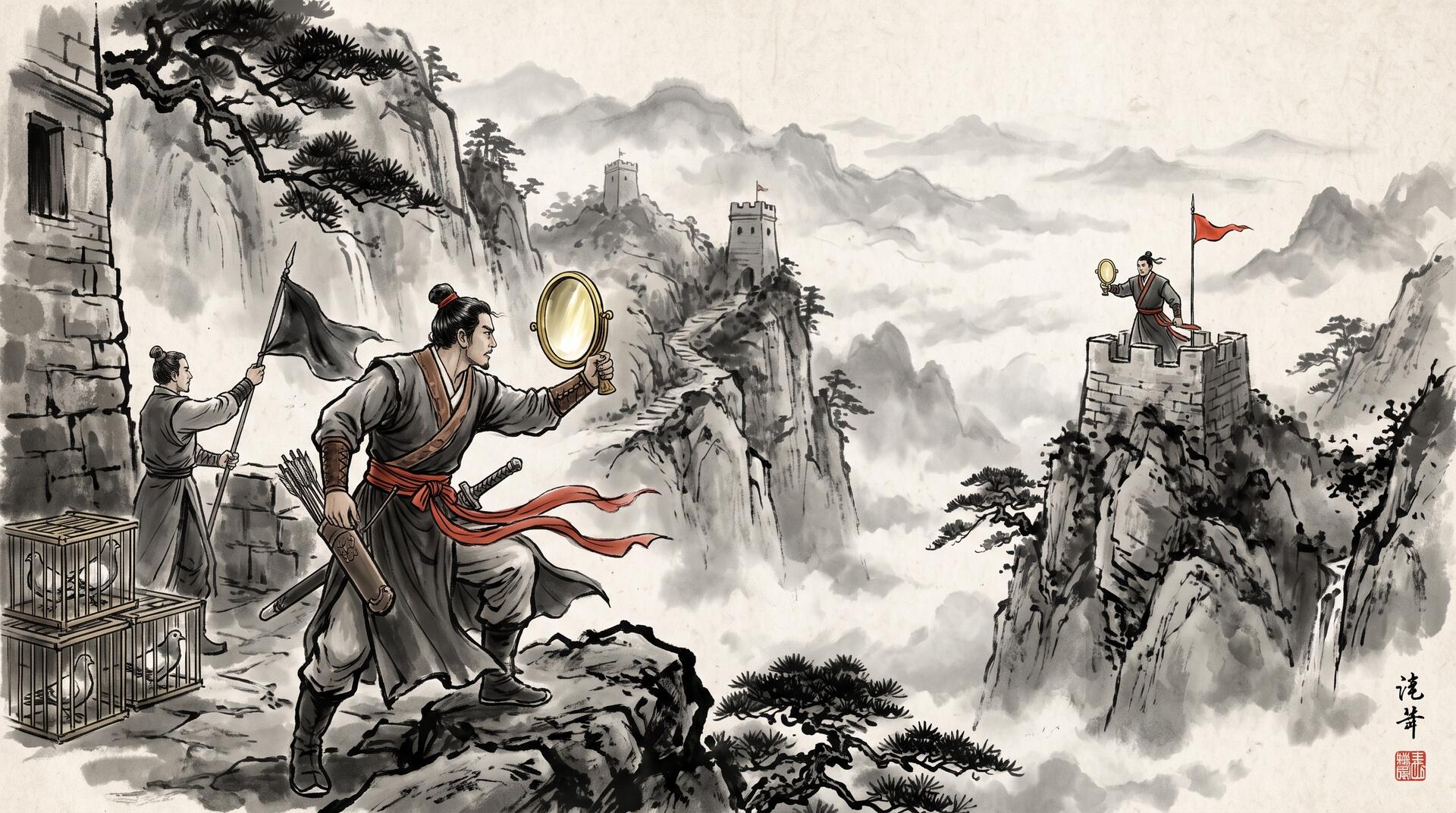
第一,静默游巡,点对相照(Direct Ping)。 每隔一炷香的时间,斥候不必环顾全营,只需在名册中随手翻翻,选出一座哨楼——比如西峰的第三十七号哨楼。斥候走到崖边,取出一面黄铜凹镜,借着日光向第三十七号哨楼晃一道金芒。若是对方尚在,第三十七号哨楼的斥候便立刻回晃一道青芒。金来青往,不过眨眼之间,一炷香便算安然度过。
“可万一浓雾遮了峡谷,或者三十七号哨楼的斥候正巧下山挑水,没看到金光呢?”老哨官急声问道,“难道就此断定他已阵亡?”
“断然不可。”苏大人微微一笑,指了指悬崖两侧另外两座近处的哨楼。
这便是第二重妙法:借羽绕巡,孤证不立(Indirect Ping via Partners)。 若是一炷香内没等到三十七号哨楼的回芒,斥候绝不轻举妄动,而是立刻向身侧任意选定的三座哨楼打出快旗:“请代某照会三十七号哨楼!” 这三座哨楼从不同角度、不同高度,各自调转铜镜,向三十七号哨楼照射探寻。只要三十七号哨楼向这三位同僚中的任何一人回了一声锣或晃了一道光,消息便能借道传回。除非四路同探皆如泥牛入海,否则绝不轻易定性。
老哨官抚须点头:“那若真被妖风截断,四路皆无回音,是否立刻除名、宣告覆灭?”
“依旧不可!”苏大人眼中精芒一闪,道出最深微的第三重机宜:留疑待辩,附羽传讹(Suspicion & Piggybacked Gossip)。 “直探无声,借道亦无应,此时只能在名册上给三十七号哨楼画一个朱砂问号——记为‘存疑’(Suspicion)。与此同时,我们绝不单独派人全营敲锣告警。每座哨楼在平日例行用铜镜晃向别处时,在铜镜边缘顺带贴上一片极轻的短羽飞笺,将‘三十七号哨楼存疑’的短语顺水推舟捎带过去(Piggybacking)。”
消息如蒲公英般在哨楼之间轻盈扩散。若三十七号哨楼真只是被暴风吹翻了铜镜,他在收到“自身存疑”的传闻后,尚有一柱香的宽限期点燃红烟自辩破疑;唯有经过整整三柱香的大限,若全关再无一人收到三十七号的音讯,全关才平静地将它划除。
自此,整条三千峰防线安静得只能听见松涛阵阵。
没有了千万铜鹞蔽日的嘈杂,没有了暴风雨中频繁误报的狼烟。哪怕整条防线再扩充十倍、增至三万座哨楼,每一位斥候每柱香依然只需晃一下铜镜、发三面借道快旗,顺带捎带一两片轻羽。任凭峰岭如何辽阔,全军万众始终如同一人般洞若观火,轻盈而坚不可摧。
这是什么
在分布式系统的大规模集群中,成百上千乃至上万台服务器节点必须时刻知晓集群里有哪些节点在线、哪些节点离线或故障,这一机制被称为集群成员与故障检测(Cluster Membership & Failure Detection)。
传统的全连接心跳(如每台机器周期性向所有其他机器发送心跳广播)在节点规模增长时,会导致网络报文量随节点数平方级暴增($O(N^2)$),极易造成网络风暴与误报。
SWIM 协议(Structured Weakly-Consistent Infection-Style Process Group Membership Protocol,结构化弱一致传染病风格进程组成员协议)由 Cornell 大学的 Abhinandan Das 等人于 2002 年提出。SWIM 将故障检测的报文开销与单机负担降到了恒定的常数级别($O(1)$),并在 $O(\log N)$ 的极短时间内将集群变动传播至全局。HashiCorp 的知名开源服务发现组件 Consul(底层 serf 库)正是基于 SWIM 协议及其扩展构建而成。
为什么重要
SWIM 协议解决了超大规模分布式集群中的三大顽疾:
- 常数级单机开销($O(1)$ Message Overhead):无论集群是一百台还是一万台机器,每个节点在每个探测周期内仅向固定数量的随机节点发送探测请求,CPU 与网络带宽开销完全恒定,不会因集群扩张而发生性能崩塌。
- 极低的误报率(Indirect Ping):当网络出现局部丢包或单向连通性故障时,直接探测失败的节点不会立即判定对方死亡,而是邀请 $k$ 个随机第三方节点进行“间接探测”(Indirect Probe)。只有当多条独立网络路径均无法连通时,才会触发疑点,彻底消除了由于单条网络链路瞬时抖动引发的误判。
- 怀疑机制与捎带传播(Suspicion Mechanism & Piggybacked Dissemination):SWIM 将节点状态划分为 Healthy、Suspect、Dead。处于 Suspect 状态的节点在超时前可通过反驳机制(Refutation)声明存活,防止因 GC 暂停或短暂卡顿被错误踢出;同时,成员变动信息不单独广播,而是作为元数据“捎带”在每次心跳报文尾部进行 Gossip 流行病式扩散,以近乎零的网络开销实现毫秒级的全集群弱一致感知。
隐喻对应表
- 三千座险峰烽火哨楼 → 大规模分布式集群中的服务器节点(Nodes)
- 全线哨楼掌握彼此存亡名册 → 分布式集群成员视图(Cluster Membership View)
- 万人同击锣飞铜鹞的大点卯 → 传统的 $O(N^2)$ 全连接广播心跳(Heartbeat Broadcast)
- 定时随手翻名册晃镜相照 → 周期性随机点对点直接探测(Direct Ping)
- 托请近处三座哨楼代为探查 → 间接健康检查机制(Indirect Ping via $k$ Targets)
- 名册画朱砂问号与宽限反驳 → 节点存疑状态与反驳机制(Suspicion & Refutation)
- 铜镜边缘捎带的短羽飞笺 → 捎带式 Gossip 传染病状态传播(Piggybacked Gossip Dissemination)
High amidst the perilous crags and jagged ravines of the northern wilderness stood three thousand solitary beacon watchtowers.
They formed the empire’s primary bulwark against tempestuous storms and northern raiders. Perched precariously atop needle-thin pinnacles above a churning sea of mist, each outpost was manned by two vigilant sentinels equipped with polished brass signal mirrors and carrier pigeons. The border command had issued an absolute mandate: military dispositions shift in the blink of an eye, and every watchtower must constantly maintain an accurate roster of which towers stood firm and which had fallen.
In the early days, the garrisons followed an intuitive yet brutal ritual known as the “Universal Roll Call.”
At every dawn break, every single watchtower was required to strike its great bronze gong and loose mechanical messenger kites to all two thousand nine hundred and ninety-nine neighboring peaks across the ridge. Three thousand watchtowers, each launching thousands of kites and echoing deafening gongs simultaneously, darkened the sky beneath a storm of brass feathers and chaotic brass chimes. Sentinels spent their entire shifts desperately reading and recording thousands of incoming messages. Worse still, whenever dense mountain fog smothered a canyon and delayed a handful of kites, distant outposts assumed their comrades had fallen and mistakenly lit catastrophic false-alarm beacons.
The border command was exhausted. The garrisons spent nearly all their rations and brass reserves just trying to prove they were still alive.
Relief arrived only when Commander Su, the newly appointed frontier general, rode up to the summit of the central peak and commanded the chaotic flurry to cease.
“True martial doctrine prizes surgical precision over blunt spectacle,” Commander Su declared, drawing a slender military register from his sleeve. “From this day forth, abolish the universal gong clamor. We shall govern the peaks by the Order of the Wandering Mirror and Borrowed Feather.”
The rules he established were astonishingly lightweight and elegant:
First, Quiet Wandering and Direct Interrogation (Direct Ping). Every incense-stick interval, a sentinel had no need to survey the entire frontier. He simply opened his ledger, selected a single random outpost—say, Tower Thirty-Seven on the Western Crag—and stepped to the cliff edge. Catching the sun with a concave brass mirror, he flashed a brief golden ray across the chasm. If Tower Thirty-Seven was intact, its sentinel flashed back an emerald glint within seconds. A golden beam out, an emerald gleam back—a solitary exchange, and the sentinel’s duty for that cycle was fulfilled.
“But what if thick valley mist blocks the direct ray, or the sentinel is momentarily fetching spring water?” asked an old outpost captain. “Must we immediately declare him dead?”
“By no means,” Commander Su smiled, gesturing toward three neighboring watchtowers flanking the ridgeline.
This was the second pillar: Borrowed Inquiries and Multi-Path Assurance (Indirect Ping via Partners). If no emerald response returned within the designated heartbeat, the sentinel did not jump to conclusions. Instead, he flashed swift signal flags to three randomly chosen neighbor towers: “Please inquire upon Tower Thirty-Seven on my behalf!” These three outposts swiveled their mirrors from entirely different angles and elevations, directing probing rays toward Tower Thirty-Seven. If the target answered even a single one of these indirect queries, the acknowledgment was routed back to the origin. Unless all four independent observation lines vanished into silence, no alarm could be sounded.
The old captain stroked his beard and nodded. “And if an uncanny gale severs all four paths and all remain silent, do we strike him from the roster immediately?”
“Still no!” Commander Su’s eyes flashed with tactical insight as he revealed the third and deepest safeguard: Suspicion with Refutation and Piggybacked Lore (Suspicion & Piggybacked Gossip). “When direct and indirect inquiries yield nothing, mark a crimson question mark beside Tower Thirty-Seven—designate it merely as Suspicious. We dispatch no frantic courier across the army. Instead, whenever any sentinel performs his routine mirror flash to another post, he affixes a tiny feather-light parchment scroll to the rim of the mirror (Piggybacking), whispering the note: ‘Tower Thirty-Seven is under suspicion.’”
Like windblown dandelion seeds, the rumor drifted gently across the outposts. If Tower Thirty-Seven had merely suffered a shattered mirror in a sudden squall, hearing the rumor granted it a grace period to kindle a distinctive crimson smoke to refute the doubt (Refutation). Only if three full intervals elapsed without a shred of life would the entire garrison quietly and concurrently strike the tower from their ledgers.
From that hour on, the three thousand peaks fell so serene that only the whisper of pines could be heard.
No deafening gongs, no sky-obscuring clouds of brass kites, and no panicky false beacons in the mist. Even had the frontier expanded tenfold to thirty thousand outposts, every sentinel still only flashed a single mirror and three indirect flags each cycle. Across boundless mountain chains, the vast army maintained a crystal-clear, unified vision of its ranks—effortless, resilient, and unbreakable.
What it is
In large-scale distributed systems, hundreds, thousands, or tens of thousands of server nodes must continually maintain an accurate view of which nodes are alive and which have crashed or partitioned. This fundamental primitive is known as Cluster Membership and Failure Detection.
Traditional all-to-all heartbeat schemes (where every node periodically broadcasts heartbeats to every other peer) generate message volume that scales quadratically ($O(N^2)$) with cluster size, inevitably triggering network congestion, CPU thrashing, and epidemic false alarms at scale.
The SWIM Protocol (Structured Weakly-Consistent Infection-Style Process Group Membership Protocol), introduced in 2002 by Abhinandan Das et al. at Cornell University, solves this bottleneck. SWIM reduces failure detection network overhead and per-node processing load to a strict constant ($O(1)$) per period, while propagating membership changes across the entire cluster in $O(\log N)$ time. HashiCorp’s widely used service discovery tool, Consul (via its underlying serf library), is built directly on SWIM and its extensions.
Why it matters
The SWIM protocol resolves three classical scalability dilemmas in modern distributed computing:
- Constant Per-Node Overhead ($O(1)$ Message Overhead): Regardless of whether a cluster contains one hundred or twenty thousand nodes, each node only pings a fixed number of random peers per interval. Bandwidth and CPU consumption remain strictly constant, immune to cluster scale.
- Resilience to Transient Jitter (Indirect Ping): When packet loss or asymmetric network partitions disrupt direct communication, the detecting node delegates the probe to $k$ random peer intermediaries (Indirect Ping). A node is only suspected if all independent auxiliary network paths fail, virtually eliminating false positives caused by transient single-link drops.
- Suspicion Mechanism & Piggybacked Dissemination: SWIM separates node state into Healthy, Suspect, and Dead. A Suspected node is granted a configurable timeout window to broadcast an authoritative Refutation if it was merely delayed by a stop-the-world garbage collection pause or temporary load spike. Furthermore, membership events are not broadcast via dedicated packets; they are piggybacked onto regular ping/ack messages using epidemic gossip, achieving cluster-wide weak consistency in milliseconds with virtually zero added network overhead.
Metaphor mapping
- Three thousand mountain beacon watchtowers → Server nodes in a distributed cluster (Nodes)
- Maintaining an accurate garrison roster across the crags → Distributed cluster membership view (Cluster Membership View)
- The universal dawn gong and kite blizzard → Traditional $O(N^2)$ all-to-all heartbeat broadcasting (Heartbeat Broadcast)
- Periodic single-mirror flash to a random peer → Periodic point-to-point direct health probing (Direct Ping)
- Enlisting three neighbor towers to probe an unresponsive outpost → Multi-hop indirect health checking (Indirect Ping via $k$ Targets)
- Crimson question mark with grace period for smoke signals → Node suspicion state and self-refutation mechanism (Suspicion & Refutation)
- Feather-light scrolls affixed to brass mirrors during routine flashes → Piggybacked gossip dissemination of membership updates (Piggybacked Gossip Dissemination)