▶ Cinematic fable · Watch on YouTube ▶ 影片版寓言 · 在 YouTube 观看
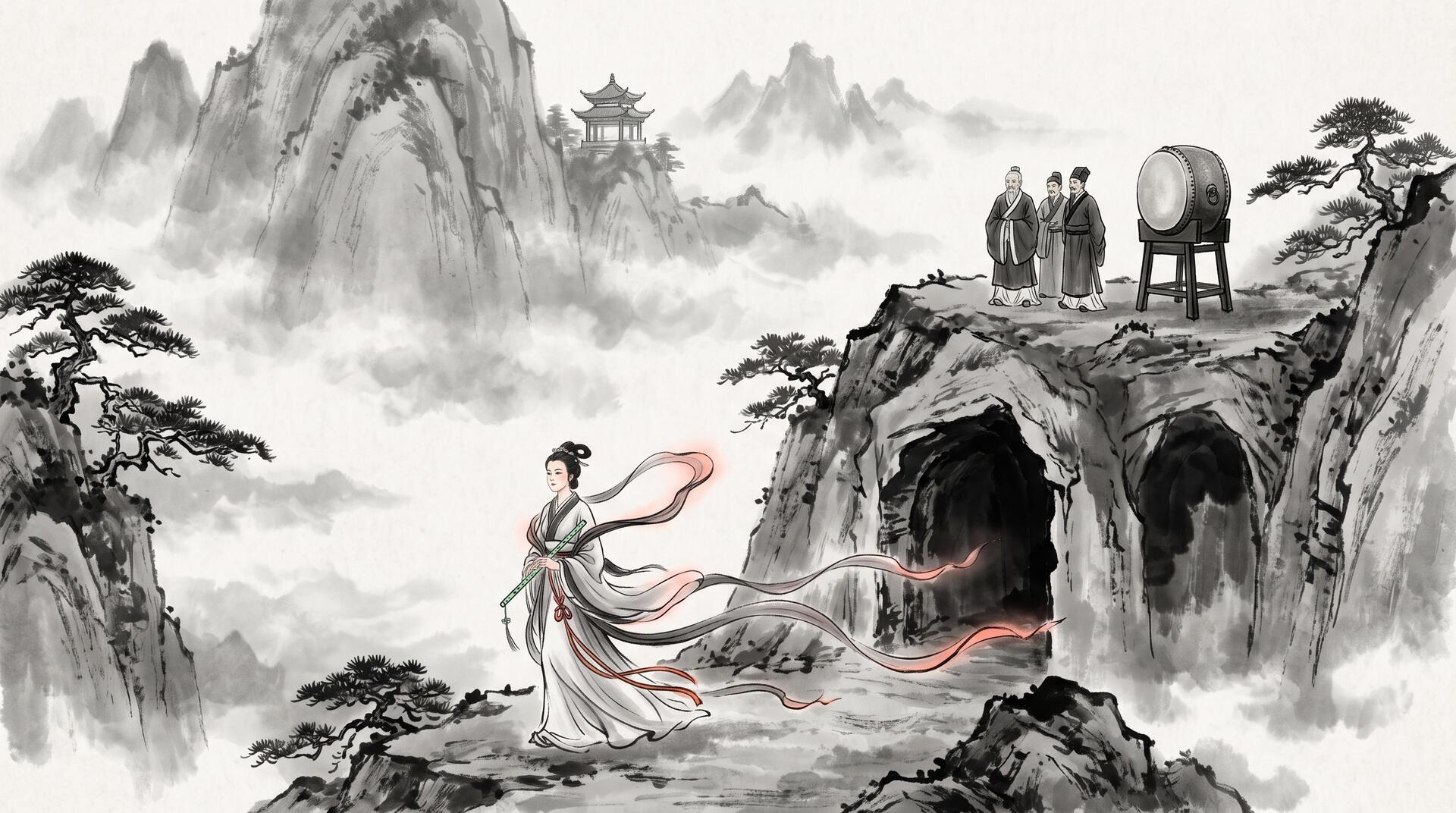
青岩城的财库不在城里,而在城后月泉山的山腹里。山有东西两个洞口,像沉睡巨人张开的两个鼻孔;两条回廊在幽深处汇合,汇合处立着一扇石门,门后是三代人攒下的粮种和银锭。
石门认的不是钥匙,是一支曲子。玉笛吹起《月泉引》,笛音震开门后的机簧,石门自开。曲子一代只传一人——传给守门人。守门人凤老爹在一个深秋撒手去了。城里顿时乱了:秋税要入库,粮种要出仓,可天下会这支曲子的,如今还有谁?
第三天,一个游方的笛娘来到城下,自称苏晚,说自己是凤老爹二十年前私下收下的弟子。曲子,她记得。
议事厅里吵翻了天。信她?疑她?黑沙会的探子在城里潜伏了十年,就为偷这支曲子,凤老爹到死没让他们听去一个音。城规也立了三代:《月泉引》过耳即泄——曲子吹给谁听,就等于给了谁。连议事厅的诸位长老,也不许听。
于是长老们面对一个古怪的难题:怎么让苏晚证明她真的会这支曲子——却一个音都不许露?
有人说:让她进洞吹一次,门开即真。立刻有人摇头:她若只记得半支?若压根是黑沙会派来的细作呢?门开一次,证明不了第二十次。要交出守门人的玉印,得证明她能在长老们的眼皮底下、按长老们的意思,随时开那扇门——不是一次,是每一次。
最后是白须的老祭酒想出了法子。
“山有两个口。”他说,”让她进山。等她走到深处、鼓声传得到也退不回去的地方,我们再摇鼓定夺:一声鼓,出东口;两声鼓,出西口。一炷香为限。她若真会曲子,过了石门,东西两口随我们指;她若不会,就只能从进去的那一边原路爬回——那时鼓点落在哪一边,便只能看她的运气。”
有人问:万一她不靠曲子,靠黑沙会挖的那条窄缝呢?东口不远处,黑沙会十年挖山,挖出过一条仅容一人爬行的烟囱窄缝。
老祭酒捻须:”窄缝要爬半晌。一炷香,够从石门从容走回任一口,不够爬那道缝。鼓声响起时,她人已在山腹深处,再想换边,来不及。”
第一天清晨,苏晚进了山。鼓响一声,她从东口出来,衣角还带着洞里的凉气。
第二天,鼓响两声,她从西口出来。
第三天,东口。第四天,西口……鼓点由长老前夜掷铜钱定,连摇鼓的差役也是清晨才领的签。
第二十天清晨,鼓响两声,苏晚从西口走出,把玉笛插回腰间,朝山上的长老们拱了拱手。
黑沙会也不是没动过手。他们买通书办,把二十天的鼓点与出洞记录抄了个遍,拿回去研读了三个月——纸上只有”一声,东;两声,西”的流水账,与掷铜钱的记录没有两样。曲子呢?曲子一个音也不在纸上。有个头目想通了什么,把账本摔在地上:”找个城里孩子雇两个戏子,也能演出一本一模一样的账。这里没有东西可偷。”
第二十一天清晨,议事厅把守门人的玉印交到苏晚手里。老祭酒说:”我们自始至终没听到一个音,可我们如今都信了。”
说到这里,你可能已经猜到了:这就是零知识证明(zero-knowledge proof)。
这是什么
零知识证明让证明者(prover)说服验证者(verifier)“我知道某个秘密”,却在证明过程中不泄露秘密本身。典型形态是一轮轮的随机挑战(random challenge):苏晚进山之后,长老才随机指定出口。她若真掌握曲子,任何指令都困不住她;她若是冒牌,每轮只有一半概率蒙对。二十轮下来,行骗成功率只剩二分之一的二十次方,约百万分之一。而整个过程中,曲子只在山腹深处响起,从不经过任何人的耳朵。这个性质有个学名:验证者看完全部记录,也学不到任何东西——那些记录与掷铜钱无异,谁都能伪造一份一模一样的。
为什么重要
密码、密钥、生物特征,只要”出示”就有泄露的一刻——听过即泄露,传过即失守。零知识证明把”证明”与”泄露”拆开:你可以证明自己知道口令而不发送口令,证明自己年满十八而不交出生日,证明一笔账算对了而不公开账目。它是现代身份认证、区块链隐私(zk-SNARKs)与可验证计算的地基。它还回答了一个比任何协议都更根本的问题:信任,不必建立在交出秘密之上。
隐喻对应表
- 苏晚(笛娘) → 证明者(prover)
- 议事厅长老 → 验证者(verifier)
- 《月泉引》 → 秘密,即见证(witness)
- 山腹石门与机簧 → 只有正确秘密才能通过的验证函数
- 山顶鼓声(掷铜钱定) → 随机挑战(random challenge)
- 二十个黎明的二十轮 → 交互轮数;行骗概率每轮减半
- 一炷香时限 → 防旁路作弊的时序约束
- 黑沙会抄走的流水账 → 可伪造的转录(transcript),不含任何秘密
- 玉印 → 验证通过后授予的凭证
- 曲子只在山腹深处响起 → 秘密永不经过第三方信道
The treasury of Green Cliff City was not in the city. It sat in the belly of Moonspring Mountain, which opened two cave mouths — east and west — like the nostrils of a sleeping giant. The two passages met in the deep dark, and there stood a stone gate. Behind it: three generations of grain seed and silver.
The gate answered to no key. It answered to a tune. Played on a jade flute, the Moonspring Prelude vibrated a hidden mechanism, and the bolt fell open. The tune passed to exactly one person per generation — the Gatekeeper. And one deep autumn, old Gatekeeper Feng died.
The city panicked: harvest taxes to store, seed grain to withdraw, and nobody left alive who knew the tune. On the third day, a wandering piper named Su Wan arrived at the gates. She claimed to be Old Feng’s secret apprentice of twenty years past. The tune, she said, she still knew.
The council chamber exploded. Believe her? The Black Sand Syndicate had kept listeners planted in the city for a decade trying to steal that melody, and Old Feng died without letting them hear a single note. City law was three generations old and absolute: a melody heard is a melody given. Not even the council elders were permitted to hear it.
So the elders faced a strange problem: how could Su Wan prove she truly knew the tune — without letting a single note escape?
“Let her walk in and play it once,” said one elder. “If the gate opens, she knows it.”
Others shook their heads. What if she only remembered half of it? What if she was a Syndicate plant? One opening proves nothing about the twentieth. Before handing over the Keeper’s jade seal, they needed proof that she could open that gate on command, under their eyes, any morning — not once, but every time.
It was the white-bearded High Sacrificer who found the way.
“The mountain has two mouths,” he said. “Let her enter. When she is deep enough to hear the drum — and too deep to turn back — we roll it. One beat: come out the east mouth. Two beats: come out the west. One incense stick of time. If she truly knows the tune, she passes the gate and walks out of whichever mouth we name. If she does not, she can only crawl back the way she came — and then everything rides on which side the drum happens to call.”
“And the crack?” someone asked. Near the east mouth, the Syndicate’s ten years of digging had left a chimney-thin seam a determined crawler could squeeze through.
The Sacrificer stroked his beard. “That seam takes half a morning to crawl. One incense stick is time enough to walk from the gate to either mouth — not enough to crawl the seam. When the drum sounds, she is already committed deep in the mountain. Too late to switch sides.”
The first dawn, Su Wan entered the mountain. One drumbeat: she walked out of the east mouth, cold cave air still on her sleeves.
The second dawn: two beats, west mouth. The third: east. The fourth: west. The drum was set by the elders’ coin toss the night before — even the drummer learned his orders at first light.
On the twentieth dawn, two beats sounded, and Su Wan stepped from the western mouth, slid the jade flute back into her sash, and bowed to the elders on the hillside.
The Black Sand Syndicate did try. They bribed a clerk and copied every record of the twenty mornings — every drumbeat, every emergence — and studied them for three months. The pages held nothing but a ledger of “one beat, east; two beats, west,” indistinguishable from a record of coin tosses. Not one note of the tune was on the paper. A Syndicate captain finally hurled the ledger to the floor. “Hire two actors and a child to keep the book, and you’d get an identical one. There is nothing here to steal.”
On the twenty-first morning, the council pressed the Keeper’s jade seal into Su Wan’s hands. “We never heard a single note,” said the High Sacrificer, “and now we believe.”
By now you’ve probably recognized it: this is zero-knowledge proof.
What it is
A zero-knowledge proof lets a prover convince a verifier that she knows a secret — without revealing the secret itself. The standard shape is repeated random challenges: only after Su Wan is inside the mountain do the elders name the exit. If she truly knows the tune, no command can corner her. If she is a fraud, each round gives her a fifty-fifty chance. Twenty rounds leave the odds of cheating at one half raised to the twentieth — about one in a million. And through it all, the melody sounds only in the deep stone, never crossing another ear. That property has a name of its own: the verifier learns nothing from the whole exchange, because the transcript looks exactly like coin flips — anyone could forge an identical one.
Why it matters
Passwords, keys, and biometrics leak the moment you present them — heard once, given away. Zero-knowledge proofs separate proof from disclosure: you can prove you know a password without sending it, prove you are over eighteen without revealing your birthday, prove a computation is correct without publishing the data. It is the foundation of modern authentication, blockchain privacy (zk-SNARKs), and verifiable computation. And it answers a question deeper than any protocol: trust does not have to be built on surrendering your secrets.
Metaphor mapping
- Su Wan the piper → the prover
- The council elders → the verifier
- The Moonspring Prelude → the secret, or witness
- The stone gate and its mechanism → the verification function only the true secret can pass
- The mountaintop drum, set by coin toss → the random challenge
- Twenty dawns, twenty rounds → protocol rounds; fraud odds halve each round
- The one-incense-stick time limit → timing constraint that defeats bypass cheating
- The Syndicate’s stolen ledger → a transcript — forgeable, containing no secret
- The jade seal → the credential granted after verification succeeds
- The melody sounding only in the deep stone → the secret never crossing a third-party channel