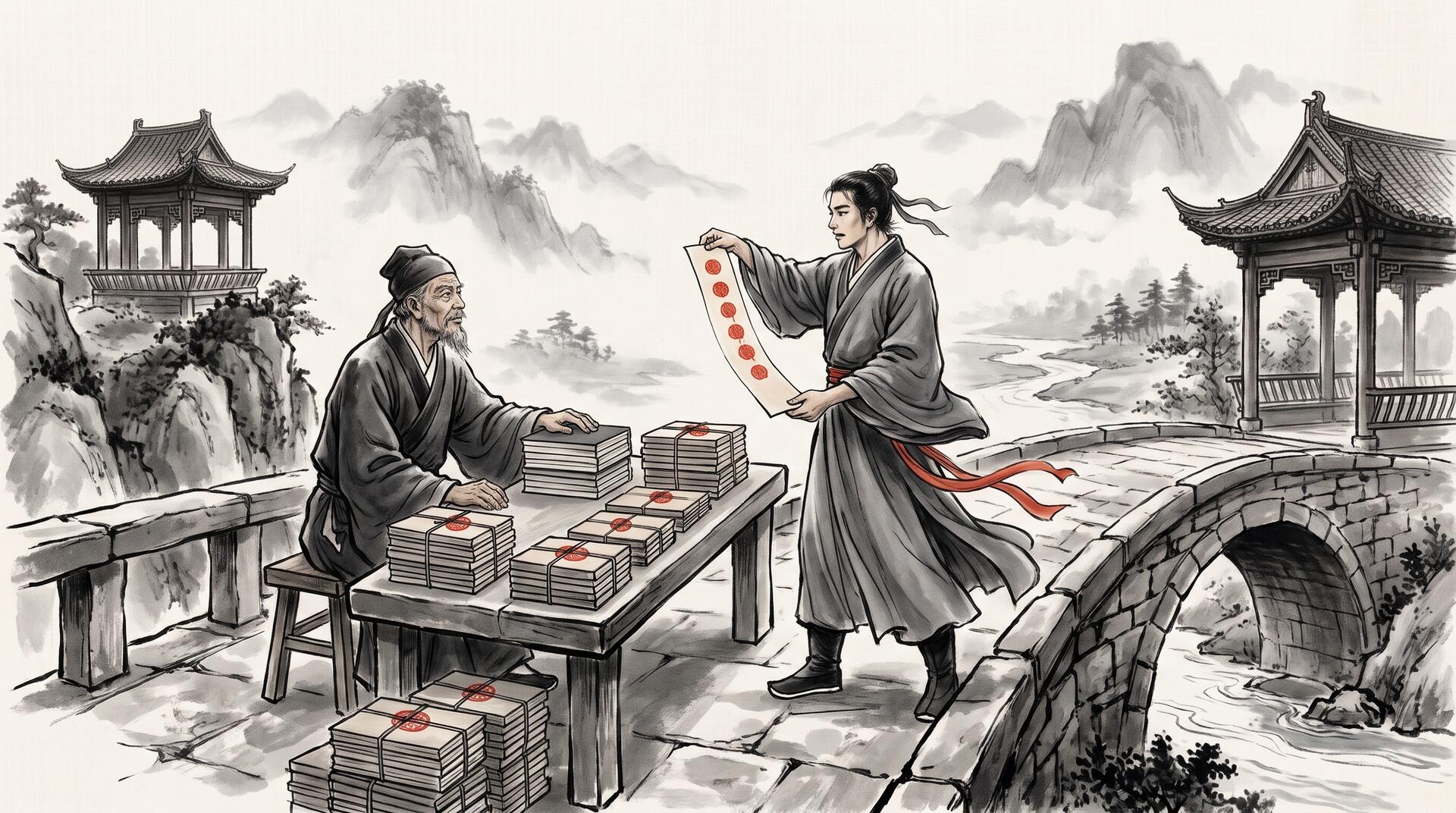
双桥镇中间隔着一条河,河上有一座石桥,桥两头各有一座书楼。
东楼和西楼存的是一模一样的书。这不是铺张,是保险:书楼是木头的,一把火就什么都不剩,所以凡入藏的书都要誊抄两份,一份过桥存到对岸。镇上有条老规矩——两座楼里的书,字字都要对得上。
书少的时候,这规矩不难。每月初一,两个守楼人各抱一摞账本走到桥心,坐在石桌上,从第一册对到最后一册。一天对完,谁也不欠谁。
后来书就多了。
先是全镇的族谱、田契、药方,接着是县里送来的水文簿子、船帮的货单,再后来是书楼自己收的杂记、戏本、乡试墨卷。三十年下来,两座楼里各存十万册。
十万册,两个人坐在桥心对不完。对一遍要九天,所以初一要一直对到初九。而新书每天都在进来——东楼今天收三册,西楼今天补两册——对账从”每月一次”变成了”永远落后”。
落后是真的会出人命的。有一年秋天,东楼的守楼人姓陈,翻到西楼抄错的一味药方:”三两大黄”被抄成了”三两黄”。抄手大概觉得”大黄”是两个词,顺手拆开了。错的那一册已经借出去七天。等陈守楼人渡过河、翻到原本、再渡回来找到借书的人,病人已经吃了六天。
人是救回来了。但陈守楼人在西楼门口站了很久,说了一句话,后来刻在了书楼的梁上:
“我们对账,从来不是为了知道错了哪一册,是为了知道哪一册没错。可这九天的工夫,全花在’没错’上了。”
镇上为此开了一次会。会上有个从京城回来的年轻人姓沈,说了个法子。
第一年:装函。
沈生的法子是:每十册装一函,函上压一枚蜡封。
蜡封不是签押,不是谁的印,是一个数——账房先生把这一函十册的册名、页数、字数、首尾数行,用算盘搅成一个数,刻在蜡上。搅的法子有讲究,全镇只有三个人会,规矩只有一条:十样东西里改一样,搅出来的数必定变;两堆不同的东西搅出同一个数,难如登天。
对账的办法跟着变了。初一那天,两人不再抱账本过桥,各自抱着函号过桥:一万枚函号,对一万枚函号。
一万枚还是太多,但对起来快——不用翻书,只念数。念到不一样的那一枚,两人就往那一函里去;一样的那一枚,翻都不用翻。
一年下来,九天变成了两天。陈守楼人第一次在初一当天过了河、回家吃了晚饭。
第二年:一路压到楼顶。
一万枚印还是太多。沈生说,那就再压一层。
十函装一架,架上压一枚架印——这枚架印不是从十函的书里搅出来的,是从下面那十枚函印里搅出来的。十架装一层,层印从架印里搅;十层为一楼,楼印从层印里搅。十万册,五层,压到最顶上一共只剩一枚”总印”。
为什么敢这么压?因为下面那十枚印已经替那十函的全部内容担保了。改一册书,那一函的印变;那一函的印变,它上面那枚架印跟着变;一路变到总印。一条线,五枚印。
对账就变成这样:
初一一早,两人在桥心各报总印。一样——收摊,回家,一天都不用花。
不一样——才往下问:”你那十枚层印,报一报。”报完,找出不一样的那一层,只往那一层里钻。再往下,报十枚架印;再往下,报十枚函印。五趟,每趟对十个数。
十万册,五趟,五十个数。
那年冬天陈守楼人在梁上又添了一句:”我们不是把对账变快了,是把’什么都没变’这件事变便宜了。”
第三年,出事。
出事在架印上。
西楼新来了个抄手,手脚麻利。他改了一册书,把错字改对,然后把那一函的蜡封重压了一枚——压得很对。但他没往上压。 架印还是旧的,层印还是旧的,总印还是旧的。
于是初一对总印,一样。
陈守楼人心头一松。这一松,就是一年。等到第二年秋上,东楼有人借一部医书,翻到那一函,才发现西楼把一整段抄漏了——漏的那一段里,有”孕妇忌服”四个字。
沈生后来把那枚没往上压的旧印供在了梁下,钉了块牌子:“旧印比没有印更坏。没有印,你会去翻;有旧印,你就不翻了。”
规矩添了一条:改一册,五枚印要一次压到底。压的时候不必重读十万册,只顺着那一条线往上压——五枚印,五炷香。
第四年,又出事。
这回出在”每十册装一函”的”每十册”上。
东楼那年多收了一册戏本,西楼没收到。于是从那一册起,东楼第三函装的是第二十一到三十册,西楼第三函装的还是第二十到二十九册——一册之错,后面所有的函都错位了。
初一报总印,不一样。往下钻,十层全红;再往下,十架全红;再往下……
两人那天从早对到夜,从夜对到第二天中午,翻了三千多函,最后抓到的东西只有一样:那一册戏本。
守楼人蹲在书堆里,说了句大实话:“我们被自己的分法骗了。”
沈生改了分法。函不再按”每十册”分,按书名分:两座楼约定同一条分割线,比如”天字第一号到天字第九十九号为一函”,西楼缺了中间一册,那一函里就空着一位,后面的函绝不挪位。缺书是缺书,错位是错位,两件事不能混。
“按数目分,是拿自己的书当尺子;按名字分,是拿同一把尺子量两边。”
第五年,最后一次。
那枚蜡封用了七十年,一直只刻两个数——最多九十九种。
第七十个年头上,终于撞了:一函十册,和另一函十册,搅出来是同一个数。那一年正好有人动过一册,动了的那一函与没动的那一函,封上了同一枚蜡。
两个数不够。沈生把封换成了十六个数的一长串,蜡条也变长了。有人嫌麻烦,沈生只回了一句:”十六个数,也要搅上万万年才撞一次。你要拿两个数去赌,那不叫放心,那叫运气好。”
后来的规矩,刻在梁上,一共四条:
一、改一册,印要一路压到顶。旧印比无印更坏。
二、分不分卷,按同一条线分。按数目分,一册之差会毁掉一千枚印。
三、印不等,往下钻;印相等,才敢收工。不许只看小印。
四、印只告诉你哪儿不一样,不告诉你谁对。谁对,问押,问日子。
第四条是最后加的。因为有一年两边都动过同一册:东楼改了错字,西楼补了缺行,两边都觉得自己对,两边都压了印,两边的总印不一样——然后两个守楼人站在桥心,谁也说服不了谁。蜡封只承认”不一样”,它不承认”谁是错的”。
到这儿,你大概已经认出来了:这就是 Merkle 树(Merkle tree)与 反熵修复(anti-entropy repair)。
这是什么
Merkle 树是一棵”哈希树”。
叶子节点是每条记录的 哈希(hash,例如 SHA-256):一段内容算出一个固定长度的值,内容改一个字,值就面目全非。中间节点不是记录本身,而是它下面所有子节点的哈希再取哈希,一直合并到根。于是根节点一个值,就替整份数据集担保。
它给你两个性质:
- 一变全变。 改任意一条记录,从叶子到根,路径上每个哈希都变;没被改的分支完全不变。所以一次写入只需重算
log n个哈希,不是n个。 - 同则全同。 两个副本的根哈希相同,则两边内容相同的概率高到可以当事实用;根哈希不同,则一定存在差异——而且顺着不同的分支往下走,能定位到具体哪一条。
反熵(anti-entropy)是副本间后台的”逐渐趋同”:不是客户端读的时候顺手修(那是 read repair),也不是临时兜底(那是 hinted handoff),而是定期把两份数据拿出来比一比、把不一样的对齐。
两者合起来的经典协议是两步:
- 交换根。 根相同,本轮结束——一次网络往返,零数据扫描。
- 根不同,逐层下降。 交换那一个分支的子哈希,只进不同的那一支,直到叶子。差异有
d处时,代价大致是O(d log n),而不是O(n)。
数字上的差距值得摆出来。一百万条键、一千条有差异:
- 全量对比:一百万条键(或一百万条键的摘要)过一遍网络与磁盘。
- Merkle 对比:根一次往返;每层最多十到几十个分支摘要;二十层深度。差异集中时,传输量是”几十 KB 到几 MB”与”几百 MB”的差别。
真实系统里到处都是它:Dynamo / Cassandra / Riak 的 anti-entropy repair 按 token range 各建一棵树;Git 的对象图(tree 对象装的是子对象的哈希,一改文件,一路换到 commit);比特币区块里的交易 Merkle root;IPFS 的 Merkle DAG;ZFS / Btrfs 的校验和树;Certificate Transparency 的 Merkle log(能给你一条”某张证书确实在这份日志里”的 inclusion proof,只带 log n 个哈希);rsync 的分块校验。
三个必须知道的坑,故事里全踩过:
- 树的形状必须对齐。 两边按不同的区间划分,或者一边按”条数”分、一边按”键范围”分,一棵树上的每个节点都会和另一棵树上的节点对不上——这就是”一册之差毁掉一千枚印”。Cassandra 里 token range 不一致引发的 repair 风暴,是这个坑的工业级版本。
- 父哈希必须真的被更新。 增量写入时只更新叶子是灾难:根说”没变”,数据已经变了。这也是为什么某些系统的”校验和树”要放在写路径的同一事务里,而不是事后补算。
- 宽度决定安全边界。 哈希碰撞不是逻辑问题,是概率问题。MD5 已经被构造出碰撞(恶意场景要考虑 collision attack,不只是偶然);两个数位的校验和,防的是手滑,不防对手。
还有一件事,Merkle 树根本不做:它不判谁对。 它只说”这两边不一样”。哪边是准的,要么靠时间戳(last-write-wins)、要么靠版本向量、要么靠 CRDT 的合并语义、要么靠一个被指定为权威的一方。把它当成”自动修好”的机制,就会在冲突上卡死。
为什么重要
因为分布式存储里最贵的操作不是写,是确认”没有不一致”。
- 它让否定结论变便宜。 副本系统的日常是”什么都没发生”。全量对比把 99.99% 的算力和带宽花在证明”一切正常”上;Merkle 把这件事压成一次哈希比较。这是工程上很少见的、量级级别的胜利:
O(n)变O(log n),不是常数优化。 - 它让修复可定位、可分段。 修复不是”把整库传一遍”,而是”找出不同的叶子,只传那些叶子”。带宽从”与数据量成正比”变成”与差异量成正比”——而差异量通常小几个数量级。
- 它让后台修复变成常态而不是事件。 全量修复必须停机、限流、排窗口,于是被一再推迟,于是拓扑变化(扩缩容、迁移、故障重建)之后的不一致越积越深。Merkle 修一轮的成本低到可以天天跑。
- 它的成本模型是诚实的。 每次写入多算
log n个哈希(相对网络与磁盘几乎免费),换来读取时不必验证、修复时可精确打击。这是一个典型的”把成本挪到写路径”的取舍,而写路径本来就是瓶颈最清楚的那一侧。
工程上的顺序建议:
- 先对齐划分。 收缩容、一致性哈希的 token range、分片键区间、时间分区,必须先让两边的”树”长得一样。这一步错了,后面全是噪声。
- 树要小而频繁,不要大而罕见。 整库一棵树(几千万叶子)构建一次要吃几百 MB 内存和大量磁盘 IO。按范围切成很多小树,按轮次分散修复,比一次巨型修复稳得多。
- 把修复和冲突解决分开实现。 用 Merkle 找差异,用 LWW / vector clock / CRDT 决定谁赢。两者混在一起,排查时你会分不清”没找到差异”和”找到了但没敢改”。
回到桥上。陈守楼人那天说的那句话,其实是这一整个数据结构存在的理由——
对账的目的不是找出错误,而是用最小的代价确认没有错误。为了做到这件事,他不去读十万册书,他去读一个由十万册书算出来的数。
隐喻对应表
- 两座书楼各存十万册 → 两份互为副本的数据集(replica)
- 每月初一在桥心逐册对比 → 全量对比扫描,
O(n)的数据与带宽 - 对一遍要九天,而新书天天进来 → 全量比对的速度赶不上写入速度,永远落后
- “为了知道哪一册没错” → Merkle 的核心价值是让否定结论变便宜
- 每十册装一函 → 把数据切成区间(range / chunk),作为树的叶子组
- 账房把十册的册名页数字数搅成一个数 → 对一段内容取 哈希(SHA-256 之类)
- “改一样,数必定变;两堆不同搅出同一个数难如登天” → 哈希的抗碰撞性
- 十函装一架、十架装一层、十层为一楼 → 中间节点:由子节点的哈希再取哈希,逐层合并
- 楼顶只剩一枚总印 → Merkle root,一个值替整份数据集担保
- 改一册,只需顺着一条线往上重压五枚印 → 增量写入只重算
log n个哈希,不是n个 - 初一先各报总印,一样就收摊 → 交换根哈希,一次往返、零扫描
- 不一样才报十枚层印、再报十枚架印 → 只下降进不同的分支,
O(d log n) - 十万册五趟五十个数 → 深度
log₁₀ n,每层只比一个分支的摘要 - 改了一册、只重压函印、没往上压 → 父哈希未更新:根说”没变”,数据已经变了
- “旧印比没有印更坏:没有印你会去翻,有旧印你就不翻了” → 陈旧摘要制造的是虚假信任,比没有校验更危险
- 东楼多收一册,后面所有的函错位 → 两侧划分不一致,树上每个节点都错位
- 翻三千函只抓到一册 → 形状不对齐时,差异会”雪崩”,修复成本退化到接近全量
- 改成按书名(号段)分函,缺册留空位 → 按 key range 划分,插入/删除不移动边界
- 蜡封只有两个数、第七十年撞了 → 校验和位宽不足,碰撞从”不可能”变成”迟早”
- 换成十六个数的一长串 → 加宽哈希(SHA-256),把碰撞压到统计上可忽略
- 两边都改过同一册,蜡封只说不一样,不说谁对 → Merkle 定位差异,但不解决冲突
- 谁对要问押、问日子 → 由 last-write-wins / 版本向量 / CRDT 决定胜者
- 陈守楼人把”对账”重新定义为”确认没有错” → anti-entropy 的工程目标:让”一致”这件事可负担地反复确认
A river ran through Twin Bridge, one stone span across it, and a library stood at each end.
East Library and West Library held the same books. Not extravagance — insurance. The walls were timber, and fire takes everything, so every volume admitted was copied twice, one copy carried across to the far bank. The town’s old rule: the two libraries must match, word for word.
While the collection was small, the rule was easy. On the first of each month the two keepers each carried an armful of catalogues to the middle of the bridge, sat at the stone table, and checked the first volume against the last. Done in a day, neither owing the other anything.
Then the books multiplied.
First the town’s genealogies, land deeds, and prescriptions; then the county’s water-level registers and the boat guild’s manifests; then miscellanies, play scripts, and examination essays the library collected itself. Thirty years on, a hundred thousand volumes in each building.
A hundred thousand, and two men on a bridge cannot finish. A full check took nine days, so the first of the month ran to the ninth. And new books arrived daily — three into the East, two into the West — so the checking went from “monthly” to “permanently behind.”
Being behind kills people. One autumn, the East keeper, Chen, found a prescription West had miscopied: “three ounces of rhubarb” had become “three ounces of yellow.” The copyist had apparently taken the two-character drug name for two words and split it. That copy had been lent out seven days earlier. By the time Chen crossed, found the original, crossed back, and tracked down the borrower, the patient had been taking it for six days.
The patient lived. But Chen stood a long while at West’s door and said a sentence that was later carved on the beam:
“We never checked in order to learn which volume was wrong. We checked to learn that the others were right. And all nine days went into ‘right.’”
The town held a meeting. At it, a young man recently returned from the capital, named Shen, proposed something.
Year one: the case.
Shen’s proposal: ten volumes to a case, and each case sealed in wax.
The seal was not a signature or anyone’s chop. It was a number — the accountant took the ten volumes’ titles, page counts, character counts, and first and last lines, stirred them together on the abacus into one number, and cut that number into the wax. The stirring had a rule, and only one: change any one of the ten things and the number must change; stir two different sets and get the same number, and the sky has fallen.
Checking changed with it. On the first of the month the two men no longer hauled catalogues across; they carried case seals. Ten thousand numbers against ten thousand numbers.
Still too many — but fast, because nobody opened a book, they just read numbers aloud. Where the numbers differed, they went into that case. Where they matched, they did not turn a page.
A year of that turned nine days into two. For the first time, Chen crossed on the first of the month and was home for supper.
Year two: all the way to the roof.
Ten thousand seals was still too many. Shen said: press another layer.
Ten cases to a rack, and each rack sealed — not from the books beneath it, but from the ten case seals beneath it. Ten racks to a floor, floor seals from rack seals; ten floors to a building, building seals from floor seals. A hundred thousand volumes, five layers, and at the very top a single “master seal.”
Why dare to press it that way? Because those ten case seals already vouched for everything in those ten cases. Change one volume and that case’s seal changes; that case’s seal changes and the rack seal above it follows; and so on to the master. One line, five seals.
Checking became this:
On the first of the month the two men recited master seals at the bridge. Same — pack up, go home, no day spent at all.
Different — only then go deeper. “Read me your ten floor seals.” Find the one floor that differs, and go into that floor alone. Then ten rack seals. Then ten case seals. Five rounds, ten numbers each.
A hundred thousand volumes: five rounds, fifty numbers.
That winter Chen added a line to the beam: “We did not make checking faster. We made ‘nothing changed’ cheap.”
Year three: the failure.
The failure was in the rack seals.
A new copyist came to West, quick-handed. He corrected a volume, fixed the error, then re-pressed that case’s wax seal — correctly. But he did not press upward. The rack seal stayed old, the floor seal stayed old, the master seal stayed old.
So on the first of the month the master seals matched.
Chen relaxed. The relaxation lasted a year. The next autumn a borrower at East opened a medical volume and found that West had dropped an entire passage — and in that passage were the four characters: not for the pregnant.
Shen had that unfollowed old seal hung under the beam with a plaque: “An old seal is worse than no seal. With no seal you go and look. With an old seal you don’t.”
A rule was added: change one volume and the five seals must be pressed all the way up in one pass. Not by re-reading a hundred thousand volumes — just up that one line. Five seals, five sticks of incense.
Year four: the failure again.
This time in the words “ten volumes to a case.”
That year East acquired one extra play script and West did not. From that volume onward, East’s third case held volumes twenty-one to thirty, while West’s third case still held twenty to twenty-nine — one volume wrong, and every case after it shifted.
On the first of the month the master seals differed. Down they went: all ten floors red; all ten racks red; down again…
They worked from morning to night and night to the next noon, opened more than three thousand cases, and the only thing they caught was that one play script.
The keeper sat down in the piles and said the plain truth: “Our own dividing fooled us.”
Shen changed the dividing. Cases would no longer be “ten volumes each” but by title: the two libraries agreed on the same cut lines — “Heaven-series numbers one through ninety-nine form one case.” If West was missing a volume in the middle, that slot stayed empty and no case after it moved. A missing book is a missing book and a shifted boundary is a shifted boundary; the two must not be confused.
“Divide by count and you use your own shelf as the ruler. Divide by name and both sides are measured with one ruler.”
Year five: the last one.
The wax seal had been in use seventy years with only two digits — ninety-nine possible values.
In the seventieth year, two collided: one case of ten volumes and another case of ten volumes stirred to the same number. That same year someone had edited one of them, and the edited case and the unedited case were sealed identically.
Two digits were not enough. Shen replaced the seal with a long string of sixteen digits and the wax strips grew longer. Someone complained about the trouble. Shen said only this: “Sixteen digits would take ten thousand ages to collide. Gamble on two and that is not confidence, that is luck.”
The rules were carved on the beam, four of them:
One: change one volume and press the seal all the way to the top. An old seal is worse than none.
Two: divide the cases by one shared line. Divide by count and one volume ruins a thousand seals.
Three: seals differ, go deeper; seals match, you may stop. Never stop at a small seal alone.
Four: a seal tells you where you differ, not who is right. For who is right, ask the chop, ask the date.
The fourth came last. One year both sides had touched the same volume — East corrected a wrong character, West restored a missing line — each certain it was right, each having pressed its seals, and the master seals differed. Then the two keepers stood at the middle of the bridge and could not persuade each other of anything. Wax admits “different.” It does not admit “wrong.”
By now you have probably recognized it: this is the Merkle tree and anti-entropy repair.
What it is
A Merkle tree is a hash tree.
Leaves are the hashes of individual records (SHA-256 and friends): run content through a function and get a fixed-length value, and change one character and the value is unrecognizable. Internal nodes are not records at all but hashes of their children’s hashes, merged upward to the root. One root value then vouches for the entire dataset.
Two properties fall out:
- Change one, change all above it. Edit any record and every hash on the path from that leaf to the root changes, while untouched branches stay identical. So one write costs
log nrehashes, notn. - Equal means equal. Two replicas with the same root are identical with a probability high enough to treat as fact; different roots guarantee a real difference — and walking only the differing branches localizes it.
Anti-entropy is the background convergence between replicas: not fixing in the read path (read repair), not the temporary safety net (hinted handoff), but a periodic comparison that reconciles the two.
The classic protocol is two steps:
- Exchange roots. Same root, done for this round — one round trip, zero scanning.
- Different roots, descend. Exchange that branch’s child hashes, enter only the differing child, repeat to the leaves. With
ddifferences the cost is roughlyO(d log n)rather thanO(n).
The numbers are worth stating. One million keys, one thousand of them diverged:
- Full comparison: a million keys (or their digests) across the network and off disk.
- Merkle comparison: one root exchange, then tens of branch digests per level, about twenty levels deep. Tens of KB to a few MB instead of hundreds of MB.
Real systems are full of it: anti-entropy repair in Dynamo / Cassandra / Riak builds one tree per token range; Git’s object graph (tree objects hold their children’s hashes, so one file edit cascades to the commit); Bitcoin’s transaction Merkle root; IPFS’s Merkle DAG; ZFS and Btrfs checksum trees; Certificate Transparency’s Merkle log (which yields an inclusion proof that a certificate is in the log, carrying only log n hashes); rsync’s block checksums.
Three traps every implementer hits, all three of which the story walked into:
- The shapes must align. Partition the two sides differently — one by record count, the other by key range — and every node in one tree faces a mismatched node in the other. That is “one volume ruins a thousand seals.” Cassandra repair storms caused by inconsistent token ranges are the industrial version.
- Parent hashes must actually be updated. Updating only the leaf on an incremental write is a catastrophe: the root says unchanged while the data has changed. Which is why a checksum tree belongs in the same transaction as the write, not recomputed later.
- Width sets the safety boundary. Hash collision is not a logic problem, it is a probability problem. MD5 collisions have been constructed (in an adversarial setting think collision attack, not accident); a two-digit checksum defends against typos, not opponents.
And one thing a Merkle tree never does: it does not decide who is right. It only says the two sides differ. Which side wins is decided by timestamps (last-write-wins), version vectors, CRDT merge semantics, or an authority you designate. Treat it as “repairs itself” and you deadlock on conflict.
Why it matters
Because in distributed storage the expensive operation is not writing — it is confirming that nothing is inconsistent.
- It makes negative results cheap. A replicated system’s ordinary day is “nothing happened.” Full comparison spends 99.99% of CPU and bandwidth proving all is well; Merkle compresses that into one hash comparison. It is a rare order-of-magnitude win:
O(n)toO(log n), not a constant-factor tweak. - It makes repair localizable and divisible. Repair is not “ship the whole database” but “find the differing leaves and ship those.” Bandwidth goes from proportional to the dataset to proportional to the divergence — usually orders of magnitude smaller.
- It turns background repair into routine instead of an event. Full repair demands downtime, throttling, and a change window, so it keeps getting postponed, so inconsistency deepens after every topology change — scaling, migration, failure recovery. A Merkle round is cheap enough to run daily.
- Its cost model is honest. Each write pays
log nhashes, nearly free next to network and disk, and buys unverified reads and surgical repair. That is the standard trade: move cost onto the write path, where the bottleneck is best understood.
Engineering order of operations:
- Align the partitioning first. Shard ranges, consistent-hashing token ranges, partition-key intervals, time windows — the two “trees” must have the same shape before anything else matters. Get this wrong and everything downstream is noise.
- Prefer small and frequent over large and rare. One tree over an entire store (tens of millions of leaves) costs hundreds of MB of memory and heavy IO to build. Chop into many small trees and repair in staggered rounds; that is far steadier than one giant repair.
- Implement repair and conflict resolution separately. Use Merkle to find the differences, and LWW / vector clocks / CRDTs to decide the winner. Fuse them and you will not be able to tell “found nothing” from “found something and did not dare change it” while debugging.
Back on the bridge. What Chen said that day is the whole reason this data structure exists —
the point of checking is not to find errors, but to confirm there are none at the lowest possible cost. To do that he does not read a hundred thousand volumes. He reads one number computed from a hundred thousand volumes.
Metaphor mapping
- Two libraries of a hundred thousand volumes each → two replicas of one dataset
- Checking volume by volume on the bridge each month → full comparison scan,
O(n)data and bandwidth - Nine days per pass while new books arrive daily → full comparison cannot keep up with the write rate; permanently behind
- “To learn that the others were right” → the Merkle payoff is making negative results cheap
- Ten volumes to a case → splitting data into ranges (chunks) as leaf groups
- The accountant stirring ten volumes’ details into one number → hashing a chunk of content (SHA-256 and friends)
- “Change one thing and the number must change; two different sets colliding, the sky has fallen” → hash collision resistance
- Ten cases to a rack, ten racks to a floor, ten floors to a building → internal nodes: the hash of child hashes, merged upward
- One master seal at the top → the Merkle root, one value vouching for the whole dataset
- Re-pressing only five seals up one line after an edit → incremental writes recompute
log nhashes, notn - Reciting master seals first; if equal, go home → exchange roots; one round trip, zero scanning
- Only then reciting ten floor seals, then ten rack seals → descending into differing branches only,
O(d log n) - Five rounds, fifty numbers for a hundred thousand volumes → depth
log₁₀ n, one branch of digests per level - One volume changed, its case re-pressed, nothing pressed upward → parent hashes not updated: the root says unchanged while the data changed
- “An old seal is worse than no seal — with no seal you look, with an old seal you don’t” → stale digests manufacture false trust, worse than no verification at all
- One extra volume at East shifts every later case → mismatched partitioning on the two sides; every node lines up against the wrong node
- Three thousand cases opened to catch one volume → misalignment makes divergence avalanche, degrading repair toward full comparison
- Dividing by title (number ranges) with gaps left empty → partition by key range; inserts and deletes do not move boundaries
- A two-digit seal colliding in year seventy → checksum width too small turns collision from impossible into eventual
- Replacing it with sixteen digits → widening the hash (SHA-256) to push collision into statistical irrelevance
- Both sides edited one volume; the seal says different, never says wrong → Merkle localizes divergence but does not resolve conflict
- Asking the chop and the date for who is right → last-write-wins / version vectors / CRDTs pick the winner
- Chen redefining checking as confirming nothing is wrong → the anti-entropy goal: make consistency affordable to re-confirm, again and again