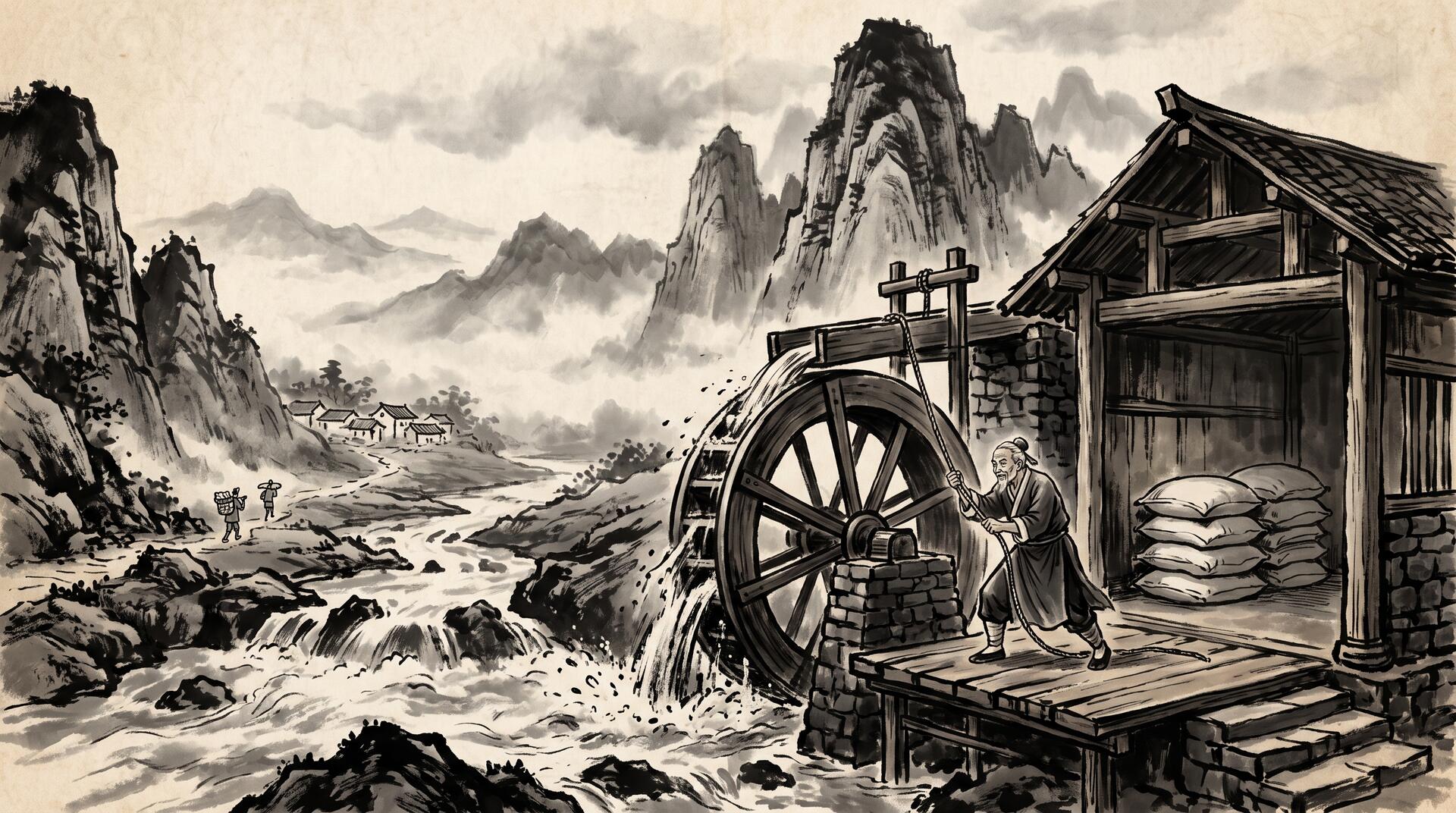
深山溪谷里有一座老磨坊,靠一架水车推着石磨,把山民送来的麦子磨成面粉。磨坊主老计守了这磨坊三十年,早年立下一条规矩:磨坊角落堆放空布袋的地方就那么大,最多摆得下十二只——磨出来的面粉必须当场装袋,装满的袋子堆在墙边,等每日午后骡队上山来驮走。
水车转得快,石磨就磨得快,麦子进得快、面粉自然也出得快。可布袋是死数:十二只用完,就没地方再装下一斗面粉了。老计想了个法子:磨坊闸口边上拴着一根绳,一头连着溪水上游那扇木闸。他每磨完一袋,就去墙边数一眼空布袋还剩几只——数目富余时,闸门开得足足的,水车呼呼转,磨得飞快;一旦空布袋只剩两三只,他立刻拽一把绳子,把闸门收窄一半,水流小了,水车慢了,石磨也就跟着慢下来,磨出来的面粉自然少了,绝不会比布袋能装的更多。等骡队一到,驮走满袋、腾出空布袋,他才把绳子松开,闸门重新开大,磨坊恢复原来的速度。
隔壁溪谷也有座磨坊,主人图省事,从不管布袋够不够——磨出来的面粉不管墙边袋子满没满,照样一个劲儿往外冒。布袋堆满那天,面粉没处装,只能眼睁睁看着白花花的面粉直接撒在磨坊的泥地上,混着尘土,一袋也救不回来。
还有一座磨坊,主人心疼粮食,咬牙不肯让面粉沾地——布袋不够就现编,面粉能堆多高就堆多高,墙边的面粉山越垒越高。某天夜里,那面粉山终于压塌了搭面粉的木架子,连带着半间磨坊都被埋了,骡队第二天来了,发现要挖三天才能把磨坊重新挖出来。
老计的磨坊从没出过这两档子事。它不快,但从不撒粮,也从不塌方。
——到这儿你大概已经认出来了:那根从布袋数目一路牵回水闸的绳子,讲的其实是 backpressure(背压)机制——下游根据自己实际的消费/处理能力,主动向上游发出信号,让上游放慢生产速度,而不是选择丢弃数据,或者放任缓冲无限膨胀。
概念解释
Backpressure 是流式处理和分布式系统里管理”生产快于消费”这类速率失配的核心手段。它的关键在于:让_下游把自己的真实容量告诉上游_,上游据此调节速率,形成一个反馈闭环,而不是两种更粗暴的替代方案——load shedding(下游满了就直接丢数据,比如老计邻居那座磨坊撒在地上的面粉)或 unbounded buffering(来者不拒地无限堆积,直到内存/磁盘耗尽,系统整体崩溃,比如压塌的面粉山,对应现实中常见的 OOM)。TCP 的_滑动窗口_(receiver 主动广播自己还能接收多少字节)、Reactive Streams 里 subscriber 显式调用 request(n) 按需拉取、Kafka 消费者的_拉模式_(consumer 主动 poll,broker 从不硬推)、gRPC/HTTP2 的 flow control window,都是同一种机制的不同实现。Kubernetes 里最直接的例子是 API Priority and Fairness(APF):kube-apiserver 给每个优先级维护有限长度的请求队列,一旦队列逼近上限,就直接对新请求返回 429(Retry-After),把”我快撑不住了”这句话明确传回给客户端,而不是硬扛着把自己拖垮,也不是把请求丢在一边装作没看见。
隐喻对应表
- 老计的磨坊 → 数据处理系统里的一段 producer → consumer 链路
- 石磨磨面粉的速度 → 生产者/上游的_发送速率_
- 墙边最多十二只的空布袋 → 有限的_缓冲区/队列容量_(bounded buffer)
- 数空布袋还剩几只 → 消费者/下游持续汇报自己的_剩余容量_
- 布袋不够时拽绳子收窄水闸 → 下游向上游发出的 backpressure 信号,上游据此_主动降速_
- 骡队驮走满袋、腾出空位后重新放开闸门 → 下游消费掉积压后,恢复正常速率(对应 window 重新放大)
- 隔壁磨坊面粉直接撒地 → load shedding:容量耗尽时选择丢弃数据
- 心疼粮食硬堆的面粉山最终压塌 → unbounded buffering 导致资源耗尽、系统崩溃(对应 OOM)
- kube-apiserver 对逼近队列上限的请求返回 429 → Kubernetes API Priority and Fairness 对客户端实施的显式 backpressure
Deep in a mountain valley stood an old mill, its water wheel turning a grindstone that ground the villagers’ wheat into flour. The miller, Old Ji, had tended it for thirty years and set one rule early on: the corner of the mill where empty flour sacks were stacked could hold at most twelve — no more. Every sack of flour ground had to be bagged on the spot, and the filled sacks piled against the wall, waiting for the mule train that came up the mountain each afternoon to haul them away.
The faster the wheel turned, the faster the grindstone worked, the faster wheat went in and flour came out. But the sacks were a fixed number: once all twelve were full, there was nowhere to put the next batch of flour. Old Ji’s solution was a rope tied from the millhouse to a wooden sluice gate upstream. After bagging each sack, he’d glance at the wall and count how many empty sacks remained. When there were plenty, he left the gate wide open and let the wheel spin fast, grinding at full speed. But the moment only two or three empty sacks were left, he’d pull the rope, narrowing the gate by half — less water, a slower wheel, a slower grindstone, and less flour coming out, never more than the sacks could hold. Once the mule train arrived, hauled off the full sacks, and freed up space, he’d release the rope, open the gate wide again, and the mill returned to full speed.
A neighboring valley had its own mill, but its owner didn’t bother tracking sacks — the mill kept grinding at full tilt no matter how full the wall was. The day the sacks filled up, there was nowhere left to put the flour, and it simply spilled onto the dirt floor, mixing with soil and dust, every bit of it ruined.
Yet another mill’s owner couldn’t bear to waste a single scoop of grain — when sacks ran out, he’d just pile the loose flour higher and higher against the wall, refusing to let any of it touch the ground. One night, the growing mountain of flour finally collapsed the wooden rack holding it up, burying half the millhouse. When the mule train arrived the next day, it took three days of digging just to unearth the mill again.
Old Ji’s mill never suffered either fate. It wasn’t the fastest — but it never spilled a grain, and it never collapsed.
—By now you’ve probably recognized it: that rope running from the sack count back to the sluice gate is backpressure — a mechanism where the downstream signals its actual capacity to the upstream, causing the upstream to slow production, rather than dropping data or letting an unbounded buffer grow without limit.
What it is, and why it matters
Backpressure is the core technique for handling rate mismatches between producers and consumers in streaming and distributed systems. Its essence: the downstream tells the upstream its real capacity, and the upstream throttles itself accordingly, forming a feedback loop — instead of the two cruder alternatives: load shedding (dropping data once the downstream is full, like the flour spilled on the neighboring mill’s floor) or unbounded buffering (accepting everything indefinitely until memory or disk runs out and the whole system crashes, like the collapsed flour pile — the real-world equivalent of an OOM). TCP’s sliding window (the receiver advertises how many more bytes it can accept), Reactive Streams’ explicit request(n) pull model, Kafka’s pull-based consumer model (the consumer polls; the broker never force-pushes), and gRPC/HTTP2’s flow control window are all different implementations of the same idea. In Kubernetes, the clearest example is API Priority and Fairness (APF): kube-apiserver maintains a bounded queue for each priority level, and once a queue nears its limit, it responds to new requests with 429 (Retry-After) — explicitly telling the client “I’m nearly at capacity,” rather than silently absorbing the load until it collapses, or quietly dropping requests without a word.
Metaphor mapping
- Old Ji’s mill → a producer → consumer link in a data-processing system
- The grindstone’s grinding speed → the producer’s/upstream’s send rate
- The wall space for at most twelve empty sacks → a bounded buffer/queue capacity
- Counting the remaining empty sacks → the consumer/downstream continuously reporting its remaining capacity
- Pulling the rope to narrow the gate when sacks run low → the backpressure signal from downstream to upstream, causing the upstream to throttle itself
- The mule train hauling off full sacks, freeing space, gate reopened → the downstream draining the backlog and the rate returning to normal (the window reopening)
- The neighboring mill’s flour spilling onto the floor → load shedding: dropping data once capacity is exhausted
- The other mill’s flour pile collapsing under its own weight → unbounded buffering leading to resource exhaustion and system crash (an OOM)
- kube-apiserver returning 429 as a queue nears its limit → Kubernetes’ API Priority and Fairness applying explicit backpressure to clients