▶ Cinematic fable · Watch on YouTube ▶ 影片版寓言 · 在 YouTube 观看
大运河与长江交汇的广济港,是天下粮纲与盐铁漕运的咽喉要道。
港中辟出一处极为宏阔的泊位群,唤作“万艘湾”。顾名思义,沿江修筑了整整一万座石砌栈桥,常年系泊着一万艘大小货船。每艘货船停进泊位,或是卸粮,或是修葺篷帆,但究竟何时装卸完毕、何时具备扬帆开闸的资格,唯有船家自己知晓。
早年间,漕运司设了一位专司验关放行的水门提调官。 提调官手下有一套祖传的排查之法,唤作“循江点卯”: 老提调官怀揣一份足有三尺厚的牛皮总名册,上面密密麻麻登记着一万艘船的名号与泊位。每隔半个时辰,漕运总台要核实一次“可有货船装毕待发”。 提调官便得挽起裤脚、换上草鞋,顶着烈日从第一座栈桥一路狂奔至第一万座栈桥。 他每到一艘船前,便扯着嗓子狠敲乌篷:“可装毕否?可待检否?” 九千九百九十八位船家都在呼呼大睡,或是慢条斯理地补网。提调官直跑得双腿打颤、口吐白沫,一整趟奔袭耗去一个多时辰,才在一万只船舱里堪堪找出两艘已然装毕挂出绿旗的运粮船。 提调官喘着粗气将这两艘船的名号记在纸上,飞奔回总台交差。 然而在他狂奔回程的路上,第四百号泊位的客船刚刚满载,第七千号泊位的盐船刚刚系缆——等提调官瘫在石凳上刚缓过气,总台又下一道催命急令:“再查一次!”提调官只能咬碎钢牙,再次提鞋下水,把那一万座栈桥从头到尾重新挨个猛敲一遍。
后来江上商贸愈盛,泊位从一万扩至三万。老提调官硬生生跑断了腿,总台收到的回执反倒越来越迟滞,整条大江水路拥堵瘫痪,怨声载道。
新任提调官沈挚履职第一天,便让人在库房里搜出了一万卷生丝细绳和一架八角紫铜挂铃。 他当场颁下一套“引水铜铃新规”:
第一着,“立架挂铃,一入永记”。 万艘湾高耸的望江楼上,立起一面巨大的硬木分格架,每一格对应江中一座泊位。 货船初次入泊时,船家只须在楼下登账一次。水兵从楼头垂下一道极韧的涂桐油生丝细绳,一头系在望江楼上专属的铜铃摆锤上,另一头固定在货船桅杆的小铜环中。从此船泊在何处、何号归于何处,楼上硬木架一次录定,再无须天天抄写万船名册。
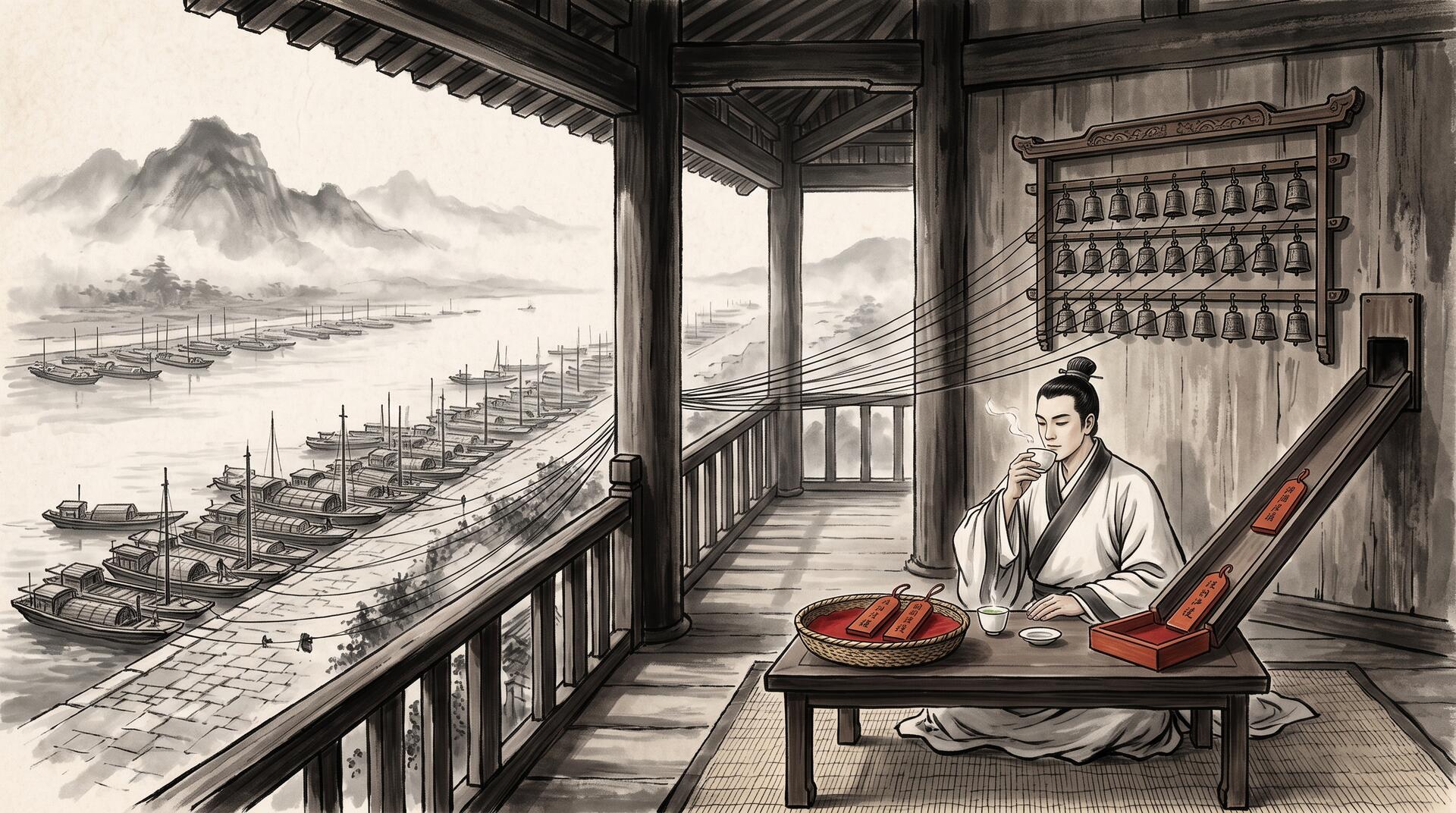
第二着,“有动自响,落牌入篓”。 立完挂铃,沈提调脱下草鞋,换上干爽的儒衫,安坐望江楼正厅,气定神闲地沏上一壶龙井。 水兵们再也不必下水狂奔。一万艘货船在江风中沉浮,只要船舱未装满,细绳便纹丝不动; 一旦某艘船装卸完毕,船家伸手在桅杆铜环上一拉——生丝细绳一绷,望江楼硬木架上对应的铜铃当即发出一声清脆的“当啷”脆响,铃下悬挂的一枚刻着泊位号的朱漆小木牌,顺着竹滑道“啪嗒”一声,精准落入案头铺着红绒的柳条编篓中!
第三着,“按篓提牌,瞬息而决”。 总台令下:“报可发之船!” 沈提调连眼皮都不用眨一下,慢条斯理地伸手探入案头的柳条编篓中——篓子里不多不少,正静静躺着方才落下的两枚朱漆木牌。 他拾起木牌,报出字号,准予开闸放行,随后顺手将空牌重新挂回铃架。 那余下九千九百九十八艘沉睡在江雾中的闲船,望江楼从头到尾连看都未曾多看一眼,耗时不过半盏茶工夫。
自此,纵使万艘湾泊位扩至十万之众,望江楼上依然松风竹韵、茶香袅袅。 江上舟子皆叹服: “奔走万艘,逐舟相问,是愚工困己;引线挂铃,待振而动,是巧夺天工。 无事静默如渊,有发落子无声。”
— — —
这是什么
——到这儿你大概已经认出来了:这正是 Linux 操作系统乃至现代高性能网络编程中最具划时代意义的技术分水岭:epoll 与 I/O 多路复用(I/O Multiplexing),以及它所击破的传奇性 C10K 难题。
在传统的网络模型中(如早期的 select 和 poll),操作系统监测套接字(Socket)可读可写的方式,正如那位顶着烈日挨船敲门的提调官:
每次应用程序调用 select(),都必须将整整一万个文件描述符(File Descriptor / FD)的列表从用户空间(User Space)全量内存拷贝进内核空间(Kernel Space)。内核无法得知究竟哪一个 FD 来了数据,只能以 $O(N)$ 的复杂度,对这一万个 FD 挨个进行暴力线性轮询与状态检查。扫完一遍发现只有两三个连接活跃,内核在数据结构上做标记,再将庞大的数组全量拷贝回用户态,应用程序还得再用一个 $O(N)$ 的循环去逐个找出到底是谁能读写。
当并发连接数从几百暴涨到一万(C10K)甚至十万时,机器的所有 CPU 时间几乎全部耗尽在“从用户态到内核态的内存拷贝”和“对海量空闲连接的无效死循环扫描”中,吞吐量断崖式暴跌。
Linux 2.6 正式引入的 epoll 架构,通过分离控制与等待,以空间换时间彻底颠覆了这种低效范式:
epoll_create与epoll_ctl(立架挂铃与一次性注册): 内核在内存中建立一个epitem事件管理实体,底层采用红黑树(Red-Black Tree)来高效维护全部被监听的 FD,并依托等待队列在操作系统底层注册硬件中断回调函数。应用程序只需通过epoll_ctl在连接建立时EPOLL_CTL_ADD一次,FD 便常驻内核,彻底终结了每次轮询都全量拷贝 FD 列表的巨大开销。ep_poll_callback(有动自响与回调入队): 网卡收到网络数据包并产生硬件中断时,驱动程序将数据送入 Socket 接收缓冲区,操作系统直接触发预挂的回调函数ep_poll_callback。该回调函数绝不扫描全局红黑树,而是以 $O(1)$ 的速度,将产生了就绪事件的那个 FD 直接追加插入到一个双向链表——就绪链表(Ready List /rdllist)中(即故事中掉进竹篓的朱漆木牌)。epoll_wait(按篓提牌与 $O(1)$ 极速唤醒): 当进程调用epoll_wait()时,它只负责检查那个就绪链表是否为空。若为空则睡眠让出 CPU;一旦网卡中断将就绪项填入链表,进程被瞬间唤醒,直接拷贝出这有限的几个活跃事件返回。无论系统维护着一万还是十万个长连接,只要此时只有两个连接有数据,epoll_wait的耗时就只与“活跃连接数”(Active Connections)相关,而与“总连接数”(Total Connections)完全解耦!
为什么重要
epoll 是构筑现代互联网整个高并发世界的隐形发动机:
- 破除 C10K 瓶颈,赋能事件驱动引擎:
Nginx 能够以极低的内存打垮 Apache Prefork/Worker 架构,Redis 能够以单线程轻松斩获十万 QPS,Node.js 和 Netty(Java)能够支撑天量并发长连接,底层完全依赖于
epoll的事件驱动(Reactor Pattern)机制。它将操作系统处理 I/O 的时间复杂度从 $O(N)$ 降维打击至 $O(1)$。 - 边缘触发(ET)与水平触发(LT)的灵活控制:
epoll提供了水平触发(Level-Triggered,只要缓冲区有数据就持续通知)与边缘触发(Edge-Triggered,仅在状态从未就绪变为就绪的“电平跳变瞬时”通知一次)两种模式。ET 模式配合非阻塞 I/O,能最大限度减少事件被重复唤醒的系统调用开销,是极致性能调优的利器。 - 极低的上下文切换与内存颠簸: 通过消灭用户态到内核态的频繁大块内存复制,并让工作线程在没有事件时进入深度的系统级睡眠,现代高并发服务器能够在数十万连接常驻的情况下,依然保持 CPU 占用率平稳如水。
隐喻对应表
- 广济港一万座石砌栈桥与系泊货船 → 操作系统管理的一万个并发套接字连接(Socket FDs)
- 老提调官烈日下狂奔敲门与厚总簿 → 传统
select/poll每次全量拷贝 FD 数组与 $O(N)$ 暴力轮询 - 望江楼上的硬木分格架 → 内核中用于管理被监听 FD 的红黑树数据结构(RB-Tree)
- 水兵挂绳入架一次登定 →
epoll_ctl(EPOLL_CTL_ADD)将 FD 注册到内核事件表 - 货船装毕扯动桅杆铜环生丝细绳 → 网卡收到数据触发硬件中断与内核回调(
ep_poll_callback) - 案头铺着红绒的柳条编篓与朱漆小牌 → 内核维护的双向就绪事件链表(Ready List /
rdllist) - 提调官信手探篓只取落牌 →
epoll_wait以 $O(1)$ 复杂度直接返回就绪事件数组 - 江中沉睡万艘而望江楼安闲煮茶 → 面对海量闲置长连接时事件驱动模型的零无谓 CPU 开销
- 江船扩至十万而回执瞬发 → 从根本上击破高并发长连接下的 C10K / C1000K 扩展性瓶颈
At the strategic junction where the Grand Canal converged with the Yangtze River stood the magnificent port of Guangji, the vital throat through which all grain tributes, salt flotillas, and merchant barges flowed.
Within the harbor lay an immense anchorage known across the provinces as the Bay of Ten Thousand Moorings. True to its name, ten thousand stone piers stretched along the embankments, perpetually harboring ten thousand river craft of every shape and timber. Each barge lay tied to its stone bollard, unloading grain or mending canvas sails. Yet none but the boatmen themselves knew the precise moment when their holds were fully laden, ready for clearance through the water gates.
In earlier reigns, the Bureau of Waterways appointed a dedicated harbor magistrate to inspect and clear vessels for transit. This elderly official relied upon an ancestral method known as the Canal-Side Roll Call: Under his arm, the magistrate tucked an immense leather ledger, three fingers thick, cataloging the names and berths of all ten thousand ships. Every half-hour, the central dispatch tower demanded an accounting: “Which vessels are fully laden and awaiting inspection?” The weary magistrate had to hike up his hemp robes, lace on straw sandals, and sprint beneath the blazing sun from the first pier all the way to the ten-thousandth. At every single boat, he beat his wooden staff against the cabin eaves, shouting into the hull: “Laden yet? Ready for clearance?” Nine thousand nine hundred and ninety-eight boatmen would be fast asleep in their hammocks or leisurely mending fishing nets. By the time the magistrate finished sprinting the two leagues of riverbank, trembling with exhaustion and parched with thirst, an hour and a half had elapsed, merely to discover two solitary barges flying green pennants of readiness. Gasping for breath, the magistrate inscribed their numbers on parchment and raced back to the watchtower to report. Yet on his return sprint, a passenger vessel at Berth 400 had just secured its final cargo, and a salt junk at Berth 7,000 had just dropped its gangplank. Before the poor official could wipe the sweat from his brow, the dispatch tower thundered another command: “Check them again!” Gritting his teeth, the magistrate had to tighten his sandals and run the entire gauntlet of ten thousand piers all over again.
As canal commerce boomed, the harbor expanded from ten thousand berths to thirty thousand. The old magistrate ran himself crippled, yet clearance dispatches arrived slower with each passing moon. The entire riverway choked in gridlock, and the cries of frustrated merchants echoed across the river.
On his first morning in office, the newly appointed magistrate, Shen Zhi, bypassed the running sandals entirely. From the harbor storeroom, he requisitioned ten thousand spools of raw oiled silk cord and a towering octagonal rack of tuned bronze bells. Before the assembled harbormasters, he instituted the Statute of the Waterway Bells:
First, “One Registry Upon the Rack; Recorded Once for All Seasons”. Within the grand watchtower overlooking the bay, Shen Zhi erected an immense hardwood cabinet, its face carved into ten thousand square compartments, each corresponding to an exact stone berth along the river. When a barge first arrived in the harbor, it registered at the tower gate once. Sentries lowered a slender, incredibly strong silk cord soaked in tung oil, tying one end to the clapper of the bronze bell inside the boat’s numbered compartment, and affixing the other end to a small brass ring on the barge’s mast. From that day on, the boat’s location and identity were anchored in the central register once, eliminating the futile chore of recopying ten-thousand-row ledgers on every inspection cycle.
Second, “Action Rings the Bell; The Token Drops into the Basket”. With the cords strung, Magistrate Shen cast off his straw sandals, donned a dry scholar’s robe, and sat serenely in the pavilion, brewing a kettle of fragrant Longjing tea. The sentries never ran a single step down the piers. Ten thousand river craft drifted in the river mist; so long as their cargo holds remained unfinished, their cords hung completely motionless. The moment a boat completed its loading, the boatman reached out and gave the brass ring on his mast a sharp tug. The silk cord tautened across the water, the tuned bronze bell in the watchtower chimed with a crisp clang, and a small vermillion wooden plaque stamped with the boat’s berth number detached from its latch, sliding smoothly down a bamboo chute and landing with a gentle clatter into a red-felt wicker basket beside Shen’s desk!
Third, “Draw From the Basket; Decision in an Instant”. When the dispatch tower sounded its horns: “Report ready vessels!” Magistrate Shen did not even lift his eyes from his tea. He reached his fingers into the wicker basket on his table. Resting inside were precisely the two vermillion plaques that had dropped moments before. He read their numbers aloud, signaled the water gates to open, and handed the plaques back to the sentry to be reset upon the rack. As for the remaining nine thousand nine hundred and ninety-eight vessels slumbering along the riverbank, the watchtower never wasted a single glance upon them. The entire accounting was concluded in the span of three sips of hot tea.
Ever after, though the harbor grew to hold a hundred thousand vessels, the watchtower remained a sanctuary of quiet composure, filled with the aroma of tea and the music of mountain breezes. The canal boatmen sang in admiration: “To sprint past ten thousand hulls, begging each for word, is the folly of exhausted men; To string the cord and let the bell report is the triumph of master design. In silence, it rests deep as the abyss; upon motion, the token falls without a sound.”
— — —
What it is
By now the architecture is unmistakable: this is the epochal dividing line of modern operating systems and high-concurrency systems programming: Linux epoll, Event-Driven I/O Multiplexing, and the legendary conquest of the C10K Problem.
In legacy UNIX network programming (represented by select() and poll()), the operating system checked socket read/write readiness exactly like the exhausted harbor magistrate running down the piers:
On every single iteration of the event loop, the application had to copy the entire array of monitored File Descriptors (FDs)—often ten thousand or more—from user space memory into kernel space memory. The kernel, possessing no internal notification mechanism, was forced to execute a brute-force linear scan across all ten thousand FDs ($O(N)$ complexity), querying the device queue of each socket one by one. After discovering that only two or three connections had incoming packets, the kernel marked flags in the array, copied the massive memory block all the way back to user space, and forced the application to run yet another $O(N)$ loop to locate the active sockets.
When concurrent connections grew from hundreds to ten thousand (the classic C10K threshold) or a hundred thousand, the CPU spent 100% of its cycles on repetitive kernel memory copies and wasteful scans of idle sockets, causing throughput to collapse into paralysis.
Introduced in Linux 2.6, the epoll architecture decoupled subscription from waiting, trading a fraction of kernel memory to reduce event notification complexity from $O(N)$ to $O(1)$:
epoll_createandepoll_ctl(The Central Bell-Rack and One-Time Registration): The kernel instantiates an eventpoll context in memory, using a balanced Red-Black Tree (RB-Tree) to track all monitored file descriptors with $O(\log N)$ insertion, deletion, and lookup efficiency. When an application accepts a new connection, it invokesepoll_ctl(EPOLL_CTL_ADD)once. The FD remains registered in the kernel, permanently eliminating the catastrophic overhead of copying FD arrays on every poll cycle.ep_poll_callback(Hardware Interrupts and the Ready List): When the Network Interface Card (NIC) receives an incoming packet, it triggers a hardware interrupt. The network stack delivers the payload into the socket buffer and immediately invokes a pre-attached kernel callback function:ep_poll_callback. This callback never touches the global Red-Black Tree; instead, it executes in $O(1)$ time, inserting the ready FD directly onto a doubly linked list known as the Ready List (rdllist) (the wicker basket in the fable).epoll_wait(Drawing From the Basket and $O(1)$ Instant Wakeup): When an application thread callsepoll_wait(), it simply inspects whether the Ready List contains elements. If the list is empty, the thread sleeps gracefully, yielding the CPU. The instant an interrupt populates the Ready List, the thread wakes and receives only the small subset of active events. Whether the server manages ten thousand or a million concurrent connections, if only two connections receive data,epoll_waitprocesses only those two events. Performance is decoupled from total connections and tied solely to active traffic!
Why it matters
epoll is the invisible thermodynamic engine powering the modern internet’s real-time infrastructure:
- Vanquishing C10K and Powering the Event-Driven Revolution:
The asynchronous, event-driven architectures that dominate the web—Nginx outperforming Apache Worker, Redis achieving 100,000 QPS on a single thread, Node.js (
libuv), Netty in Java, and Tokio in Rust—are all built directly upon the foundation ofepoll’s non-blocking Reactor pattern. - Edge-Triggered (ET) vs. Level-Triggered (LT):
epolloffers two operational semantics: Level-Triggered (LT, default, alerting repeatedly as long as buffer data remains unread) and Edge-Triggered (ET, alerting exactly once when socket state transitions from unready to ready). Paired with non-blocking sockets, ET mode minimizes redundant context switches and system call churn, providing the ultimate lever for high-throughput network engineering. - Radical Reduction in Context Switches and Cache Thrashing: By abolishing massive user-to-kernel memory copies and allowing idle worker threads to enter deep sleep without active polling, modern servers maintain steady sub-millisecond latencies and cool CPU temperatures while keeping hundreds of thousands of long-lived WebSockets or gRPC streams open.
Metaphor mapping
- Ten thousand stone piers and moored river barges → Ten thousand concurrent socket file descriptors (FDs)
- Old magistrate sprinting down piers with the heavy leather roll → Legacy
select/pollrepeatedly copying FD arrays and running $O(N)$ linear scans - Hardwood compartment rack in the watchtower → In-kernel Red-Black Tree (RB-Tree) tracking monitored file descriptors
- Attaching the silk cord to the mast and rack once →
epoll_ctl(EPOLL_CTL_ADD)registering an FD into the kernel once - Boatman pulling the cord upon loading completion → Network packet arrival triggering hardware interrupt and
ep_poll_callback - Red-felt wicker basket collecting dropped wooden plaques → In-kernel doubly linked Ready List (
rdllist) - Magistrate drawing plaques from the basket without looking at berths →
epoll_waitreturning ready events in $O(1)$ time - Ten thousand slumbering barges while the magistrate sips tea → Zero CPU waste when managing massive pools of idle connections
- Harbor expanding to 100,000 vessels without throughput collapse → Conquering the C10K and C1000K scalability barriers