▶ Cinematic fable · Watch on YouTube ▶ 影片版寓言 · 在 YouTube 观看
荆襄九郡的水路枢纽江陵关,横跨在大运河与大江的咽喉上。
每年开春,自巴蜀顺流而下的盐船、江南运往京畿的绸缎画舫、江北贩运药材的乌篷船在此汇聚,千帆竞发,桅杆如林。朝廷户部每隔三年要在此清核一次”天下商贾实数”——不是查验总共过了多少船次,而是要精准算出:在这三十天汛期里,究竟有多少不同字号的商贾真正经过了关口。
往年的核算,是江陵关所有司吏的噩梦。
按照老规矩,水门两侧支起八座大帐,里面堆满了红漆樟木大柜。每当一条货船靠岸,商贾必须呈上自家的青铜商号私印。帐中司吏铺开一丈多长的桑皮纸总名册,一边翻查一边高喊:”苏州同庆号!本月可曾记过?”另一名司吏便在浩如烟海的卷帙中逐行核对。如果未曾记录,便饱蘸浓墨添上一笔;若已记过,便挥手放行。
头五天尚能勉强支撑。到了第十天,名册已经写满了整整六十卷,翻查一个名字需要耗费三柱香。到了第二十天,十余条主航道全被滞留的船只堵死,排队的客商绵延三十里,怨声载道。司吏们累得双眼赤红,手指抽筋,遇到阴雨天,湿气晕开浓墨,名字黏成一团,更是错漏百出。
那一年,总督水运的费司务(人称费夫子)奉旨接管关卡。他看着堆积如山的账册和江面上暴躁的船夫,做了一件让满关吏员目瞪口呆的事:他下令把所有樟木柜与空白名册全部锁进库房,一张纸也不准搬出来。
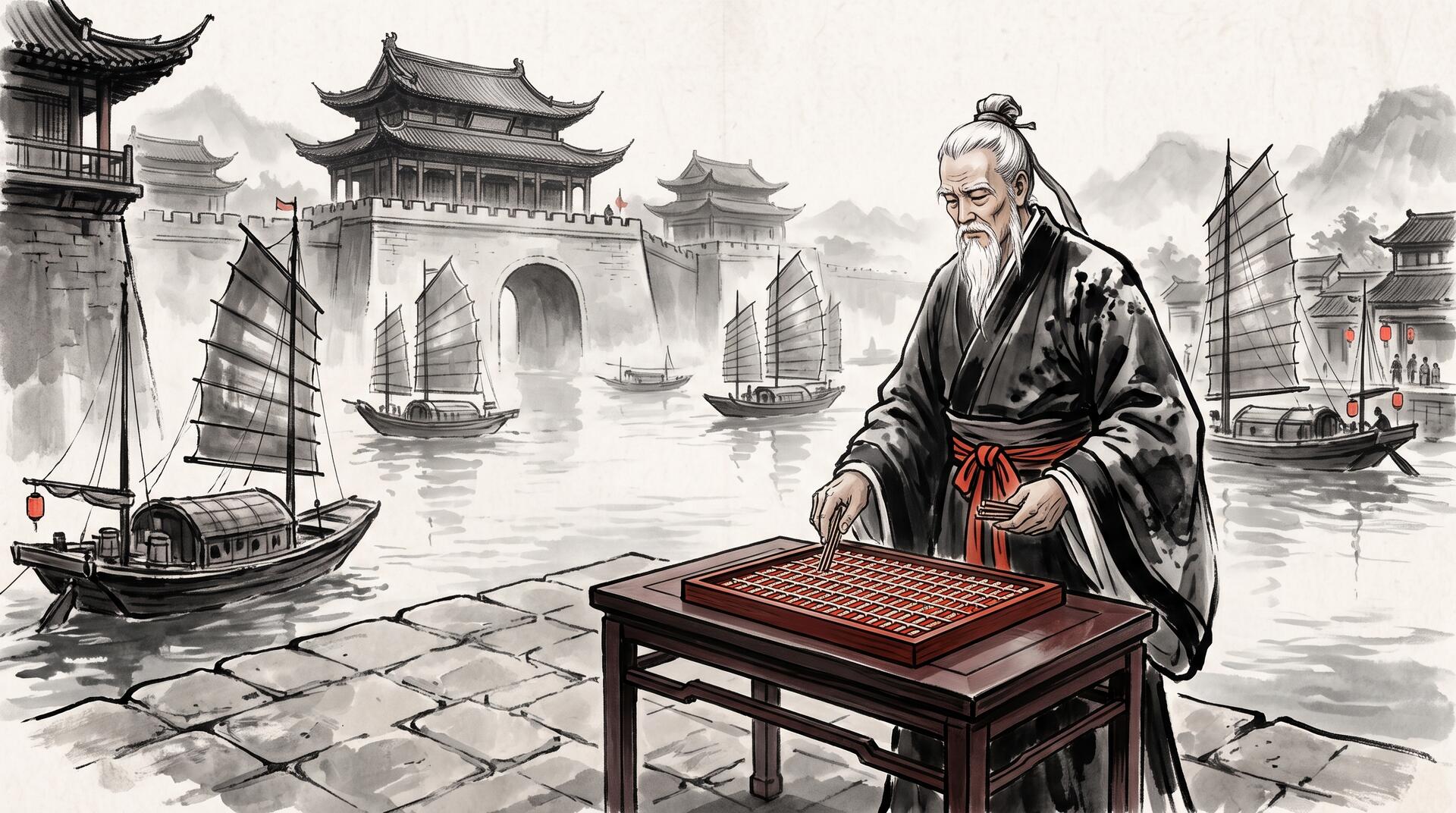
他在每道水门前只摆设了一件物什——一块长宽不过两尺、整块红檀木雕凿而成的方形浅盘。盘内规整地凹刻着一千零二十四个拇指大小的陶制小格,每格下方刻着一枚细小的编次;盘旁放着一个盛着铜钱的青铜小钵。
“夫子,不记商号名字,朝廷问起几十万行商基数,我们拿什么回禀?”年轻的录事慌忙问道。
费夫子抚须微笑道:”朝廷问的是’来了多少家’,又不是’张三还是李四’。既然只要人数,何苦把他们的祖宗三代与字号抄在纸上?”
新法随即推行。客商靠岸,依然呈递商号青铜印。但录事不再翻看任何名册,而是把印章在一方刻满易经六十四卦回形纹的铜规上一印。铜规的齿轮轻转,瞬间将印文的笔画笔顺化为一串长长的算筹数码。
这串数码的使用极尽奇巧: 最前面的一小段数码,化作一千零二十四以内的序号,直接决定了这枚印章归属于檀木盘上的哪一个具体陶格; 而剩下的数码,则决定了商贾掷钱的规矩——录事并不真的让客商逐枚抛掷,而是顺着数码推算这枚印章在掷钱时”能连续出现多少次铜钱背面,才首次撞见正面”。
在常理中,抛掷一枚平正的铜钱,连续掷出一次背面的概率是一半;连续掷出两次背面的概率是四分之一;若能连续掷出十次背面才遇到正面,那是千人中才难得一见的奇事;若能连掷二十次背面,非数十万人不可得。
录事只做一件事:望向对应的陶格。如果该格里原本插着的竹签数字,小于这枚商号算出的”连续背面次数”,便拔掉旧签,换上一根刻着更大数字的新竹签;如果小于或等于,则原样不动,抬杆放行。
整套流程不过一眨眼的工夫,货船扬帆而去。水门前再无半点停滞。
然而关中的老吏们私下里冷汗涔涔。一名老录事忧心忡忡地找费夫子进言:”夫子,这法子全凭概率机巧!万一清晨第一艘船上的商贾祖坟冒青烟,恰好掷出了连续十六次背面,我们岂不是立刻误以为已经有六万家商贾过关了?”
费夫子哈哈大笑:”一人掷钱,或有狂幸;千格分流,天地归衡!”
他指着檀木盘解释道:”若只有一个格子,一个鸿运当头的狂徒确实会把天捅个窟窿。但我辟出了一千零二十四个陶格!天下的商号依其印文,被打散分流到这一千零二十四个格子里。某一个格子里固然可能撞上侥幸的狂徒,但绝大多数格子记录的都是真确的潮起潮落。”
三十天汛期转瞬即逝。江南塞北的万艘舟楫早已入海入江,水门前水波平静,既无滞留,亦无纸山墨海。
户部按察使带着两百名核算官乘官船按期抵关。按察使步入大堂,见堂上空空荡荡,案头只有那块小小的千格檀木盘,顿时面色铁青:”费司务,本官调拨数十万文公帑供你采买纸张笔墨,如今卷宗安在?商贾大籍安在?”
费夫子神色自若,取出一面精巧的铜尺与一柄特制的倒数平衡秤。
他并未将这一千零二十四个陶格中的竹签数字简单相加取均——因为狂幸的极大值依然会把寻常均值拉向虚妄。他取的是每一格数字的”倒数之和”(Harmonic Mean,调和平均):狂幸掷出的极大值在倒数面前微如芥子,反倒是那些沉稳的大多数主导了衡器。铜尺滑过,再乘上一枚朝廷通用的规正基数。
“回按察使,”费夫子在宣纸上写下一个数字,”本月过关的不同商贾,实为四十八万九千一百家。”
按察使拍案大怒,认定这是荒诞不经的戏法。他下令将沿江八道税卡所有的船税关税存根全部起获,命两百名精算官通宵达旦地逐张拼合比对、剔除重复商号。
整整核查了二十一天,算盘打断了数十把,两百名精算官累得面无人色,终于呈上了最终的红旗大账:
除去重复出入者,江陵关本月实到不重复商号,四十八万六千二百一十家。
与费夫子仅凭一块两尺檀木盘测算的结果相比,误差不足千分之六!
满堂皆惊,按察使握着账卷,半晌说不出话来。整整两百人花费大半个月、耗费数十车文书才理清的庞然巨流,竟早已被一千零二十四个小小的竹签数字,举重若轻地尽收于方寸之间。
——到这儿你大概已经认出来了:这就是计算机科学与海量数据系统中名震天下的基数估计算法——HyperLogLog(简称 HLL)。
这是什么
在大数据与分布式系统领域,统计海量数据流中不重复元素的个数(即统计 Cardinality / 基数,例如网站独立访客 UV、分布式追踪中的唯一链路数、网络设备中的独立 IP 数)是一个基础且代价极其高昂的操作(Count-Distinct Problem)。
传统的精确做法是使用哈希集合(Hash Set)或位图(Bitmap):每来一个元素,先计算哈希值并存储下来,遇到重复项则忽略。当去重基数达到数亿甚至数十亿时,这种做法需要消耗数十吉字节(GB)的高速内存,分布式汇总时的网络传输更是不堪重负。
法国计算机科学家 Philippe Flajolet 等人于 2007 年提出的 HyperLogLog 彻底颠覆了这一现状。它是一种极度精巧的概率型流式数据结构,其核心洞察建立在伯努利过程(Bernoulli Process)与概率统计之上:
- 哈希均匀散列:将输入的每个元素通过高品质哈希函数映射为均匀分布的二进制位串(通常为 64 位)。每一位出现 0 或 1 的概率皆为 50%。
- 分桶分流(Stochastic Averaging):取哈希值的前 $p$ 位作为分桶索引(bucket index),将海量数据均匀分散到 $m = 2^p$ 个独立寄存器(registers)中(例如 $p=14 \implies m=16384$ 个桶)。
- 前导零位置(Leading Zeros):对哈希值剩余位,观察从左向右数遇到的第一个 ‘1’ 出现的位置(记为 $\rho$)。连续出现 $k$ 个 0 的概率是 $1 / 2^{k+1}$。如果观测到的最大前导零个数为 $k$,则意味着该桶大约见识过了 $2^{k+1}$ 个不重复的样本。
- 寄存器只留峰值:每个桶仅维护一个极小的数字——记录该桶见过的最大前导零位置 $\rho_{max}$。64 位的哈希值,最大前导零不超过 64,只需 6 个比特($2^6 = 64$)即可存下一个桶的值!16384 个桶总共仅需 $16384 \times 6 \text{ bits} \approx 12 \text{ KB}$ 内存!
- 调和平均抑制异常值(Harmonic Mean):为了消除极少数幸运元素(碰巧投出极长前导零)带来的巨大估计偏差,HLL 放弃了算术平均,改用调和平均数(倒数的平均值)。调和平均对极小值(即倒数后的大权重)敏感,天然抑制了离群极大值的干扰。最后通过精密的无偏修正系数 $\alpha_m$ 与小基数/大基数偏差修正,得出最终基数估计值。
对于 $m=16384$ 的典型配置,HyperLogLog 的标准相对误差仅为 $\frac{1.04}{\sqrt{m}} \approx 0.81\%$,却将内存开销从数以 GB 计压缩到了不可思议的 12 KB!
为什么重要
HyperLogLog 被誉为现代数据基础设施中最具美感与实用价值的算法发明之一。它是云原生大数据与高吞吐系统的基石组件:
- 惊世骇俗的内存压缩比:在 Redis 中,一个原生
HyperLogLog键(PFADD/PFCOUNT,以 Philippe Flajolet 的缩写命名)最多仅占用固定的 12 KB 内存,就能以 0.81% 的标准误差估算高达 $2^{64}$(约 1800 亿亿)个不重复元素的基数。相比之下,存放一亿个 64 位整型的精确哈希集合需要近 800 MB 内存,压缩比超过数万倍。 - 天生完美的分布式合并能力(Mergeable Sketch):HLL 属于一种单调半格(monotone semilattice)。两个独立收集的 HLL 结构进行并集计算(
PFMERGE,对应集合的 $A \cup B$),无需任何原始数据,只需将两者对应桶中的数值按位置取最大值即可!这意味着在 MapReduce、ClickHouse、Apache Spark、Presto、Trino 或 Google BigQuery 等分布式 OLAP 引擎中,各个计算节点可以在本地并行流水线式累加,最终仅需传输几个 KB 的桶状态进行按位最大值规约,即可瞬时完成跨数百台服务器的全局去重统计。 - 彻底解放实时流计算:在网络流量安全监控(如 DDoS 攻击中独立源 IP 探测)、监控系统的唯一活跃实体追踪、电商广告的海量 UV 计数中,系统吞吐量往往高达每秒数百万事件。HLL 的单次插入只需一次哈希与一次位运算更新,时间复杂度恒定为 $O(1)$,且没有锁争用与扩容重平衡,使实时海量指标计算成为可能。
从你每天打开的社交媒体阅读计数、分布式追踪系统(如 OpenTelemetry/Jaeger)的高基数分析,到云数仓里的 APPROX_COUNT_DISTINCT(),背后都在无声运转着那块仅需微末内存的千格陶盘。
隐喻对应表
- 浩瀚水路汇聚的万千商贾货船 → 待去重统计的海量数据流(input stream of high-cardinality items)
- 查核三十天内经过的”不同字号”商贾 → 统计独立元素个数的基数问题(Count-Distinct / Cardinality Estimation)
- 堆满八座大帐的樟木大柜与六十卷总名册 → 传统的精确哈希集合或位图(Hash Set / Bitmap,内存与磁盘消耗随基数线性暴增)
- 两尺见方的千格红檀木陶盘 → HyperLogLog 的内存寄存器数组(registers array, $m=2^p$)
- 易经六十四卦回形纹铜规转出的数码 → 均匀高品质的哈希函数(uniform hash function,将任意输入转化为离散二进制位串)
- 数码前段决定的陶格序号 → 哈希值前导分桶位(bucket index bits,将样本随机分流至各寄存器)
- 数码后段决定的连续掷出背面的次数 → 哈希值剩余位中的前导零位置(leading zeros,代表以 $1/2^k$ 概率发生的稀有度)
- 陶格中只留峰值的竹签 → 每个寄存器仅保存观测到的最大前导零数值($\rho_{max}$,每个桶仅耗 6 bit 空间)
- 录事担忧单个幸运客商抛出极多背面毁掉全局 → 概率统计中单个桶遭遇离群极大值的抽样风险(outlier skew)
- 千格分流归衡与倒数平衡秤(调和平均) → 调和平均数(Harmonic Mean,抑制极端极值影响,保障全局估计稳健)
- 最终仅凭两尺檀木盘精准测算四十八万商流 → HLL 以微小固定常数级内存(12 KB)实现极致精度的基数估计
Jiangling Pass, the hydraulic crossroad of the Nine Commanderies, spanned the narrow throat where the Grand Canal converged with the mighty Yangtze River.
Every spring, when the snowmelt surged, salt barges drifting down from Shu, flower-boats laden with Suzhou silks bound for the imperial capital, and black-awning skiffs carrying northern medicines converged beneath the water gates. Thousands of sails crowded the riverway, their masts dense as winter bamboo. Every three years, the Ministry of Revenue dispatched imperial commissioners to conduct a grand audit: not to tally the total traffic of passing boats, but to calculate with rigorous precision how many distinct merchant houses traversed the pass during the thirty-day flood tide.
In past audits, this reckoning was an inescapable nightmare for every clerk stationed at the pass.
By ancient statute, eight grand pavilions were erected along the wharves, packed to the rafters with red-lacquered camphor chests. Whenever a barge moored, the merchant presented his bronze trade seal. Inside the pavilion, scribes unfurled mulberry-bark scrolls ten feet long, shouting across the room: “Tongqing House of Suzhou! Has it been inscribed this moon?” Scribes buried within towering rows of dossiers would spend frantic minutes combing line by line through thousands of records. If unrecorded, they dipped horsehair brushes in thick soot-ink to enter the title; if already entered, they waved the vessel through.
For the first five days, order tenuously held. By the tenth day, the scrolls numbered sixty volumes, and verifying a single merchant consumed three incense sticks of time. By the twentieth day, the main navigational channels were hopelessly strangled with idling vessels. The convoy of waiting barges stretched for thirty li downriver, boiling with fury and despair. Clerks developed bloodshot eyes and cramped fingers; when torrential rains struck, the humidity smeared the fresh ink into illegible stains, plunging the registry into chaos.
That spring, Chief Bailiff Fei—revered by the watermen as Master Fei—was appointed to command the water gates. Gazing upon the mountain of ledgers and the seething sea of boatmen, he issued an edict that stunned every clerk in the province: he ordered every single camphor chest and blank ledger locked away in the fortress vaults. Not a single slip of parchment was permitted on the docks.
Before each water gate, he installed only a single apparatus: a square, two-foot tray carved from aged red sandalwood. Inside the tray rested one thousand and twenty-four thumb-sized ceramic pockets arranged in an exquisite grid, each inscribed with a minute numerical rune. Beside each tray sat a bronze bowl holding a handful of polished coins.
“Master,” a young scribe gasped in horror, “if we record neither name nor clan, how shall we answer to the imperial inspectors when they demand the reckoning of half a million merchants?”
Master Fei stroked his white beard with a serene smile: “The Son of Heaven asks ‘how many distinct houses came’, not ‘was it Zhang or Li’. When cardinality alone is demanded, why must we carve every ancestor’s lineage upon our scrolls?”
The new rite commenced at dawn. When a merchant vessel moored, the master still presented his bronze trade seal. But the scribes consulted no rolls. Instead, they pressed the seal into a bronze template engraved with the sixty-four hexagrams of the Book of Changes. A geared mechanism whirled softly, instantly translating the seal’s calligraphic contours into a long sequence of numerical rods.
The destiny of these numbers was devilishly ingenious: The leading digits of the sequence, bounded within one thousand and twenty-four, determined which exact ceramic pocket on the sandalwood tray claimed custody of this merchant; The remaining digits governed the coin-tossing trial: the scribe did not physically make the traveler flip coins, but rather deduced from the sequence how many consecutive “tails” the seal would yield before striking its first “heads.”
By the laws of nature, flipping a fair coin yields a single tail half the time. Two consecutive tails occur once in four trials. A unbroken run of ten tails before a head is a marvel seen only once in a thousand tosses; an unbroken streak of twenty tails requires the trials of hundreds of thousands.
The scribe did only one task: he glanced at the designated pocket. If the small bamboo tally stick currently standing in that pocket bore a number smaller than the consecutive tails produced by this seal, he plucked out the old stick and inserted a new one bearing the higher count. If the pocket’s existing number was equal or greater, he did nothing at all. He raised the gate rope, and the boat sailed on.
The entire process took less than a breath. Vessels glided past the barrier like leaves upon a rapid brook. The water gate was clear.
Yet behind closed doors, the veteran scribes broke out in cold sweats. One elder approached Master Fei with furrowed brows: “Master! This method rests entirely upon the capricious whims of luck! What if the very first merchant at daybreak enjoys extraordinary ancestral fortune and happens to roll sixteen tails in a single breath? Shall we not instantly hallucinate that sixty thousand houses have passed our gates?”
Master Fei laughed heartily: “A single man may be blessed with wild luck; a thousand pockets will never conspire in a lie!”
He gestured toward the sandalwood tray: “Were there but one pocket, a lucky rogue would indeed tear the heavens asunder. But I have partitioned the river’s flow into one thousand and twenty-four independent pockets! By their seals, the merchants of the four seas are scattered uniformly across these pockets. While one pocket may be deceived by a stroke of fortune, the vast multitude of pockets reflects the true, unvarnished tide of commerce.”
The thirty-day flood tide slipped by. The fleets of Jiangnan and the northern steppes had long sailed into lakes and oceans. The water gates stood tranquil—free of blockages, free of mountains of ink-stained paper.
The Imperial Commissioner of the Revenue arrived on his flagship, accompanied by two hundred imperial auditors. Sweeping into the great hall, the commissioner found it empty of ledgers. Upon the mahogany table sat only the lone sandalwood tray with its thousand pockets. His countenance darkened with fury: “Bailiff Fei! The court disbursed tens of thousands of strings of cash for your papers and scribes! Where are the grand rolls? Where are the dossiers of the merchants?”
Master Fei remained undisturbed. From a silk sleeve, he produced a calibrated bronze slide-rule and a counterbalanced reciprocal scale.
He did not calculate the simple arithmetic average of the numbers upon the thousand bamboo tallies—for the extreme fortune of a rare lucky streak would distort a normal average into fantasy. Instead, he measured the sum of their reciprocals—the Harmonic Mean. Before a reciprocal, an inflated streak of luck shrank into insignificance, while the steady, disciplined majority anchored the scale. The bronze slider glided smoothly, multiplied by the calibrated universal constant of the tray.
“My Lord Commissioner,” Master Fei inscribed a single figure upon a silk banner, “the distinct merchant houses traversing Jiangling Pass this flood moon number four hundred and eighty-nine thousand, one hundred.”
The commissioner slammed his fist upon the table, denouncing the figure as sorcery and fraud. He ordered every tax receipt and checkpoint counterfoil impounded from eight garrison stations along the river, and commanded his two hundred auditors to tally, cross-examine, and eliminate every duplicate merchant by hand.
For twenty-one agonizing days, two hundred auditors labored from dawn till midnight until their abacus beads wore smooth and their faces turned pale as ash. At long last, they presented the final ledger:
Deducting all repeat passages, the exact count of unique merchant houses was four hundred and eighty-six thousand, two hundred and ten.
Compared with Master Fei’s calculation derived from a single two-foot wooden tray, the difference was less than six-tenths of one percent!
The great hall fell into awed silence. The commissioner clutched the parchment, struck dumb with wonder. The ocean of commercial traffic that had taken two hundred men half a month and wagonloads of paper to unravel had been captured with effortless grace inside one thousand and twenty-four tiny bamboo counters, resting quietly within the palm of a hand.
By now you’ve probably recognized it: this is the celebrated cardinality estimation algorithm in computer science and distributed systems—HyperLogLog (or HLL).
What it is
In large-scale data engineering and distributed systems, determining the number of unique items in a high-volume stream (calculating Cardinality, such as daily unique visitors (UV), unique trace IDs in distributed telemetry, or distinct IP addresses in networking) is known as the Count-Distinct Problem—and doing so exactly is astronomically expensive.
The traditional exact approach relies on a Hash Set or Bitmap: every incoming element is hashed, compared against stored values, and recorded if novel. When cardinality reaches hundreds of millions or billions of items, this approach demands tens of gigabytes of expensive RAM and causes massive network bottlenecks when merging results across distributed nodes.
Introduced in 2007 by French computer scientist Philippe Flajolet and his colleagues, HyperLogLog overturned this paradigm. It is an exquisitely designed probabilistic streaming data structure grounded in the mathematical principles of the Bernoulli Process:
- Uniform Hashing: Every input element is passed through a high-quality 64-bit hash function, producing a uniformly distributed stream of binary bits where each bit has an equal 50% probability of being 0 or 1.
- Stochastic Averaging (Bucketing): The first $p$ bits of the hash value serve as a bucket index, partitioning the vast data stream uniformly across $m = 2^p$ independent registers (e.g., $p=14 \implies m=16384$ registers).
- Leading Zeros: In the remaining bits of the hash, the algorithm finds the position of the first ‘1’ bit (denoted as $\rho$). Observing $k$ consecutive leading zeros has a probability of $1 / 2^{k+1}$. If the maximum observed run of zeros in a bucket is $k$, that bucket has likely witnessed approximately $2^{k+1}$ distinct items.
- Peak-Only Registers: Each bucket stores only a single tiny integer—the maximum leading zero count observed so far ($\rho_{max}$). For a 64-bit hash, the count cannot exceed 64, requiring only 6 bits ($2^6 = 64$) per register! An array of 16,384 registers requires a mere $16384 \times 6 \text{ bits} \approx 12 \text{ KB}$ of memory!
- Harmonic Mean for Outlier Suppression: To protect against rare lucky items that happen to roll abnormally long runs of zeros, HLL abandons the arithmetic mean and instead computes the harmonic mean (the reciprocal of the average of reciprocals). The harmonic mean naturally dampens extreme outliers. Multiplying by a bias-correction constant $\alpha_m$ and applying small/large range corrections yields the final cardinality estimate.
With $m=16384$ registers, HyperLogLog achieves a standard relative error of just $\frac{1.04}{\sqrt{m}} \approx 0.81\%$, while compressing memory consumption from gigabytes down to a breathtaking 12 KB.
Why it matters
HyperLogLog is celebrated as one of the most elegant and practically transformative algorithms in modern data architecture. It forms the backbone of modern cloud analytics and high-throughput monitoring:
- Astounding Memory Compression: In Redis, an HLL key (
PFADD/PFCOUNT, named in honor of Philippe Flajolet) is capped at exactly 12 KB of memory, yet can estimate cardinalities up to $2^{64}$ (approximately $1.8 \times 10^{19}$) distinct items with an 0.81% error margin. In contrast, an exact hash set holding 100 million 64-bit identifiers requires nearly 800 MB of RAM—a compression ratio exceeding tens of thousands to one. - Effortless Distributed Merging (Mergeable Sketch): Mathematically, HyperLogLog forms a bounded semilattice. To compute the union of two independent HLL sketches ($A \cup B$ via
PFMERGE), no raw data is needed; one simply takes the element-wise maximum of corresponding registers across the two arrays! In distributed query engines like ClickHouse, Apache Spark, Trino, Presto, or Google BigQuery, worker nodes can aggregate billions of records locally in parallel, shipping only lightweight 12 KB summaries over the network to compute exact global unions in milliseconds. - Liberating Real-Time Stream Analytics: In DDoS defense (detecting unique attack source IPs), user activity tracking across edge CDNs, and telemetry ingestion (OpenTelemetry metrics), event volumes routinely exceed millions per second. Inserting an item into an HLL requires only a single hash and a single bitwise comparison—an $O(1)$ operation completely free of locks, dynamic resizing, or cache evictions.
From the real-time viewer counters on streaming platforms to APPROX_COUNT_DISTINCT() in modern cloud data warehouses, that quiet thousand-pocket sandalwood tray continues to reckon the boundless tides of data with mere grains of memory.
Metaphor mapping
- The converging fleet of merchant barges on the waterways → high-volume incoming data stream (input stream of high-cardinality items)
- Auditing distinct merchant houses over thirty days → the count-distinct problem (Cardinality Estimation)
- Camphor chests and sixty volumes of mulberry-paper ledgers → traditional hash sets or bitmaps (Hash Set / Bitmap, whose memory scales linearly with unique items)
- The two-foot red sandalwood tray with a thousand ceramic pockets → the array of registers (registers array, $m=2^p$)
- The geared hexagram template translating seals to numbers → a uniform, high-quality hash function (uniform hash function)
- The leading digits directing each merchant to a specific pocket → the bucket index bits (bucket index, stochastic partitioning across registers)
- The remaining digits dictating consecutive tails before a head → leading zeros in the hash suffix (leading zeros, geometric rarity of $1/2^k$)
- The bamboo tally stick recording only the peak streak in each pocket → registers storing only the maximum observed leading zeros ($\rho_{max}$, 6 bits each)
- The fear of a lucky merchant throwing sixteen tails and corrupting the count → outlier variance caused by stochastic variance in individual buckets (outlier skew)
- Balancing the thousand pockets with the reciprocal scale (harmonic mean) → the harmonic mean (Harmonic Mean, penalizing extreme outliers to secure stable estimates)
- Reckoning half a million merchants within a fraction of a percent using one small tray → HLL achieving 0.81% error on massive datasets using a fixed 12 KB footprint