▶ Cinematic fable · Watch on YouTube ▶ 影片版寓言 · 在 YouTube 观看
蜀道难,难于上青天。
在剑门绝壁与秦岭群山之间,数百里栈道如一条条木骨游龙,全凭粗粝的方木嵌入刀劈斧削的千仞石壁,下临万丈深渊,白雾吞吐。
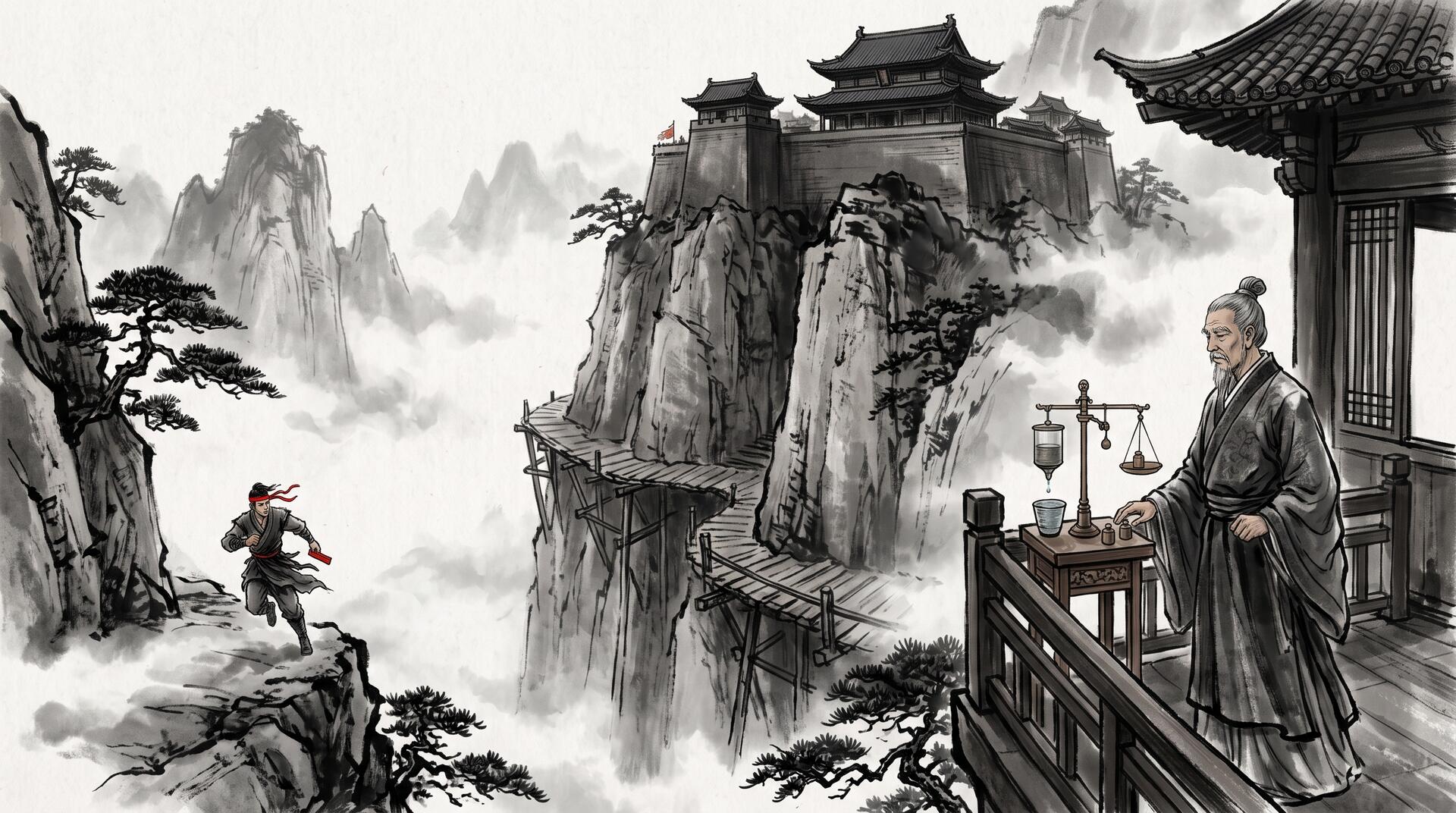
驻守剑门关的李都尉,麾下统御着沿途散布在悬崖绝顶上的数十座烽燧暗桩。悬崖之间无法放鸽,更无飞索,暗桩与主关唯一的联络,全靠精悍的斥候踏着湿滑的栈木,按固定的时辰往返穿梭,向主关的值守官递上一枚带着掌心余温的朱砂漆木牌——关中管这叫”平安筹”。
只要平安筹按时送达,主关便知前哨无恙。
然而,栈道上的风雨是天底下最捉摸不透的物什。
李都尉是个杀伐决断的宿将,最恨含糊其辞。他在关楼正门前立了一尊丈余高的大铜漏,水流淅淅沥沥,漏尽恰好一刻钟。李都尉当着全军拍案定策:”暗桩斥候,以一刻为限。水尽而筹未至者,即判为前哨陷落!全关鸣角,铁闸断锁,披甲精骑即刻拔营掩杀!”
这条铁律颁布未及半月,大祸便接踵而至。
七月蜀道暴雨如注,第七哨的年轻斥候在折鹰嘴遭逢山泥崩落,骡马受惊踢飞了蹄铁。斥候只得背着包袱在泥泞中步行,生生迟了半刻钟。
主关门前,铜漏水尽。守关都头脸色惨变,当即拽断警绳。沉重的生铁闸门轰然砸落,惊天动地的青铜号角撕裂雨幕。副将亲率八百重骑冒着倾盆暴雨与滚石狂奔三十里杀向折鹰嘴,战马跌落深渊折损十余匹,待满身泥浆的骑兵赶到,却见那年轻斥候正披着破蓑衣,喘着粗气在一株老松下用短刀修刮马蹄。
斥候活得好好的,前哨安然无恙,关中精锐却人困马乏,元气大伤。
更荒唐的是,此类”狼来了”的惊变旬月数起:有时是峡谷穿堂风掀翻了油布,有时是晨雾浓重迷了栈道,每一次虚惊,整座要塞便如惊弓之鸟般大动干戈,铁甲震天,辎重虚耗。
李都尉面子上挂不住,暴怒之下走向了另一个极端:他命人打造了一具庞大如水缸的巨型沙漏,将判死的时限一口气拉长到”两个时辰”——只要两个时辰内有人送筹,便一律视作无事。
虚警果然绝迹,关防重回宁静。
然而三个月后入冬,北境流寇潜过铁索,夜袭拔除了第九哨,将十余名守卒尽数封喉。由于那具巨型沙漏要悠悠漏上整整四个小时,主关在这期间毫无所觉。直到流寇借着前哨掩护摸到关城三里之外点起冲天大火,主关才仓促迎敌,险些丢了剑门雄关。
一刀切的死规矩,成了绝壁栈道上解不开的死结:定得紧,风吹草动便满盘皆乱;定得松,兵临城下却浑然不知。
开春之后,新任参军顾先生奉调入关。
顾先生没有砸碎铜漏,也没有重铸沙漏。他在关楼水门侧辟出一座静室,命书吏翻出关中过去两年来积压的数万卷斥候行军签单。
他在案头铺开一张三丈长的熟宣,将各哨斥候每次送达平安筹的时间间隔,逐一研磨细算。年轻的书吏们不解其意,顾先生一边用朱笔勾画,一边指着宣纸上的墨迹道:
“天地呼吸,各有常数。晴空万里时,自第七哨至主关,斥候脚程大多在八百步至九百步之间,偶有快慢,亦不逾百步之差;可若遇连阴梅雨,栈木湿滑,脚程自然拉长至一千二百步,且缓急离散。山中的阻滞从来不是一根非黑即白的铁条,而是一片起伏涨落的水波。”
顾先生在关楼正中立起了一座奇巧的机械——”千步疑衡”。
这衡器由一座精密的滑动水盘与一杆悬空升降的铜质游标构成。它永远只收录各哨最近一千次送达平安筹的时间间隔,去古纳新,常保千数。每次斥候带筹叩关,游标归位;而自上一枚平安筹送达的那一刻起,随着水滴流逝,疑衡并不给出任何”生”或”死”的武断结论,而是依据那一千次历史的分布起伏,在铜尺上推算出一个不断攀升的悬度——顾先生称之为”疑度”($\Phi$)。
这疑度的奥妙,令满关将士叹为观止: 若迟延片刻,疑度攀至三级,意味着在此等风雨下,斥候纯因寻常路阻而晚到的概率已仅剩千分之一; 若迟延拉长,疑度攀至八级,意味着此时仍属寻常迟误的几率,已不足一亿分之一; 若疑度跃过十二级,则在常理乾坤中,出现此等迟延的几率已微若尘埃,非哨卡全军覆没不可解释。
最让都头们折服的,是顾先生定下的”分司度势”之策:各营各司不再共用一个死板的警钟,而是依据自身行事的代价,各取门槛。
关内的驿馆与文书房代价极轻,疑度方至三级,录事便不再往该哨方向发放加急公文,悄然改走沿江小道,免受阻塞; 辎重营发运粮草代价中等,疑度升至八级,管勾便点亮关前黄灯,命预备斥候跨马挽弓,在关门内待命巡查; 而李都尉调动八百重骑出关决战代价极巨,则稳坐中军,唯有当疑度穿透十二级、确定断无幸存生机之时,才鸣响沉雄大锣,拔营荡寇!
自此,蜀道栈道风雨依旧,山洪迷雾时有发生。但剑门关前,加急文书再无延误,精锐重骑再无虚发,那座无言起伏的疑度天平,在万丈深渊之上,为整座雄关织就了一张张弛有度、不动如山的警戒天网。
——到这儿你大概已经认出来了:这就是分布式系统与网络故障检测中名震天下的核心算法——$\Phi$-Accrual Failure Detector($\Phi$-累积型故障检测器)。
这是什么
在分布式系统与大规模集群中,如何准确判断一个节点(服务器、微服务实例、数据库副本)是否已经宕机,是保证高可用与数据一致性的核心基石。
传统最直观的做法是固定心跳超时机制(Heartbeat Timeout):节点周期性发送心跳报文,接收端设置一个硬编码的固定阈值 $\Delta t$。若超过 $\Delta t$ 未收到心跳,则立刻断定该节点已崩溃(Dead)。
但在真实的分布式环境与云原生网络中,这种一刀切的做法存在致命缺陷: 网络拥塞、跨可用区抖动、虚拟机超卖争抢、乃至 JVM 的垃圾回收停顿(Stop-The-World GC Pause),都会导致心跳报文偶发性延迟。
- 若将超时阈值设得太短:系统对偶发网络抖动极其脆弱,频繁误判健康节点为宕机(False Positives),触发昂贵的主从重新选举、数据跨节点疯狂重平衡搬迁,甚至引发集群雪崩;
- 若将超时阈值设得太长:真实宕机发生时,系统需要数分钟甚至数十分钟才能察觉,期间大量客户端请求被黑洞路由吞没,系统整体可用性断崖式下跌。
日本会津大学的 Naohiro Hayashibara、瑞士洛桑联邦理工学院的 Xavier Défago 等学者于 2004 年提出了 $\Phi$-Accrual Failure Detector。其根本性的架构思想是:将故障检测(Failure Detection)与故障处置(Action / Policy)彻底解耦。
它不再输出冰冷的二元布尔值(Alive / Dead),而是输出一个随时间连续攀升的动态怀疑程度指标——$\Phi$(Phi):
- 历史间隔滑动窗口(Sliding Window):检测端在内存中维护一个定长滑动窗口(例如保存最近 1,000 次心跳到达的实际时间间隔),持续丢弃过时的老样本,实时捕捉当前网络环境的动态变化。
- 正态分布概率建模(Distribution Modeling):利用窗口内的样本计算心跳到达间隔的历史均值 $\mu$ 与方差 $\sigma^2$,将心跳到达规律建模为连续概率分布(通常为正态分布,亦可结合非参数估算)。当网络因高峰期拥塞而整体变慢时,$\mu$ 与 $\sigma^2$ 会自动扩大;网络平稳时又会自动收紧。
- 疑度 $\Phi$ 的数学定义:设距离上一次收到心跳已经过去了 $t - t_{\text{last}}$ 时间。算法计算假设该节点仍然存活的情况下,心跳会在比当前时刻更晚的时候才到达的概率 $P_{\text{later}}(t - t_{\text{last}})$。由此定义疑度 $\Phi$ 为:
\(\Phi = -\log_{10}(P_{\text{later}}(t - t_{\text{last}}))\)
- $\Phi = 1 \implies P_{\text{later}} = 0.1$(当前迟延属于正常波动的概率为 10%);
- $\Phi = 2 \implies P_{\text{later}} = 0.01$(正常波动的概率仅为 1%);
- $\Phi = 8 \implies P_{\text{later}} = 10^{-8}$(正常波动的概率为一亿分之一); $\Phi$ 是一个随时间单调递增的实数。时间流逝越久,$\Phi$ 越大。
- 多级动作的解耦触发(Decoupled Actions):上层系统不同的子模块,可以根据自身动作的代价高低,各自订阅不同的 $\Phi$ 阈值,分级做出反应。
为什么重要
$\Phi$-Accrual Failure Detector 是现代无主架构分布式存储与响应式集群系统的中枢神经。Apache Cassandra(节点探活与副本嗅探器)、Akka Cluster(集群成员管理与脑裂决议)等顶级系统均以其作为默认的故障检测引擎:
- 自适应应对云端不可预测性(Adaptive Elasticity):公有云网络充斥着喧闹邻居(Noisy Neighbors)与瞬态丢包。静态超时在跨洲跨洋的公有云链路上脆弱不堪。$\Phi$ 检测器能够根据昼夜网络流量潮汐与硬件负载变化,自适应拉伸与收缩怀疑门槛,在平稳期保持毫秒级敏锐,在风暴期自动展现宽容,彻底终结了人工反复微调硬编码超时的运维噩梦。
- 渐进式韧性降级(Graceful Degradation):传统的故障处理是灾难性的非此即彼。而基于 $\Phi$ 的系统能够做到如丝般顺滑的分层演进:
- 当 $\Phi \ge 3$ 时,负载均衡器仅需对该节点进行请求对冲(Hedged Requests)或降低分发权重,请求几乎无感;
- 当 $\Phi \ge 8$ 时,Gossip 协议将节点状态置为疑似离线(Suspect),停止路由新连接;
- 当 $\Phi \ge 12$ 时,才正式宣告节点死亡(Convict / Down),触发持久化存储的拓扑重建、数据副本补齐与分布式租约收回。
- 严格受控的误报率上限(Bounded Error Rate):由于 $\Phi$ 与概率对数严格绑定,系统设计者可以直接推导出数学意义上的误报率。当配置阈值
phi_convict_threshold = 8时,系统在数学上保证因网络自然波动导致误判的理论概率不超过千万分之一,有效阻断了因个别节点短暂 GC 而在整个集群引发的大规模副本重建风暴。
从分布式数据库的集群心跳、RPC 网关的熔断避障,到服务网格中对慢实例的静默切流,这杆藏在算法深处的千步疑衡,始终在不可预测的网络风雨中精确平衡着敏捷与稳健。
隐喻对应表
- 栈道与峭壁绝岭中的暗桩烽燧 → 分布式集群拓扑与跨可用区数据节点(distributed nodes across network partitions)
- 斥候按时送达的带温朱砂平安筹 → 节点周期性发送的心跳报文(periodic heartbeat signals)
- 峡谷暴雨、泥石流与骡马失蹄 → 瞬态网络拥塞、跨区抖动与 JVM 垃圾回收停顿(network jitter & GC pauses)
- 刻板的一刻钟断魂铜漏 → 硬编码的固定心跳超时时间(hardcoded static timeout)
- 误发全军八百重骑冒死驰援的惨剧 → 超时过短误判健康节点引发的虚假报警与昂贵数据重平衡(false positive failover storm)
- 换用四小时巨型沙漏导致失守九号哨 → 超时过长导致真实宕机发现迟缓、可用性严重受损(high detection latency)
- 翻检数万卷记录斥候脚程的签单账本 → 心跳到达间隔的历史滑动统计窗口(sliding window of inter-arrival history)
- 晴日千步与雨天千二百步的起伏水波 → 动态建模的正态分布均值与方差($\mu, \sigma^2$ Gaussian distribution)
- 随水滴流逝自适应攀升的千步疑衡游标 → 连续计算的故障怀疑度指标 $\Phi$(suspicion scale $\Phi = -\log_{10}(P_{\text{later}})$)
- 疑度到三级时文书房改走沿江小道 → 低疑度下无损的请求对冲与流量重定向(hedged requests & traffic rerouting)
- 疑度到八级时预备斥候执弓待命 → 中疑度下节点置为疑似状态(suspect state in gossip)
- 疑度穿透十二级时李都尉鸣锣发重骑拔营 → 高疑度阈值触发终极节点剔除与副本重建(convict threshold & replica recovery)
The road to Shu is perilous—more daunting than scaling the azure heavens.
Suspended between the sheer precipices of the Sword Gate and the jagged ridges of the Qinling Mountains, hundreds of miles of wooden plank roads clung to the stone face like timber dragons. Hewn square beams were hammered into holes driven straight into the vertical rock, suspended above unfathomable abysses swathed in churning white mist.
Commander Li, garrisoned at the Sword Gate fortress, commanded dozens of hidden outposts perched upon isolated peaks along the canyon. Between these vertiginous cliffs, carrier pigeons were swept away by drafts and iron cables could not bridge the chasm. The outposts maintained contact with the main fortress through a single, perilous lifeline: fleet-footed scouts traversing the slippery mountain timbers on a rigid schedule, delivering a hand-carved wooden tally brushed with cinnabar—a token the garrison called the “Peace Chit.”
So long as the Peace Chit arrived on the appointed hour, the fortress knew the outpost held.
Yet the wind and torrential rain along the gorge were the most capricious forces under heaven.
Commander Li was a hardened warrior who abhorred ambiguity. At the fortress gatehouse, he erected a bronze clepsydra—a water clock standing ten feet tall, its water dripping steadily down a graduated scale. The vessel emptied in precisely one-quarter of an hour. Before his gathered officers, Commander Li slammed his gauntleted fist upon the war table: “The outposts are bound by this quarter-hour! If the water runs dry and no chit is in hand, that outpost is deemed fallen! Sound the bronze horns, drop the iron portcullises, and dispatch our heavy cavalry in full battle array!”
The decree had not stood half a moon before catastrophe struck.
In midsummer, a sudden cloudburst triggered a rockslide at Eagle-Turn Pass. The mount of a young scout from the Seventh Outpost took fright, throwing an iron shoe against the rock. Forced to shoulder his leather satchel and trudge through ankle-deep mud, the scout was delayed by a mere seven minutes.
At the fortress gate, the clepsydra ran dry. The watch captain turned pale and hauled down the warning cord. A four-ton iron portcullis slammed into the granite sill with a thunderous crash, and the brazen bellow of war horns shattered the rain. The deputy commander led eight hundred heavy cataphracts galloping thirty miles through blinding torrents and falling boulders. Ten warhorses slipped into the abyss, and when the mud-caked vanguard finally reached Eagle-Turn Pass with drawn sabers, they found the young scout crouching under a pine tree in a sodden straw cloak, panting as he scraped a hoof with his dagger.
The scout was alive. The outpost was secure. But the fortress’s elite strike force was spent, battered, and crippled by the false muster.
Worse, such ghost panics recurred month after month. A downdraft tearing away a scout’s oiled saddlecloth, or thick dawn mists obscuring the plank road, repeatedly threw the fortress into frenzy. Each false alarm exhausted rations, lamed horses, and frayed the nerves of the garrison.
Stung by humiliation, Commander Li lurched to the opposite extreme. He commissioned an immense sandglass the size of a water cistern, stretching the death verdict to two full watches—four long hours. So long as a chit arrived within four hours, no alarm was raised.
The false alarms ceased. Tranquility returned to the gatehouse.
Three months later, in the dead of winter, northern raiders crossed the frozen torrents on grappling lines and silently slit the throats of the entire garrison at the Ninth Outpost. Because the monstrous sandglass trickled lazily for four hours, the Sword Gate remained utterly blind to the slaughter. By the time the raiders had infiltrated within three miles of the inner curtain wall and set the watchtowers ablaze, the fortress barely rallied in time to avert total ruin.
The commander’s rigid, binary rule had forged an inescapable paradox: set it tight, and the garrison tore itself apart over every mountain gust; set it loose, and the enemy severed its limbs while it slept.
With the coming of spring, a new military counselor arrived: Master Gu.
Master Gu neither smashed the bronze clepsydra nor recast the giant sandglass. He sequestered himself in a quiet chamber beside the gatehouse, ordering the scribes to unearth tens of thousands of scout arrival chits accumulated over the previous two years.
Unrolling a thirty-foot scroll of sized mulberry paper across the tables, he ground ink and began calculating the precise intervals between every arrival. When junior scribes asked what he sought, Master Gu dipped his vermillion brush and traced the curve of ink strokes:
“The breath of heaven and earth follows continuous rhythms. On clear, sunlit days, the trek from the Seventh Outpost to our gatehouse falls almost invariably between eight hundred and nine hundred paces. It fluctuates, but rarely by more than a hundred paces. Yet when summer rains drench the timber, the slick planks stretch the journey to twelve hundred paces, widening the natural variance. The delay of the mountain is never an iron bar of black and white; it is an undulating wave of probability.”
In the center of the watchtower, Master Gu erected a remarkable apparatus: the “Balance of Suspicion.”
The device consisted of a water reservoir linked to a counterweighted bronze arm that glided smoothly across a graduated scale. The apparatus retained only the last one thousand recorded arrival intervals for each outpost, continuously discarding obsolete records to mirror current conditions. Each time a courier arrived with a Peace Chit, the balance reset. As the seconds ticked by without a chit, the balance produced no blunt declaration of life or death. Instead, derived from the historical distribution of those thousand intervals, the bronze indicator rose steadily to register a continuous level of doubt—which Master Gu named the “Suspicion Index” ($\Phi$).
The elegance of the balance captivated the garrison: If an arrival was slightly overdue and the index climbed to Level 3, it indicated that under current weather conditions, the chance of this being an ordinary travel delay had fallen to one in a thousand; If the silence lingered and the index reached Level 8, the probability of it being a benign mishap fell below one in one hundred million; If the arm passed Level 12, the likelihood that the scout remained alive under normal conditions was less than one in a trillion—a certainty of catastrophe beyond reasonable doubt.
What truly transformed the garrison was Master Gu’s policy of decoupled thresholds: different military departments responded at different levels of suspicion, matching their reactions to the cost of action.
The courier bureau, where delays carried little risk, took action early. The moment the index touched Level 3, the dispatchers ceased routing urgent royal decrees along that mountain ridge, quietly diverting them to alternate valleys without interrupting the imperial post. The supply train faced moderate costs. When the index reached Level 8, the supply master lit an amber caution lantern over the gate and ordered backup scouts to saddle fast horses, standing by within the courtyard. Commander Li, whose heavy cavalry cost immense blood and treasure to deploy, moved only when the index crossed Level 12. Convinced that chance was exhausted and disaster was absolute, he sounded the heavy war gongs, dropping the portcullis and launching the iron legions with deadly certainty.
Thereafter, mountain storms still lashed the Shu plank roads, and winter frosts still slowed the couriers. Yet at the Sword Gate, urgent dispatches never stalled, and the heavy cavalry never rode in vain. High above the roaring chasm, the silent balance of suspicion held the frontier in unfaltering, adaptable equilibrium.
By now, you have probably recognized the ancient balance: this is the celebrated $\Phi$-Accrual Failure Detector in distributed systems and networking.
What it is
In distributed systems and large-scale computing clusters, accurately determining whether a node (a server, microservice instance, or database replica) has crashed is foundational to high availability and data consistency.
The traditional, intuitive approach is a fixed heartbeat timeout: nodes periodically emit heartbeat packets, and the receiver enforces a hardcoded threshold $\Delta t$. If no heartbeat arrives within $\Delta t$, the node is summarily declared dead.
In real-world distributed architectures, this binary timeout creates an agonizing dilemma: Transient network congestion, cross-availability-zone packet jitter, virtualization noisy neighbors, and Java Virtual Machine Stop-the-World garbage collection (GC) pauses regularly delay heartbeats by seconds.
- Short timeouts: Make the cluster hyper-sensitive to transient blips. Healthy nodes undergoing momentary GC pauses are falsely convicted (False Positives), triggering expensive master failovers, massive data re-sharding across the network, and catastrophic cascading failure storms;
- Long timeouts: Mean genuine node crashes go undetected for minutes. During this period, user traffic pours into a dead black hole, cratering overall service availability.
In 2004, Naohiro Hayashibara, Xavier Défago, and their colleagues introduced the $\Phi$-Accrual Failure Detector (SRDS 2004). Its central architectural breakthrough was: strictly decoupling failure detection from failure action.
Instead of emitting a brittle boolean value (Alive or Dead), the detector outputs a continuous, dynamically scaling suspicion level—$\Phi$ (Phi):
- Sliding Window of Inter-Arrival Times: The detector maintains a fixed-size sliding window in memory (typically tracking the last 1,000 heartbeat arrival intervals), dropping ancient data points to dynamically capture shifting network realities.
- Probabilistic Modeling: The algorithm computes the historical mean $\mu$ and variance $\sigma^2$ from the window, modeling heartbeat arrival as a continuous probability distribution (typically Gaussian, or estimated via bootstrap distribution). When the network experiences sustained peak load, $\mu$ and $\sigma^2$ expand automatically; during quiet hours, they tighten.
- Mathematical Definition of $\Phi$: Given an elapsed time $t - t_{\text{last}}$ since the last observed heartbeat, the algorithm calculates $P_{\text{later}}(t - t_{\text{last}})$: the probability that a heartbeat would arrive at or after this time, assuming the node is still alive. The suspicion level $\Phi$ is defined as:
\(\Phi = -\log_{10}(P_{\text{later}}(t - t_{\text{last}}))\)
- $\Phi = 1 \implies P_{\text{later}} = 0.1$ (a 10% chance that this delay is normal fluctuation);
- $\Phi = 2 \implies P_{\text{later}} = 0.01$ (a 1% chance);
- $\Phi = 8 \implies P_{\text{later}} = 10^{-8}$ (a one in a hundred million chance); $\Phi$ increases monotonically as silence persists.
- Decoupled Action Triggers: Different subsystems throughout the cluster configure independent $\Phi$ thresholds, reacting according to the cost and reversibility of their specific operations.
Why it matters
The $\Phi$-Accrual Failure Detector serves as the nervous system for premier distributed stores and reactive platforms, notably Apache Cassandra (node membership and dynamic snitch) and Akka Cluster (node reachability and split-brain resolution):
- Adaptive Elasticity Under Cloud Volatility: Public cloud environments are rife with noisy neighbors and transient packet drops. Static timeouts are brittle across multi-region or cross-cloud topologies. An accrual detector naturally breathes with the tide of network traffic: it remains razor-sharp during calm periods and graciously forgiving during transient storms, eliminating the operational misery of constantly tuning hardcoded timeouts.
- Graceful Multi-Stage Degradation: Rather than inflicting catastrophic all-or-nothing failovers, systems leveraging $\Phi$ can enact progressive, low-cost mitigations:
- At $\Phi \ge 3$, API gateways can initiate hedged requests to backup replicas or gently lower routing weights, shielding clients from latency without declaring an outage;
- At $\Phi \ge 8$, the Gossip cluster layer flags the node as Suspect, halting new connection establishment;
- At $\Phi \ge 12$, the cluster formally convicts the node as Down, initiating heavy partition rebalancing, replica rebuilding, and lease revocation.
- Mathematically Bounded Error Rates: Because $\Phi$ maps directly to the negative logarithm of probability, engineers can mathematically bound false-positive rates. Setting a threshold of
phi_convict_threshold = 8guarantees that under normal distribution assumptions, the theoretical probability of falsely convicting a healthy node due to network noise is less than one in one hundred million—permanently putting an end to cascading cluster-wide resharding storms triggered by transient GC pauses.
From distributed database gossip to circuit breakers and zero-trust service meshes, the ancient balance of suspicion continues to quietly safeguard modern infrastructure, striking an exquisite balance between vigilance and composure.
Metaphor mapping
- Plank roads and mountain outposts across the abyss → Distributed cluster topology and multi-AZ network nodes
- Punctual delivery of the warm cinnabar Peace Chit → Periodic node heartbeat messages
- Canyon squalls, mudslides, and threw horseshoes → Transient network congestion, cross-AZ jitter, and JVM GC pauses
- The rigid, ten-foot clepsydra emptying in a quarter-hour → Hardcoded static heartbeat timeout
- False mobilization of eight hundred heavy cavalry → Erroneous node eviction and costly cluster-wide re-sharding storms (false positive failover)
- The four-hour giant sandglass masking the fall of the Ninth Outpost → Excessive timeout duration causing dangerously delayed failure detection
- The thirty-foot scroll tracking thousands of past arrivals → Sliding window of historical heartbeat inter-arrival times
- Shifting pace between sunny days and rainy seasons → Gaussian distribution with dynamic mean and variance ($\mu, \sigma^2$)
- The rising counterweighted indicator on the Balance of Suspicion → Continuously accrued suspicion level $\Phi = -\log_{10}(P_{\text{later}})$
- The courier bureau quietly redirecting urgent decrees at Level 3 → Cheap request hedging and proactive traffic rerouting at low suspicion
- The supply master lighting amber lanterns and saddling horses at Level 8 → Marking node as Suspect in gossip membership protocols
- Commander Li sounding war gongs to deploy heavy cavalry at Level 12 → High conviction threshold triggering irrevocable eviction and partition repair