▶ Cinematic fable · Watch on YouTube ▶ 影片版寓言 · 在 YouTube 观看
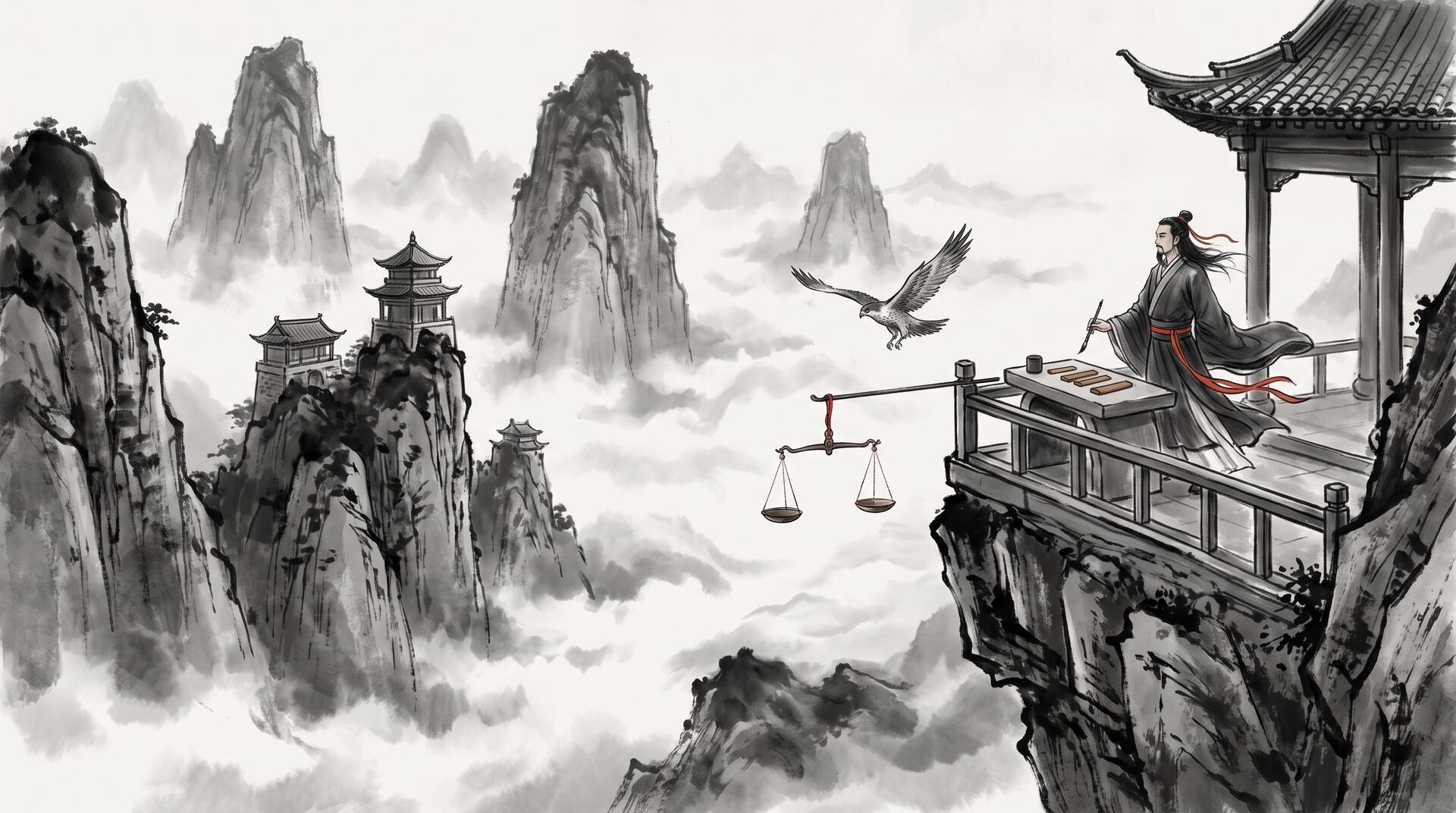
太行之巅,群峦如聚,终年被翻涌的冷雾笼罩。
在这片名为”云岫五峰”的绝壁之上,耸立着五座以玄铁铸就的观星高台。五位性情古怪的守台隐士各执一台,俯瞰着关内数百万黎民与关外蠢蠢欲动的游牧狼骑。这五座高台承载着帝国的最高天命——一旦烽烟骤起,五台必须向山下军营传出不可撤回的决战天命:
究竟是升起“朱雀火旗”(誓死出击,倾国决战),还是悬挂“青龙寒旗”(坚壁清野,退守深渊)?
五台孤悬于千仞深谷之间,彼此没有索桥相连,唯有在乱云与狂风中穿梭的驯养岩鹰传递密信。然而,这片绝壁的造化生来严酷,有着三道令历代兵家窒息的天地桎梏:
第一,云雾无常,关山阻隔(无界延迟与异步网络)。 深谷中的山风变幻莫测。驯鹰从一座峰头飞往另一座峰头,有时顺风只需半盏茶,有时遭遇横切逆流却会在云海中盘旋三日三夜。但这群灵禽极具韧性,除非峰头崩塌,否则密信绝不丢失,终究会被送到隐士的案头。可没有任何人能够预知,一封信究竟何时才能穿破浓雾。
第二,千仞断壁,或有一折(至多单点停机崩溃 Crash-Stop)。 崖顶岩壁常年风化。在这场关乎国运的密谋期间,至多可能有一座星台遭遇崩塌巨石砸毁,台毁人亡。然而,其余四台的隐士只看得见漫天大雾,根本无从分辨:那一座久无音讯的星台,究竟是守台人已然气绝身亡,还是仅仅因为他的信鹰在暴风雨中迷了归途?
第三,天命之仪,三诫如铁(共识三大性质:一致性、合法性、必终止性)。 老国师在五台初建时,于绝壁之上下了血誓法则:
- 同心如一(Agreement / 一致性):所有活着的隐士,最终升起的战旗颜色必须完全相同,决不允许一军分兵两色、自相残杀;
- 源自天命(Validity / 合法性):最终决断的颜色,必须至少有一位隐士在破晓时初次主张,绝不可凭空臆造未经提议的指令;
- 终局必临(Termination / 必终止性):只要峰台未毁,隐士在有限的密信往来之后,必须决断下定,绝不可在深渊之前无休止地延宕下去。
更为苛刻的是,隐士们皆是信奉算筹的墨家学者,他们的一言一行皆依严密的规矩而动:拆开信件、对照算筹、提笔回复,每一步都是绝对确定的推演(Deterministic Algorithm)。他们坚信,凭借五人超凡的智谋与确定的算筹,定能寻得一套完美无缺的推衍密仪,在云雾与可能的断崖面前,算出唯一的终局。
然而,在这片迷雾笼罩的深山之中,还隐匿着一位不为人知的“弄风者”。
弄风者不偏袒朱雀,也不偏袒青龙。他的唯一乐趣,是操控深谷中的气流与鹰信的先后顺序。他洞悉每一位隐士心中的算筹,也洞悉天地间最隐秘的数学命门。
破晓之时,群山寂静。 朝阳破云而出的那一刻,东峰与南峰的隐士起初偏向朱雀旗,而西峰、北峰与中峰的隐士则起初偏向青龙旗。此时此刻,天平的两端悬于中空。未来既有可能走向全军朱雀,也有可能走向全军青龙。在算筹推演的天地里,这种两种结局皆有可能达成的混沌之态,被唤作“双价之秤(Bivalent State)”。
若想打破这种悬空之势,五台必须开始放飞信鹰。每一封信的送达与拆阅,都是推演棋局向前走的一步。五位隐士期望着:随着书信往来,天平终将倾斜,全员终会步入只有可能走向单一颜色的“定局之境(Univalent State)”。
然而,弄风者冷笑着拨动了山风。
当东峰的信鹰携带着足以打破均势的密信穿过雾霭,眼看就要落在南峰隐士的手臂上时——南峰只要拆开此信,推演天平便会彻底倒向朱雀,定局成真!
弄风者悄然挥袖,召来一阵横风,将这只信鹰悬停在峰顶的白云之后。 与此同时,弄风者在狂风中向所有的隐士制造了一具恐怖的幻象:他让南峰陷入诡异的死寂,仿佛南峰已被巨石砸毁、守台人已然殒命。
其余四座峰台的隐士等不到南峰的回音。依照老国师的第三诫,他们不能无休止地等待一座可能已经毁灭的峰台!为了拯救黎民,余下的四座峰台必须依靠自己手中的信件继续推演。 中峰、西峰与北峰的信使交错往来,算筹碰撞之声不绝于耳。随着四台的密信交织,推演天平不可阻挡地向着青龙旗沉沉倾斜!
就在四台即将于绝壁上提笔写下”青龙”定论、将天平彻底砸入青龙单价之境的千钧一发之际——
弄风者笑了。他撤去了悬在白云后的横风。 那只被扣留良久的东峰信鹰,突然穿云而下,狠狠落在了南峰隐士的肩头!与此同时,南峰并未死去,他不仅活着,还在拆开信件的瞬间,依照既定的算筹规矩,向其余诸岛放飞了满载朱雀誓言的响箭!
响箭划破长空,带着朱雀的烈焰撕裂了青龙的势头。已经倾斜的天平被这股滞后却汹涌的信息猛然拉扯,原本即将落定的青龙死局瞬间被打破,五台推演再次被硬生生拽回了既可能向左、又可能向右的双价悬秤!
年复一年,日复一日。 每当隐士们的算筹即将把天命推向朱雀,弄风者便扣留关键信使,让青龙的力量借由”某台或许已死”的迫切决断而滋长; 每当算筹推演即将倒向青龙,弄风者又恰到好处地将那封被扣留的书信送达,并截留另一封信,将局势再次平衡于刀刃之上。
在独立星台之间,信件处理的顺序如同交错的落子,先落子于东与先落子于西,在深谷阻隔下根本无法分出先后的天平差(独立事件的可交换性 / Commutativity of Independent Steps)。只要信鹰的行程允许任意延迟,只要深渊中可能有一座峰台无声陨灭,弄风者便永远能够通过调配信鹰扑翼的时间,在天平即将冻结为不可逆判词的前一刹那,将其推入下一个双色摇摆的迷宫。
五位隐士白发苍苍,算筹磨平如镜。他们耗尽了一生的智巧,却骇然发现: 只要他们坚持每一个推演步骤必须绝对确定,只要绝壁间允许哪怕一位同伴默默沉沦,只要狂风还能肆意拖延信鹰的归期——那个属于终局的确定判词,就永远无法在保证绝对齐心(Safety)的前提下,由天地承诺其必然降临(Liveness)!
悬秤在狂风中静静摇摆,指向万古的虚空。
—此时你大约已经认出:这道揭示了”即使在信道绝不丢包、至多只有一个节点崩溃的极端温和假设下,纯异步网络中也不存在任何确定性共识算法能够同时保证一致性与必终止性”的残酷数学铁律,正是 1985 年由三位理论计算机科学家 Michael Fischer、Nancy Lynch 与 Michael Paterson 联合发表、并在 2001 年荣获 Dijkstra 奖的分布式系统无冕神碑——FLP 不可能性定理(Fischer-Lynch-Paterson Impossibility Theorem, 1985)。它与图灵停机问题、哥德尔不完备定理并列,是计算世界中最深邃、最不可逾越的天堑之一。
这是什么
FLP 不可能性定理(Fischer-Lynch-Paterson Impossibility Theorem) 是分布式计算理论中最核心的奠基性定理,由 Michael J. Fischer、Nancy A. Lynch 和 Michael S. Paterson 于 1985 年在论文《Impossibility of Distributed Consensus with One Faulty Process》中严格证明。
定理的数学表述极为冷峻: 在纯异步网络模型(Asynchronous Network)中,只要存在哪怕仅仅一个可能发生无预警停机故障(Crash-Stop)的节点,就不存在任何确定性算法(Deterministic Algorithm)能够在保证一致性(Agreement)与合法性(Validity)的同时,确保系统一定会终止(Termination)。
为了理解该定理的深刻内涵,必须厘清其严苛但极其普适的系统模型:
1. 系统假设与约束
- 异步消息传递网络(Asynchronous Network):没有全局物理时钟,没有消息传递延迟的上限($\Delta = \infty$)。消息的到达时间任意,但信道是可靠的(Reliable)——任何发送的消息最终必将送达,不丢包、不篡改、不重复伪造。
- 故障模型(Fail-Stop / Crash Failure):至多允许一个节点发生故障并永久停止运转(甚至不包含恶意伪造信息的拜占庭错误)。关键在于:在异步网络中,健康节点无法区分一个沉默的节点究竟是彻底崩溃了,还是仅仅遭遇了极其漫长的网络延迟。
- 确定性进程(Deterministic Processes):节点的每一步状态转移完全由当前状态和接收到的消息决定,不存在随机数发生器(Randomized Coin-Flipping)。
- 共识的三大黄金契约:
- 一致性(Agreement / Safety):任意两个非故障节点决议出的值必须完全相同。
- 有效性(Validity / Non-triviality / Safety):系统不能硬编码决议结果。如果所有节点初始值均为 $0$,决议必为 $0$;若全为 $1$,决议必为 $1$。
- 可终止性(Termination / Liveness):所有健康节点最终必须在有限步骤内决定一个值。
2. 核心证明推导:双价态与对抗性调度(Bivalence and Adversarial Scheduling)
FLP 定理的证明精妙绝伦,其核心构造围绕系统全局状态的“价态(Valence)”展开:
- 系统配置(Configuration $C$):由所有节点当前的内部状态以及网络信道中所有待处理的飞行消息(In-flight Messages)构成的全局快照。
- 单价态(Univalent Configuration):从该状态出发,无论后续网络中的消息以何种顺序送达,系统最终只能走向唯一的可能结果。若必决议为 $0$,称为 $0$-价(0-valent);若必决议为 $1$,称为 $1$-价(1-valent)。
- 双价态(Bivalent Configuration):从该状态出发,根据未来消息调度的不同排列组合,系统既可能走向决议 $0$,也可能走向决议 $1$。决策权依然悬而未决。
证明通过三个不可动摇的引理构建:
- 初始双价态必定存在(Lemma 2: Initial Bivalence): 考虑所有可能的初始配置。如果初始配置全都是单价的,通过反证法,比对两个仅有一个节点初始输入不同的相邻配置(一个为 $0$-价,一个为 $1$-价)。如果那个唯一不同的节点在一开始就崩溃不发一言,其余节点根本无法感知到两者的区别,却必须分别达成 $0$ 和 $1$,直接打破一致性。因此,任何满足有效性的共识协议,必然存在至少一个初始双价配置。
- 独立步的可交换性(Lemma 1: Commutativity / Diamond Property): 若事件 $e_1 = (p_1, m_1)$ 与事件 $e_2 = (p_2, m_2)$ 分属两个不同的节点 $p_1 \neq p_2$,则先执行 $e_1$ 再执行 $e_2$,与先执行 $e_2$ 再执行 $e_1$,最终达到的系统配置完全恒等。
- 双价态的永恒维持(Lemma 3: Bivalence Conservation): 这是整个证明的精髓。设系统处于双价态 $C$,任取一个待投递给节点 $p$ 的消息 $e = (p, m)$。如果将 $e$ 延迟处理,探索从 $C$ 出发不应用 $e$ 的所有合法演化路径,必然存在某个临界状态,使得应用 $e$ 会试图迫使系统跨入单价态(例如从双价跃迁到 $0$-价)。 然而,通过对引发状态跃迁的另一个并发事件 $e’$ 展开分类讨论($e’$ 究竟是作用在相同节点 $p$ 还是其他节点 $p’$),利用独立步的可交换性与单节点崩溃的假设,证明者证明:在状态跨入单价的边缘,永远存在一条执行分支,使得先投递或后投递某些消息后,系统依然落回一个双价配置 $C’$!
因此,一个掌握网络调度权的对抗性调度者(Adversarial Scheduler),永远可以通过精心设计消息到达的微观顺序,使得系统无限期地在双价态之间徘徊,永远无法跨过终局决断的临界点!
为什么重要
FLP 不可能性定理是分布式工程领域的一座灯塔,它划定了物理宇宙与算法逻辑的不可逾越边界:
- 破除对”完美异步共识”的虚妄幻想: 在 FLP 之前,许多系统设计者试图发明一种既能在任意恶劣网络延迟下永不脑裂、又能在节点宕机时保证百分之百快速响应终止的确定性算法。FLP 定理在数学上判处了这种追求的死刑:鱼与熊掌不可兼得。在纯异步不可靠世界中,完美的确定性共识在理论上是不可能的。
- 现代共识协议取舍哲学的总源头(Safety over Liveness):
它解释了为什么后世所有工业级强一致共识协议——无论是 Paxos、Raft、Zab 还是 Viewstamped Replication——都做出了完全相同的妥协:
- 绝对坚守安全性(Safety / Agreement):一致性绝不能妥协,永远不允许发生脑裂或双重决议;
- 在极端异步下牺牲确定性的可终止性(Sacrificing Pure Liveness):当网络陷入病态延迟、分区或活锁竞争时(例如 Paxos 中的两个 Proposer 互掷更高提案号形成 Dueling Proposers,或 Raft 中多个 Candidate 瓜分选票形成 Split Votes),协议允许系统暂时停滞、无法选主或无法提交日志,直到网络条件恢复!
- 指明了绕过不可能性的三条工程通途:
既然纯异步确定性不可行,现代分布式系统正是通过打破 FLP 的四项前提假设,才在现实中构建起了坚如磐石的云基础设施:
- 打破纯异步:引入部分同步假设(Partial Synchrony / DLS 88):现实网络并非病态无界。系统假设存在一个全局稳定时间(GST),在 GST 之后消息延迟存在上界 $\Delta$。Raft 的超时选举计时器(Heartbeat Timeouts)正是依赖部分同步来保证活性的终局收敛;
- 打破确定性:引入随机化算法(Randomization / Randomized Consensus):Ben-Or 算法与 Raft 的随机化选举超时(Randomized Election Timeout),正是利用随机扰动彻底打破对抗性调度器的对称性死锁,以概率 $1$ 确保系统快速跨越双价态;
- 打破不可靠侦测:引入不可靠故障检测器(Unreliable Failure Detectors / Chandra-Toueg 96):通过 $\diamondsuit\mathcal{W}$ 或 $\diamondsuit\mathcal{S}$ 等最终弱故障检测器,允许系统以极低代价猜测节点状态,从而在无需完美同步的时钟下达成共识。
隐喻对应表
- 绝壁观星五台 → 分布式系统节点集群(Processes / Nodes)
- 漫天迷雾与风向变幻 → 任意无界延迟的异步网络(Asynchronous Network with Unbounded Delays)
- 坚韧不拔的灵禽信鹰 → 可靠的消息传递信道(Reliable FIFO / Non-lossy Channels)
- 孤崖可能风化崩塌 → 允许至多一个节点的无预警宕机(Crash-Stop Failure Model)
- 无法分辨信使迟归还是人亡 → 异步网络中无法区分节点慢速与节点崩溃(Impossibility of Accurately Detecting Failures)
- 朱雀火旗与青龙寒旗 → 共识决策的两个二元选项(Binary Decisions: 0 or 1)
- 墨家推演规矩 → 节点运行的确定性状态机算法(Deterministic State-Machine Transitions)
- 天平两端摇摆的双价之秤 → 依然可能达成任意一种决议的系统双价状态(Bivalent Configuration)
- 拨动云海的弄风者 → 刻意操纵消息到达顺序的对抗性调度者(Adversarial Scheduler)
- 关键信件送达逆转局势 → 临界状态下的事件交换性与双价态守恒(Diamond Property & Bivalence Conservation)
- 终年无定论的判词 → 异步确定性共识算法无法保证终止性(Lack of Guaranteed Termination / Loss of Liveness)
Atop the jagged precipice of the Taihang peaks, the mountain crags stood forever shrouded in cold, churning mist.
High above this bottomless abyss rose five ironcast star towers known as the Cloud Pavilion of the Five Peaks. Five reclusive wardens kept their solitary vigils across the peaks, looking down upon the millions of subjects within the empire and the nomadic war-hordes prowling outside the mountain passes. The five towers bore the supreme destiny of the realm: should war drums rumble, they were bound to deliver an irrevocable decree to the garrisons below:
Should they unfurl the Vermillion Banner (to march south in an all-out assault), or raise the Azure Banner (to fortify the mountain passes and retreat into deep defense)?
The five towers stood isolated across the chasms, connected by neither bridges nor cables. Their sole communion lay with trained rock-falcons that wheeled through the howling winds and blinding clouds, bearing sealed letters. Yet the natural order of this craggy realm imposed three unyielding constraints that had vexed commanders for centuries:
First, Unbounded Winds and Misty Gorges (Asynchronous Network with Arbitrary Delays). The currents within the abyssal ravines were completely capricious. A falcon winging from one crag to another might make the passage in half a cup of tea on a fair tailwind, or battle cross-shear squalls in the clouds for three full days and nights. Yet these resilient raptors never gave up: barring a catastrophic cliff-collapse, no letter was ever lost; it would eventually strike the warden’s desk. But no living soul could predict when any given letter would pierce the fog.
Second, The Crumbling Precipice (Fail-Stop Crash of at Most One Node). The cliffs suffered endless weathering. Throughout the deliberation of the empire’s fate, at most a single tower might be suddenly struck by falling boulders, collapsing into the void. Yet looking out from their solitary crags, the surviving four wardens saw only the impenetrable gray mist. They could never discern the truth: had that silent neighbor truly perished into dust, or was his courier falcon merely fighting a fierce headwind in the gorge?
Third, The Sacred Covenant of the Three Decrees (The Classic Consensus Triad: Agreement, Validity, Termination). When the towers were first forged, the imperial grand astrologer had inscribed three unbreakable oaths in stone:
- Agreement: All surviving wardens must ultimately hoist the exact same color banner; under no circumstances could the armies be split into opposing factions.
- Validity: The chosen color must have been proposed by at least one warden at dawn; an arbitrary verdict conjured out of thin air was forbidden.
- Termination: So long as a tower survived, its warden was bound to reach a final, irrevocable decree within a finite number of message exchanges; lingering in perpetual hesitation was treason.
Crucially, the wardens were strict scholars of mechanical calculation: every action followed deterministic deduction. Reading a letter, updating the ink tallies on their boards, and inscribing a reply was governed by pure determinism. They believed that through rigorous logic, a flawless protocol could be crafted to guarantee a unified verdict despite the mist and the peril of a fallen cliff.
Yet within the shrouded peaks lurked an invisible adversary: The Spirit of the Mist.
The Spirit favored neither the Vermillion nor the Azure. His singular joy lay in manipulating the drafts within the valleys and the order in which couriers arrived. He understood the deterministic rules of every warden, and he perceived the most profound mathematical vulnerability in the universe.
At dawn, silence blanketed the ranges. As the morning sun breached the cloud sea, the wardens of the East and South peaks initially favored the Vermillion Banner, while the West, North, and Center peaks leaned toward the Azure Banner. At that initial sunrise, the celestial balance hung precisely in the middle. The future could still evolve into a universal Vermillion decree or a universal Azure decree. In the mathematics of distributed states, this poised equilibrium was known as a Bivalent State.
To break this suspension, the five towers began dispatching their couriers. Every delivered letter and every tally update moved the configuration forward. The wardens trusted that as messages crossed the gorges, the balance would tilt, inevitably locking the system into a Univalent State where only one outcome remained possible.
The Spirit of the Mist smiled and stirred the winds.
When the courier from the East Peak, bearing a critical reply that would tip the balance toward Vermillion, drew near the arm of the South Peak warden—a delivery that would permanently fix the outcome as Vermillion—the Spirit gently waved his sleeve, summoning a cross-shear eddy that held the falcon circling behind a bank of white clouds.
Simultaneously, the Spirit projected an eerie illusion of silence across the chasm: he made the South Peak appear entirely dead, as though crushed by rockfall.
The remaining four wardens waited in vain for a response from the South. Bound by the grand astrologer’s Third Covenant—Termination—they could not wait forever for a tower that might have perished! To save the realm, the four surviving peaks pressed on, deliberating only amongst themselves. Couriers darted between the Center, West, and North peaks. Under their collective calculations, the balance tilted heavily toward the Azure Banner!
Just as the four wardens were about to inscribe “Azure” onto their stone plinths, freezing the system into an irrevocable Azure univalent state—
The Spirit released the wind. The detained eastern courier plunged from the cloud bank, striking the South Peak warden’s arm! The South Peak was not dead; he was alive, and upon reading the deferred letter, his deterministic calculations compelled him to loose whistling signal rockets across the valley, reaffirming the Vermillion mandate!
The roaring rockets split the gloom, shattering the Azure consensus. The tilting balance was violently wrenched back by this delayed deluge of truth. The impending Azure finality evaporated, and the five-tower configuration was plunged back onto the razor’s edge of a Bivalent State, where both Vermillion and Azure remained simultaneously reachable!
Season after season, the game played out. Whenever the wardens’ calculations were about to collapse the system into Vermillion, the Spirit delayed a crucial falcon, allowing the Azure faction to gather momentum under the urgent suspicion that an absent colleague was dead. Whenever the scales dipped toward Azure, the Spirit delivered the held letter and detained another, nudging the global state back into exact equilibrium.
Across disjoint peaks, the execution of independent letters commuted seamlessly: delivering a message to the East before the West produced the exact same configuration as delivering it to the West before the East. So long as messages could experience arbitrary delays, and so long as a single tower could silently crumble without announcement, the Spirit could forever find an interleaving of winds to rescue bivalence from the jaws of a final decree.
The wardens grew gray; their stone counters wore smooth as river pebbles. In the end, they realized with a shudder: So long as their actions remained strictly deterministic, so long as a single brother could silently vanish into the mist, and so long as the winds could delay a courier without bound—a final, unified decree could never be guaranteed to terminate (Liveness) while preserving absolute unity (Safety)!
The suspended scales hung motionless in the gale, swaying into eternity.
—By now you’ve probably recognized it: this merciless mathematical law—proving that in an asynchronous network where messages are never lost and at most one node may crash, no deterministic algorithm can simultaneously guarantee Agreement, Validity, and Termination—is the crowning theoretical milestone published in 1985 by Michael Fischer, Nancy Lynch, and Michael Paterson, which won the 2001 Dijkstra Prize: the FLP Impossibility Theorem (1985). Standing alongside Turing’s Halting Problem and Gödel’s Incompleteness Theorem, it is one of the deepest and most unyielding boundaries in computer science.
What it is
The FLP Impossibility Theorem is the most fundamental impossibility result in distributed computing theory, proven by Michael J. Fischer, Nancy A. Lynch, and Michael S. Paterson in their landmark 1985 paper, “Impossibility of Distributed Consensus with One Faulty Process”.
The formal statement is startlingly austere: In an asynchronous network, no deterministic consensus protocol can guarantee both Safety (Agreement and Validity) and Liveness (Termination) in the presence of even a single unannounced crash failure (Crash-Stop).
To appreciate the theorem’s reach, one must examine its unassumingly mild assumptions:
1. System Assumptions and Model
- Asynchronous Message-Passing Network: There is no global physical clock and no upper bound on message propagation delay ($\Delta = \infty$). Message delivery is, however, reliable: any message sent to a non-faulty process will eventually be delivered; messages are neither lost, corrupted, nor duplicated.
- Fail-Stop Model (Crash Failure): At most one process may fail by halting silently and permanently. There are no malicious Byzantine adversaries. Crucially: in a purely asynchronous network, non-faulty processes cannot distinguish between a node that has crashed and a node that is merely experiencing extreme network delay.
- Deterministic Processes: Each process transition is completely determined by its internal state and the received message; there are no randomized choices.
- The Classical Consensus Triad:
- Agreement (Safety): No two non-faulty processes decide on different values.
- Validity (Non-triviality / Safety): If all processes start with $0$, the decision must be $0$; if all start with $1$, the decision must be $1$. The protocol cannot hardcode a trivial constant.
- Termination (Liveness): Every non-faulty process must eventually decide on a value within a finite number of execution steps.
2. Core Proof Architecture: Bivalence and Adversarial Scheduling
The FLP proof operates by analyzing the global state of the entire system, called a Configuration ($C$), which encompasses the internal states of all processes and the multiset of all in-flight messages in transit:
- Univalent Configuration: A configuration from which all future valid execution paths inevitably lead to the same decision value. If all reachable terminal states decide $0$, it is $0$-valent; if all decide $1$, it is $1$-valent.
- Bivalent Configuration: A configuration from which both a decision of $0$ and a decision of $1$ remain reachable, depending on how messages are scheduled in the future.
The impossibility is established via three fundamental lemmas:
- Lemma 2 (Existence of Initial Bivalent Configuration): Any valid consensus protocol must possess at least one initial configuration that is bivalent. If all initial configurations were univalent, consider two adjacent initial configurations differing by only a single process’s input (one yielding $0$, the other $1$). If that single differing process crashes before taking a single step, the surviving processes cannot distinguish between the two universes, yet would be forced to reach contradictory decisions—violating Agreement.
- Lemma 1 (Commutativity / Diamond Property): If two events $e_1 = (p_1, m_1)$ and $e_2 = (p_2, m_2)$ act upon disjoint processes ($p_1 \neq p_2$), applying $e_1$ followed by $e_2$ produces the exact same configuration as applying $e_2$ followed by $e_1$.
- Lemma 3 (Conservation of Bivalence): Starting from any bivalent configuration $C$ and any message $e = (p, m)$ awaiting delivery to process $p$, an adversarial scheduler can always select a sequence of events such that applying or delaying $e$ leaves the system in a new bivalent configuration $C’$. The proof examines the boundary step where applying $e$ threatens to tip the balance into univalence, and demonstrates through the commutativity of independent events and single-node crash indistinguishability that an alternate execution path always exists that preserves bivalence.
Consequently, an adversarial scheduler controlling the delivery order of messages can indefinitely steer the system from one bivalent configuration to another, preventing the protocol from ever reaching a decision while maintaining safety.
Why it matters
The FLP Impossibility Theorem is the compass that guides all real-world distributed systems engineering:
- Dispelling the Myth of the “Perfect Asynchronous Protocol”: Before FLP, engineers and academics strove to invent consensus algorithms that would remain 100% consistent, totally partition-tolerant, and guaranteed to terminate instantly under any network conditions. FLP proved mathematically that this is an impossible quest: under pure asynchrony, something must give.
- The Foundational Philosophy of Modern Consensus (Safety over Liveness):
FLP explains why every major production consensus protocol—Paxos, Raft, Zab, and Viewstamped Replication—makes the exact same compromise:
- Absolute Preservation of Safety: Never sacrifice Agreement. Split-brain, double-commit, and conflicting states are strictly forbidden under all network conditions.
- Sacrificing Pure Liveness during Asynchronous Upheaval: Under pathological network delays, partitions, or livelock (such as Raft split-votes or Paxos dueling proposers), protocols accept that the system may temporarily stall without reaching a decision until network stability resumes.
- The Three Engineering Gateways Around the Impossible:
Modern cloud infrastructure works in practice because practical systems break one or more of FLP’s four foundational assumptions:
- Breaking Pure Asynchrony: Partial Synchrony (DLS 1988): Real networks are not endlessly adversarial. Systems assume a Global Stabilization Time (GST), after which message delays are bounded by $\Delta$. Raft and Paxos rely on heartbeat timeouts under partial synchrony to guarantee election termination and liveness.
- Breaking Determinism: Randomized Consensus (Ben-Or 1983, Raft Randomized Timeouts): By replacing deterministic decisions with coin flips or randomized election timeouts, algorithms break the symmetry required by adversarial schedulers, achieving termination with probability $1$.
- Breaking Unreliable Failure Detection: Failure Detectors (Chandra-Toueg 1996): Introducing weak failure detectors (such as $\diamondsuit\mathcal{W}$ or $\diamondsuit\mathcal{S}$ 等) allows nodes to eventually suspect crashed processes accurately, enabling consensus without synchronized physical clocks.
Metaphor mapping
- Five ironcast star towers → Distributed system nodes / processes
- Shrouded chasms and capricious mountain winds → Asynchronous network with unbounded message delays
- Resilient rock-falcons bearing letters → Reliable, non-lossy FIFO communication channels
- A crag silently collapsing in the storm → Fail-stop crash failure of at most one node
- Inability to discern whether a neighbor died or a courier was delayed → Inability to distinguish slow processes from crashed processes in an asynchronous network
- Vermillion Banner vs Azure Banner → Binary consensus decisions (0 or 1)
- Rigid calculation rules of the wardens → Deterministic state-machine transitions
- The poised balance of the two-colored scales → Bivalent configuration where both 0 and 1 remain reachable
- The Spirit of the Mist orchestrating the drafts → Adversarial scheduler controlling message delivery order
- Timely delivery of delayed couriers restoring equilibrium → Commutativity of independent events and bivalence conservation
- The decree that can never safely be etched in stone → Impossibility of guaranteed termination (loss of pure liveness)