▶ Cinematic fable · Watch on YouTube ▶ 影片版寓言 · 在 YouTube 观看
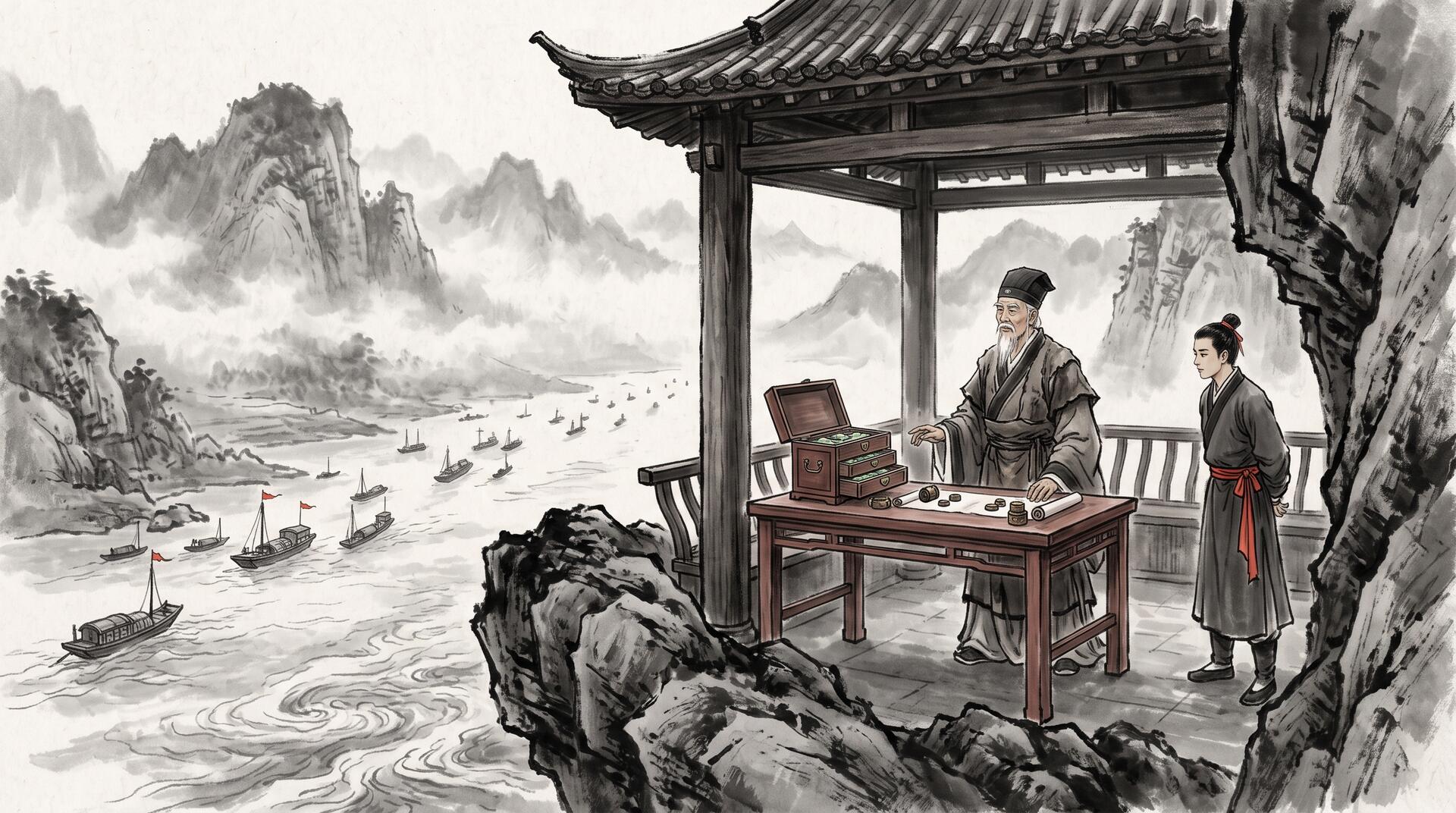
大运河在天门峡骤然收窄,两岸青崖如削,奔涌的浊浪在此汇成一道险隘的咽喉——千帆渡。
天下七十二州的粮船、盐舶、茶舫与游侠扁舟,昼夜不息地从这座石闸穿梭而过。闸官公署前的一块青石矶头上,立着一间小小的青瓦水阁。
这天清晨,新任的司关少吏捧着厚厚的几大箱空白宣纸跌跌撞撞地跑进水阁,满脸惊惶:
“老闸监!巡抚衙门下了死命令,要在秋汛期间清查两件事:第一,江面上若有形迹可疑的私盐帮暗号,到底偷偷过闸了多少次?第二,整整三个月里,哪几条巨舟是往来最频繁的’江龙’(过江巨舶,即 Heavy Hitters)?”
少吏抹着冷汗,指着门外遮天蔽日的桅樯:”可江上每天穿梭的船只何止百万艘!每艘船的帮派徽记各不相同,有的雕青龙,有的刻并蒂莲,有的描三道水纹,甚至还有数不清的无名渔舟。就算把我们公署堆满账本,也记不下所有船号;即便把属下累死在案头,翻账簿也根本来不及核对!”
坐在茶案后的老闸监须发皆白,身穿一袭洗得发白的长衫。他轻啜了一口热茶,放下茶盏,指了指水阁正中那张狭窄的红木几案。
几案上只有一件器物。
那是一尊不大不小的紫檀木匣,长宽不过两尺。木匣内部分为上下并列的 $d$ 层抽屉,每一层抽屉里又整整齐齐地开凿出 $w$ 个浅浅的黄铜小格。在木匣旁边,放置着一斗冰凉圆润的青玉豆,以及挂在墙上的 $d$ 枚奇巧古怪的八卦铜印。
“世间愚人总以为,记账必立全册,量水必舀干长河。”老闸监温和地笑了笑,”随我来。今日过闸,一页纸也不许动。”
正午时分,潮水大涨。一艘挂着”玄铁黑鹰”旗帜的盐枭大船轰鸣着驶入石闸。
老闸监对少吏道:”看清它的徽记——’玄铁黑鹰’。取墙上的第一枚铜印,沾上印泥,对着徽记照一照。”
少吏依言拿起第一枚铜印。那铜印内嵌复杂的璇玑齿轮,徽记一照,齿轮咔哒转动,印面上弹出了一个数字:”七”。
“去第一层抽屉,在第七个黄铜格里,投下一枚青玉豆。”老闸监吩咐。
少吏投下一豆。接着,老闸监又道:”莫停。再取第二枚铜印。”
第二枚铜印的齿轮走向与第一枚截然不同,照过黑鹰徽记后,弹出的数字是:”十九”。少吏在第二层抽屉的第十九格中,同样投入一枚青玉豆。
如此依法施为,直到第 $d$ 枚铜印照毕,少吏在第 $d$ 层对应的格子里各投下一粒青玉豆。
“记完了!”老闸监挥动令旗,大船隆隆过闸。
少吏看得目瞪口呆:”老先生,这就算记下了?可天下的船何止千万,每一层抽屉里一共才 $w$ 个铜格。若是别家船只过来,照出的格号与黑鹰撞在一起,那格里的玉豆岂不是混成了一团?”
话音未落,一艘满载蜀锦的官船驶来,旗绘”三色锦鲤”。少吏拿第一枚印去照,齿轮转动,弹出的数字竟然也是”七”!
少吏的手猛地僵住:”撞了!锦鲤船的玉豆也要落在第一层的第七格!两家的账混在一起,谁分得清这格里的豆子到底是谁留下的?”
“投下去。”老闸监神色自若,”每一层的铜印,推衍阴阳的机理全无瓜葛。锦鲤与黑鹰在第一层偶然碰上,难道在第二层、第三层还能层层碰上不成?天地广阔,巧合岂能千篇一律?”
少吏半信半疑地投下豆子。随着第二枚铜印照向锦鲤,弹出的数字成了”四十三”——果然与黑鹰分道扬镳。
黄昏降临,江面上成千上万艘巨轮木筏呼啸而过。少吏不知疲倦地照印、投豆。那个小小的木匣里,一颗颗青玉豆在不同的铜格里悄然堆叠,有的格子里空空如也,有的格子里已堆起了小小的玉山。
入夜,巡抚衙门的快马疾驰而来。差官厉声质问:”查!’玄铁黑鹰’今日究竟闯过了几次?”
少吏慌忙拉开木匣,将所有相关的黄铜格逐一检视:
- 拿第一印去查黑鹰,对应的第一层第七格里,堆着 四十二 粒豆子;
- 拿第二印去查黑鹰,对应的第二层第十九格里,堆着 十七 粒豆子;
- 拿第三印去查黑鹰,第三层对应的格里,堆着 五十九 粒豆子;
- 拿第四印去查黑鹰,第四层对应的格里,堆着 十七 粒豆子……
少吏的脸色瞬间变得煞白:”糟了!四层抽屉,数出来的玉豆各不相同!第一层说四十二,第二层说十七,第三层说五十九……这到底哪一个才是真数?我们是不是犯了欺君之罪?”
老闸监缓步走上前来,用竹篾挑了挑那几格玉豆,淡然一笑:
“痴儿,为何慌张?你想想看,这木匣之中的青玉豆,可有一粒会凭空飞走,或是被江水冲掉?”
少吏一愣:”自然不会,只投不取。”
“黑鹰每一次过闸,是不是都必定在每一层对应的铜格里落下一枚玉豆?”
“正是。”
“那好。”老闸监目光如炬,”如果格子里多出了豆子,那必定是别家船只’撞格’时硬塞进来的;但绝没有任何神鬼之力,能从格子里偷走黑鹰应得的豆子!换言之,每一个格子里的数目,只可能比黑鹰的真实次数更多,绝不可能比它的真实次数更少!”
少吏脑中如惊雷闪过:”只可能虚增,绝不会偏少……”
“既然如此,”老闸监朗声点破天机,”取最小的那个!”
“取小?!”
“不错。第十九格有十七粒,说明其他船只在这格里至多只撞进来了几粒杂豆,甚至可能一粒未撞;而四十二与五十九,不过是别的喧闹舟帮在别层格子里添进来的市井杂音罢了。所有的格中之数皆是真实之上的云雾,而唯有那最小的一格,距离云雾散尽后的真实最近!”
老闸监转过身,从容地报出判词:”十七次。黑鹰过关,其数必不超十七!”
差官核对随行密探的岸边暗记,拍案惊呼:”神准!不多不少,正是十七次!”
少吏瘫坐在木椅上,望着那尊不过两尺见方的紫檀匣,心中波澜万丈:天下千帆如瀚海之水,而一匣之木、数枚铜印,竟以”取小”之无上妙意,在方寸之间将狂暴的洪流驯服得秋毫无犯!
—到这儿你大概已经认出来了:这套以极小固定空间精准丈量海量数据洪流的奇妙算器,正是流式计算与现代网络系统中最优雅的概率型数据结构之一——Count-Min Sketch(最小计数草图)。
这是什么
Count-Min Sketch(最小计数草图,简称 CMS) 是流式算法(Streaming Algorithms)领域最核心的次线性空间概率数据结构,由理论计算机科学家 Graham Cormode 与 S. Muthukrishnan 于 2005 年在奠基性论文《An Improved Data Stream Summary: The Count-Min Sketch and its Applications》中提出。
与关注”集合中是否存在元素”的 Bloom Filter 以及关注”集合中有多少独立不重复元素”的 HyperLogLog 不同,Count-Min Sketch 专门解决海量数据流中的频次估算(Frequency Estimation)与重度访问者挖掘(Heavy Hitters / Top-K)难题。
1. 核心数学模型与数据布局
Count-Min Sketch 的核心结构是一个紧凑的二维计数器矩阵 $C$:
- 深度(Depth) $d$:矩阵的行数,对应 $d$ 个彼此独立的哈希函数 $h_1, h_2, \dots, h_d$。
- 宽度(Width) $w$:矩阵的列数,每行包含 $w$ 个无符号整型计数器(Counters)。
- 空间开销:仅由 $d \times w$ 个整型单元构成,其内存占用在初始化后完全固定,与流中涌入的独立元素总数(Cardinality)彻底解耦。
2. 运作机制:更新与查询
-
流式更新(Update): 当流中到达一个事件(键为 $x$,增量为 $c$,通常 $c=1$)时: 对矩阵的每一行 $i \in {1, 2, \dots, d}$,使用该行专属的哈希函数计算其在当前行的桶索引: \(j = h_i(x) \quad (1 \le j \le w)\) 然后将对应位置的计数器累加: \(C[i, j] \leftarrow C[i, j] + c\) 更新的时间复杂度仅为严格确定的 $O(d)$,处理一条消息只需完成 $d$ 次简单的哈希与数组内存递增。
-
频次查询(Point Query): 当需要查询某个元素 $x$ 在历史数据流中累计出现的频次时,算法分别读取其在每一行对应桶中的计数值,并计算其全局最小值(Minimum): \(\hat{a}_x = \min_{1 \le i \le d} C[i, h_i(x)]\) 查询的时间复杂度同样是极其极致的 $O(d)$。
3. 数学证明:为什么”取小”能消除碰撞噪声?
Count-Min Sketch 的数学美感建立在概率不等式与哈希碰撞的单向性之上:
- 绝对无负偏差(No Underestimation): 因为流中的计数增量恒为正数($c > 0$),且计数器绝不递减,哈希碰撞只能导致其他元素向该桶”多贡献”数值,而绝不可能凭空吞噬计数。因此,对于任意元素 $x$ 的真实频次 $a_x$,估计值恒满足: \(\hat{a}_x \ge a_x\)
- 误差上限与参数设计($(\epsilon, \delta)$-Guarantee):
设整个流中所有事件的总累加计数为 $N = \sum_y a_y$。
若我们希望估计误差不超过 $\epsilon N$,且发生超额误差的概率不超过 $\delta$(即 $\Pr[\hat{a}_x > a_x + \epsilon N] \le \delta$),根据马尔可夫不等式(Markov’s Inequality)与独立事件概率乘积原理,理论推导给出了极其简洁优雅的参数选型公式:
- 宽度:$w = \left\lceil \frac{e}{\epsilon} \right\rceil$ (其中 $e \approx 2.71828$ 为自然常数)
- 深度:$d = \left\lceil \ln \frac{1}{\delta} \right\rceil$ 例如:若要求误差在总流量的千分之一以内($\epsilon = 0.001$),且置信度达到 $99.9\%$($\delta = 0.001$),只需取 $w \approx 2719$,$d \approx 7$。区区约两万个计数器(几十千字节内存),便可监视数以亿计的实时数据流!
4. 关键变体:保守更新(Conservative Update)
在标准 CMS 中,每次更新都会盲目给所有 $d$ 行的计数器加 1。 而在保守更新(Conservative Update / Count-Min-CU)优化中: 当为元素 $x$ 执行更新时,先计算当前的估计值 $\hat{a}x = \min{i} C[i, h_i(x)]$。更新时,只递增那些当前计数值恰好等于该最小值的计数器(即值已经偏大的碰撞桶不予递增)。这一微小的启发式改进在几乎不增加 CPU 开销的前提下,将高频碰撞场景下的估计误差降低了一个数量级。
为什么重要
在当代高并发、超大规模分布式基础设施中,内存墙与全量哈希表的扩容开销是所有高吞吐数据通路的死穴。Count-Min Sketch 是现代系统在资源极限压榨下的破局利刃:
-
超高速网络防御与 DDoS 流量过滤: 在运营商级骨干路由器、eBPF/XDP 数据面以及 Cloudflare 等 CDN 边缘节点中,100Gbps 乃至 400Gbps 的网络数据包呼啸而过。面对海量的源 IP 地址,系统根本不可能为每个 IP 在内核里分配哈希表条目(瞬间导致内存耗尽或哈希表锁竞争)。 工程师在 eBPF 映射区内放置一个紧凑的 Count-Min Sketch,硬件网卡收到数据包后,直接在内核驱动层对源 IP 计算 $d$ 次哈希并累加计数器。一旦某 IP 的 $\min$ 估算值突破设定的阈值,立即断定其为泛洪攻击源(Heavy Hitter / Elephant Flow),当场执行
XDP_DROP。几百 KB 内存即可守护数以百万计的并发连接。 -
现代缓存淘汰算法的核心基石(TinyLFU / W-TinyLFU): 在广为人知的高性能本地缓存框架 Caffeine(Java 生态标杆)、Ristretto(Go)以及新版 Redis 的近似 LFU 机制中,传统的 LFU(最不经常使用)策略需要维护巨大的访问频次字典,自身占用的元数据内存往往比缓存数据本身还要庞大,且无法应对突发热点转移。 Caffeine 采用了 W-TinyLFU 架构:利用一个带周期性衰减(Decay / Aging)的 Count-Min Sketch 来统计全局数据的历史访问频次。当缓存已满、新条目试图进入时,系统查询 CMS 估算新条目的热度,并与当前淘汰候选者的热度进行 PK。只有新条目证明自己”比即将被驱逐的老条目更有价值”时才准予准入(Admission Policy),以极微小的内存代价实现了逼近理论最优的命中率。
-
实时大数据流中的 Top-K 与偏度检测: 在 Apache Flink、Spark Streaming、Kafka 以及 ClickHouse 等流批处理引擎中,要在数百亿条日志中实时挖掘最热门的商品、最频繁的搜索词或发生倾斜(Data Skew)的数据分区,Count-Min Sketch 与最小堆(Min-Heap)结合构成的 Heavy Hitters 算法,使得单机节点能够在固定的微量内存下,从吞吐浩瀚的流水线中秒级抓取头部热点。
隐喻对应表
- 奔涌不息的千帆渡江面 → 无限高速的数据事件流(High-velocity Data Stream)
- 雕刻各异的帮派船徽 → 待统计的未知海量键(Key / IP / URL / Identifier)
- 巡抚衙门清查的私盐暗号与过江巨舶 → 频次点查询(Point Query)与重度访问者挖掘(Heavy Hitters / Top-K)
- 狭窄水阁与不能动用的账册纸墨 → 严格受限的内存预算(Sublinear Fixed Memory Budget)
- 紫檀匣内的 $d$ 层抽屉与每层 $w$ 个铜格 → 深度为 $d$、宽度为 $w$ 的二维计数器矩阵 $C[d \times w]$
- 挂在墙上的 $d$ 枚各不相同的八卦铜印 → $d$ 个彼此独立的哈希函数 $h_1, \dots, h_d$
- 锦鲤与黑鹰在同层铜格中撞落玉豆 → 散列冲突与哈希碰撞(Hash Collision)
- 投下的青玉豆绝不凭空消失 → 计数器的单调累加性与绝对无负向偏差($\hat{a}_x \ge a_x$)
- 铜格计数只多不少的云雾干扰 → 碰撞导致的频次正向虚增误差
- 老闸监勘破天机的”取最小之格” → 取所有行哈希桶计数的全局最小值 $\min_i C[i, h_i(x)]$
- 独立铜印让多层同时碰撞的几率骤降 → 独立哈希函数将误差超额概率压制在 $\delta$ 之内
At the Tianmen Gorge, the Grand Canal suddenly constricts between towering, razor-sharp crags, its turbulent waves churning into a treacherous bottleneck known as Thousand Sails Ferry.
Grain barges, salt cutters, tea ketches, and swift wanderer skiffs from all seventy-two imperial provinces surged through the stone sluice day and night. Upon a green reef before the harbor magistracy perched a modest, black-tiled water pavilion.
Early that morning, the newly appointed junior customs officer came stumbling into the pavilion clutching several wooden chests loaded with blank calligraphy scrolls, his face pale with dread:
“Warden! An urgent decree from the Governor’s tribunal has arrived. Throughout the autumn flood, we are ordered to determine two things: First, exactly how many times did contraband salt clippers bearing illicit marks slip past our gates? Second, across these three months, which vessels were the supreme leviathans of the river—the most frequent travelers (the Heavy Hitters)?”
The junior officer wiped cold sweat from his brow, gesturing frantically toward the forest of masts blotting out the sky outside: “Yet millions of ships traverse these waters every day! Each vessel bears a distinct insignia—coiled azure dragons, twin lotuses, three-wave crests, or nameless marks of common fishermen. Even if our offices were packed from floor to ceiling with ledgers, we could not record every hull; even if I worked myself to death at this desk, thumbing through scrolls would take an eternity!”
Seated behind the tea table was the ancient warden, his hair and beard snow-white, wearing a faded linen robe. He took a slow sip of hot tea, set down his cup, and pointed toward the narrow redwood table standing in the center of the pavilion.
Upon the table sat a single instrument.
It was a rosewood chest, no larger than two feet in length and breadth. Inside, it was carved into $d$ tiers of sliding drawers, and within each drawer lay a neat row of $w$ shallow brass compartments. Beside the chest stood a bushel of cool, polished green jade beans, and hanging from the wall were $d$ intricate, bronze astrolabe-seals.
“The foolish believe that keeping a tally requires recording every name, just as they believe measuring a river requires drinking it dry,” the old warden smiled gently. “Come with me. Today, we shall not touch a single sheet of parchment.”
By noon, the tide was roaring. A massive salt junk bearing the black eagle crest thundered into the lock.
The warden turned to the young officer: “Mark its crest—the Black Eagle. Take the first seal from the wall, dip it in vermillion paste, and bring it before the hull’s emblem.”
The officer obeyed. Inside the first bronze seal, intricate celestial gears whirred and clicked against the pattern, springing open a tiny mechanical counter: “Seven.”
“Go to the first drawer. Drop a single jade bean into the seventh brass compartment,” the warden instructed.
The officer dropped a bean. “Do not pause,” the warden continued. “Take the second seal.”
The gearwork of the second seal followed a completely different geometry. When pressed before the Black Eagle, its brass dial registered: “Nineteen.” In the second drawer, the officer deposited a bean into the nineteenth compartment.
They repeated the ritual until all $d$ seals had left their mark. Into each of the $d$ corresponding compartments across the tiers, the officer cast a single jade bean.
“Recorded!” The warden waved his signal pennant, and the great junk rumbled onward through the gates.
The junior officer was flabbergasted: “Master, is that truly all? There are millions of distinct vessels under heaven, yet each drawer contains merely $w$ brass compartments. If another ship arrives and its seal directs it to the very same compartment, will our beans not become hopelessly mixed?”
Before the words had settled, a government vessel laden with Shu brocade glided into the lock, flying the banner of the “Tri-Color Carp.” The officer pressed the first seal against its hull. The gears spun, and the brass dial popped open: “Seven!”
The officer’s hands froze in midair: “A collision! The Carp’s bean will fall into the seventh compartment of the first drawer as well! Their tallies are now entangled—who could ever tell whose bean belongs to whom?”
“Drop it in,” the warden said calmly. “Each bronze seal derives its harmony from completely independent mechanics. If the Carp and the Eagle happen to share a compartment in the first tier, will they inevitably share one in the second, and the third? The cosmos is vast; pure coincidence cannot repeat itself indefinitely.”
Skeptical yet obedient, the officer dropped the bean. As the second seal touched the Carp, its counter clicked to “Forty-three”—parting ways with the Eagle completely.
As dusk fell, tens of thousands of barges and rafts roared through the pass. Tirelessly, the junior officer pressed the seals and dropped jade beans. Within the small wooden chest, the beans quietly accumulated. Some compartments remained empty, while others grew into miniature jade mounds.
At midnight, a courier horse from the Governor’s tribunal galloped up to the water gate. The inspector demanded coldly: “Give your report! Exactly how many times did the contraband Black Eagle pass this post today?”
The junior officer hurriedly pulled open the rosewood drawers and examined the corresponding brass compartments one by one:
- Consulting the first seal, the seventh compartment of the first drawer held forty-two beans;
- Consulting the second seal, the nineteenth compartment of the second drawer held seventeen beans;
- Consulting the third seal, its corresponding compartment held fifty-nine beans;
- Consulting the fourth seal, its corresponding compartment held seventeen beans…
The officer’s face turned ashen: “Catastrophe! The four drawers give four conflicting answers! One says forty-two, one says seventeen, another says fifty-nine… Which one is the truth? Have we committed a capital offense against the crown?”
The old warden stepped forward, flicked a bamboo probe against the brass compartments, and let out an easy laugh:
“Foolish lad, why panic? Tell me: can any jade bean within this rosewood chest vanish into thin air or be swept away by the river?”
The officer blinked: “Of course not. We only deposit beans; we never withdraw them.”
“And did the Black Eagle fail to leave a bean in its assigned compartment on any single passage?”
“Never.”
“Then hear this,” the old warden’s eyes gleamed with razor clarity. “If a compartment contains extra beans, they could only have been tossed in by other ships colliding into the same slot. But no ghost in heaven or earth can steal the beans that rightfully belong to the Black Eagle! In other words, every single compartment’s tally can only ever be equal to or greater than the true count—it can never, ever be smaller!”
The truth struck the officer like a lightning bolt: “It can only be inflated by noise… it can never be diminished…”
“Therefore,” the warden spoke the eternal secret of the lock, “take the smallest one!”
“Take the minimum?!”
“Precisely. The nineteenth compartment has seventeen beans, which means other ships barely collided here at all; while forty-two and fifty-nine are merely noisy chatter introduced by busy fleets colliding in the other drawers. Every number in these boxes is a mountain wrapped in mist, but the smallest among them sits closest to the naked peak of truth!”
The warden turned to the royal inspector and declared with serene authority: “Seventeen times. The Black Eagle crossed our sluice at most seventeen times—not once more!”
The inspector checked the secret shore tally of his embedded scouts, striking the table in awe: “Uncanny precision! Exactly seventeen times!”
The junior officer sank into his wooden chair, gazing at the modest rosewood chest. Millions of ships surged like a boundless ocean, yet a chest of drawers, a handful of jade beans, and the sublime art of the minimum had subdued the violent torrent into crystal-clear order, without spilling a single drop of ink.
— By now you’ve probably recognized it: this ingenious algorithmic instrument that measures torrents of streaming data within a tiny, constant memory footprint is one of the most elegant probabilistic data structures in computer science—the Count-Min Sketch.
What it is
The Count-Min Sketch (CMS) is the canonical sublinear-space probabilistic data structure for streaming algorithms, introduced by theoretical computer scientists Graham Cormode and S. Muthukrishnan in their landmark 2005 paper, An Improved Data Stream Summary: The Count-Min Sketch and its Applications.
Unlike the Bloom Filter (which tests set membership: is item $x$ in set $S$?) and HyperLogLog (which estimates cardinality: how many unique items exist?), the Count-Min Sketch tackles frequency estimation (how many times has item $x$ appeared?) and heavy hitter discovery (which items exceed an $\epsilon$-fraction of total traffic?) over high-volume data streams.
1. Core Mathematical Structure
A Count-Min Sketch consists of a compact two-dimensional array of counters, $C$:
- Depth ($d$): The number of rows in the matrix, corresponding to $d$ independent pairwise-independent hash functions $h_1, h_2, \dots, h_d$.
- Width ($w$): The number of columns per row, each holding an unsigned integer counter.
- Space footprint: Bounded strictly to $d \times w$ integers. Its memory footprint is completely fixed upon allocation and never grows, regardless of how many billions of unique keys flow through the stream.
2. Mechanics: Updates and Point Queries
-
Streaming Update: When an event arrives in the stream with key $x$ and weight $c$ (typically $c = 1$): For every row $i \in {1, 2, \dots, d}$, the algorithm hashes the key using that row’s specific hash function: \(j = h_i(x) \quad (1 \le j \le w)\) It then increments the counter at that coordinate: \(C[i, j] \leftarrow C[i, j] + c\) The update runs in deterministic $O(d)$ time, requiring only $d$ fast hash evaluations and $d$ array additions.
-
Point Query: To estimate the historical occurrence frequency of key $x$, the algorithm inspects the counters at $h_i(x)$ across all $d$ rows and returns their minimum: \(\hat{a}_x = \min_{1 \le i \le d} C[i, h_i(x)]\) Querying takes deterministic $O(d)$ time as well.
3. Mathematical Foundations: Why the Minimum Crushes Noise
The mathematical beauty of the Count-Min Sketch rests on the one-way nature of hash collisions:
- No Underestimation: Because stream increments are non-negative ($c > 0$) and counters are never decremented, hash collisions can only artificially inflate a counter. They can never erase counts. Therefore, for any key $x$ with true frequency $a_x$: \(\hat{a}_x \ge a_x\)
- Error Bounds and Dimension Sizing ($(\epsilon, \delta)$-Guarantee):
Let $N = \sum_y a_y$ be the total count of all events observed in the stream.
To guarantee that the estimate error does not exceed $\epsilon N$ with probability at least $1 - \delta$ (that is, $\Pr[\hat{a}_x > a_x + \epsilon N] \le \delta$), Cormode and Muthukrishnan demonstrated that dimensions scale with absolute sublinearity:
- Width: $w = \left\lceil \frac{e}{\epsilon} \right\rceil$ (where $e \approx 2.71828$ is Euler’s number)
- Depth: $d = \left\lceil \ln \frac{1}{\delta} \right\rceil$ For instance, to ensure an error within $0.1\%$ of the total stream volume ($\epsilon = 0.001$) with $99.9\%$ confidence ($\delta = 0.001$), one requires only $w \approx 2719$ and $d \approx 7$. A microscopic matrix of fewer than 20,000 integer counters—a few dozen kilobytes—is sufficient to monitor hundreds of millions of streaming requests.
4. The Conservative Update Optimization
In standard CMS, every row counter is blindly incremented on each arrival. Under Conservative Update (Count-Min-CU): Upon the arrival of key $x$, the current estimate $\hat{a}x = \min{i} C[i, h_i(x)]$ is computed first. The update then increments only those counters that currently match the minimum value. Any counter already inflated by prior collisions in another row is left untouched. This simple heuristic slashes collision error by an order of magnitude in practice with negligible CPU overhead.
Why it matters
At high concurrency and petabyte scale, allocating unbounded hash tables on the fast path exhausts memory and triggers debilitating cache misses and lock contention. The Count-Min Sketch is the ultimate weapon for bounded-space frequency tracking:
-
Line-Rate Network Defense and DDoS Mitigation: At 100GbE and 400GbE line rates in backbone routers, eBPF/XDP data paths, and CDN edges, millions of packets flood through per second. Allocating kernel hash map entries per source IP would instantly trigger out-of-memory crashes or hash lock stalls. By embedding a compact Count-Min Sketch inside an eBPF map, kernel drivers compute $d$ hashes directly in the packet hook. When an IP’s minimum counter exceeds a safety threshold, it is instantly recognized as an elephant flow or volumetric DDoS attacker and dropped on the spot via
XDP_DROP. -
The Backbone of Modern Cache Admission (TinyLFU / W-TinyLFU): In high-performance in-memory caches like Caffeine (Java), Ristretto (Go), and modern Redis, classic LFU requires maintaining sprawling metadata per item, consuming more RAM than the cached payloads themselves. Caffeine’s W-TinyLFU architecture solves this by using an aging Count-Min Sketch (with periodic halving of counters) to track historical request frequencies. When the cache is full and an entry is considered for eviction, the CMS compares the frequency of the newcomer against the candidate victim. The cache only admits the newcomer if it has demonstrably higher historical utility, achieving near-optimal hit ratios at virtually zero memory overhead.
-
Streaming Top-K and Skew Detection: In distributed stream processors such as Apache Flink, Spark Streaming, and ClickHouse, finding the most popular items or detecting worker partition skews across billions of streaming rows is achieved by pairing a Count-Min Sketch with a small bounded Min-Heap. The sketch acts as a filter that only promotes genuine heavy hitters into the heap, preserving sublinear memory across entire clusters.
Metaphor mapping
- The surging traffic through Thousand Sails Ferry → High-velocity, unbounded streaming events
- Intricate ship hull crests → Vast universe of keys (IPs, URLs, identifiers)
- Tribunal inquiry into contraband clippers and river leviathans → Point frequency queries and Heavy Hitters / Top-K queries
- Modest water pavilion unable to house sprawling ledgers → Sublinear, strictly bounded memory budget
- Rosewood chest with $d$ drawer tiers and $w$ brass compartments per tier → Two-dimensional counter matrix $C[d \times w]$
- The $d$ distinct bronze astrolabe-seals on the wall → $d$ pairwise-independent hash functions $h_1, \dots, h_d$
- The Carp and Eagle dropping beans into the same compartment → Hash collision across keys
- Beans never disappearing or escaping the chest → Monotonic counter accumulation with zero underestimation ($\hat{a}_x \ge a_x$)
- Collisions creating inflated tallies wrapped in mist → One-sided positive error from hash collisions
- The old master’s secret of “taking the minimum compartment” → Taking the minimum across all row counters $\min_i C[i, h_i(x)]$
- Independent seals preventing simultaneous collisions across all tiers → Exponential decay of failure probability bounded by $\delta$