▶ Cinematic fable · Watch on YouTube ▶ 影片版寓言 · 在 YouTube 观看
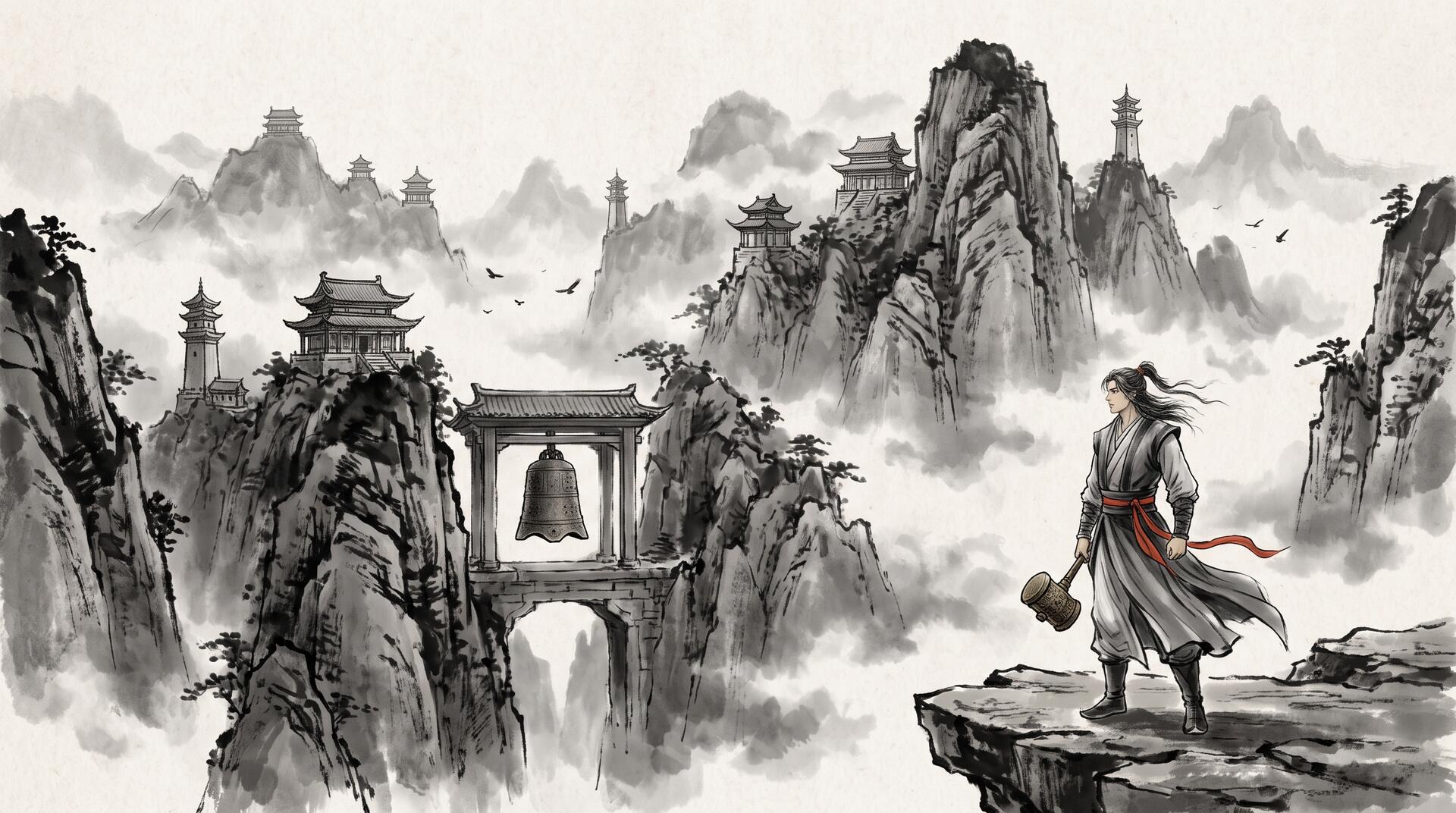
终南山深处,九座剑阁凌霄而立,按三纵三横之势错落分布于千仞绝壁之间,唤作“九宫剑阵”。
九阁环抱的中央玄渊深处,悬着一口上古传下的“太玄青铜钟”。此钟乃开山祖师以天外玄铁所铸,钟波浩荡,能荡涤剑心、助剑修勘破瓶颈。然而石殿窄狭、钟音霸烈,同一时辰天地间绝不可有两柄钟槌同时叩击钟身。若两阁弟子同时鸣钟,激荡的音煞会在石谷间共振绞杀,顷刻震塌整座玄渊(互斥保证)。
昔年,九阁为求独占石殿,用的是“天枢独断之法”。
九峰共推正中天枢阁的大长老掌管钟殿木牌。凡欲叩钟之阁,皆需遣快马奔赴天枢阁跪求准令。然而岁月渐长,大长老精力衰竭,门外求牌的剑客排成长龙,天枢峰成了九山最大关卡;有一年严冬暴雪断路,天枢阁与外界断绝音讯三月,整座终南山便随之彻底封冻,无一人能近钟殿半步。
后来,剑盟拆了天枢独断,换了“全峰齐准之令”。
规矩改作:凡欲叩钟者,需派出八头白羽神雕,向其余八座剑阁尽数传书,必须收齐所有八位阁主的朱砂印信,方可推门持槌。起初九阁之时,每趟鸣钟需发十六羽飞雕;待后来三十六峰结盟,每次叩钟便需在云海间往来飞驰七十羽神鹰。山风猎猎,飞羽遮天,各阁门前尽是信鹰啼鸣之声;若恰逢某座偏远偏殿长老闭关、鹰信迟滞,整座剑盟便陷入漫长死寂。
那一年暮秋,前川长老踏云而来。
他立于九宫绝顶,俯瞰苍茫群山,拂袖笑道:“欲求一人独叩古钟,何须惊动全山神禽?亦何须仰赖一人独断?”
前川长老取出一卷丝绢,将九座剑阁列为三行三列之局: 乾、坎、艮为第一横列; 震、巽、离为第二横列; 坤、兑、中为第三横列。
他为九峰立下了震撼天地的九宫盟环之法:
其一,交乘成契,唯取五席。 凡欲叩钟之阁,无需向天下广发飞鹰,只需向与自己同处一列、同处一行的剑阁求取青铜信符(在三乘三的方阵中,除却本阁,只需向纵横四阁派信,合自身共五席)。 前川长老执笔于绢上轻点:“任意两阁,无论相隔多远,其所在横纵之线在九宫格中必定在交汇之处重合于至少一阁!乾阁求取其行其列,离阁亦求取其行其列,二阁之盟环必在某处狭路相逢。”
其二,一印不事二主。 每座剑阁的守印长老手中,皆有一枚代表本阁意志的青铜信符。铁律昭告九峰:守印长老只要借出了青铜信符,在对方归还之前,绝不可再将符借与第二人!
山中剑修闻之抚掌大叹:妙极! 既有行与列之交乘,任意两阁的求符队伍必在至少一位守印长老门前相撞;而那位长老手中的信符只有一枚,绝不可能同时交予两方。天地之间,便绝无可能出现两座剑阁同时集齐五道信符之奇事! 每一次叩钟,山间往返的飞鹰从数十羽骤降至数羽,轻盈若鸿毛。
然而,大巧若拙,天地骤起波澜。
翌年惊蛰,天门大开。乾阁、离阁与坤阁三位首席剑客,竟在同一瞬心有所感,各自向石殿发起叩钟之请! 乾阁的飞鹰飞出,顺利借到了行内之符,却在等待离阁那一纵的印信; 离阁的飞剑驰骋,拿下了自己横列之符,却在枯候坤阁那一列的回音; 坤阁的弟子执礼,扣住了本纵诸阁之符,偏偏在等乾阁长老的青铜令!
三座剑阁,各自握着半数信符;三位交界处的守印长老,各自紧咬牙关、严守“一印不借二主”的铁规。 云海上空神鹰盘旋,石殿大门紧闭如铁。乾阁不肯退,离阁不能进,坤阁动不得。九峰之间陷入了可怕的死结僵持(死锁)!古钟静默无声,天地灵气却因三方对峙几近爆裂。
危急关头,前川长老自九天降下,于钟阁铜漏前敲响青玉磬,颁下解开天地死局的三令之约:
其一,铜漏刻刻,长幼有序。 各阁发鹰求符之时,必须以铜漏水刻打上发符时戳。若有多方争执,水刻早者为尊,水刻迟者为谦。
其二,问令(Inquire)探虚实。 守印长老若已将符借予后来之客,此时若接到了更早发令之尊客的求符飞书,长老不得坐视,需立刻向那后来之客发出一支轻灵金羽,唤作“问令”:“老夫之符虽在你手,敢问阁下可已凑齐五符、踏入石殿?若尚未成行,当知长幼有序!”
其三,绝辞(Failed)与还礼(Yield)。 那后来之客若在中途碰壁、接到了别阁的“绝辞”(知晓对方信符已借予旁人,自己短期绝无可能凑齐五符),一旦接到守印长老的“问令”,绝不可强横霸占,必须立刻俯首发出回函,唤作“还礼”,将手中尚未凑齐的青铜信符恭恭敬敬暂退还给长老!
守印长老收回还礼之符,立借于早发令的尊客。尊客五符齐备,从容迈入石殿,一槌叩响太玄钟,浩荡龙吟震散九峰阴霾! 鸣钟既毕,尊客出殿,五符如飞鸟归林尽数奉还(Release);长老再将信符重新借予先前还礼的后客。
那一夜,钟声如潮,九峰剑修无不拜服。 无一人独揽之壅滞,无全山喧嚣之靡费,亦无寸步不让之死局。群峰依纵横而守望,遇相持而还礼,太玄古钟岁岁长鸣。
——到这儿你大概已经认出来了:那座九峰环抱的玄渊与同一时辰严禁二人同叩的太玄钟,正是多节点分布式系统中需要独占访问的临界区(Critical Section);昔年天枢阁大长老的独断关卡,正是集中式锁服务(Centralized Lock Manager)及其必然面临的单点故障与吞吐瓶颈;向其余所有剑阁广发飞雕以求全票准许的旧法,正是经典的 Lamport 或 Ricart-Agrawala 算法那高达 $O(N)$ 的消息爆炸与脆弱性;而前川长老以行与列交乘构建、仅需 $\sqrt{N}$ 规模投票集并以相敬还礼化解死锁的传世之法,正是分布式互斥理论中名垂青史的经典之作——前川算法(Maekawa’s Algorithm)。
这是什么
Maekawa’s Algorithm(前川算法)是 Mamoru Maekawa(前川守)于 1985 年在 ACM Transactions on Computer Systems (TOCS) 上发表的分布式互斥算法(Distributed Mutual Exclusion)。它开创了分布式系统中基于法定人数集合(Quorum-based)实现安全互斥的先河。
在此之前,无中心节点的分布式互斥(如 Lamport 算法与 Ricart-Agrawala 算法)普遍采用全员投票机制:一个节点欲进入临界区,必须向集群中所有其他 $N-1$ 个节点广播请求并全部获得同意,每次访问临界区需要 $2(N-1)$ 条消息,网络开销随节点规模线性增长($O(N)$),且任何一个节点故障都会阻塞全局。
前川守提出了一个天才般的数学洞察:为了保证互斥,并不需要所有节点的同意,只需要任意两个节点的“支持者集合”存在至少一个公共节点即可。
- 法定人数集合的构造(Voting Sets / Quorums):
- 将集群中的 $N$ 个节点虚拟排列为一个 $\sqrt{N} \times \sqrt{N}$ 的网格(或利用有限射影平面 Fano Plane 构造对称集合)。
- 为每个节点 $i$ 分配一个投票子集 $S_i$。在经典的网格构造中,$S_i$ 包含节点 $i$ 所在行的所有节点以及所在列的所有节点,集合大小 $K \approx \sqrt{N}$(更精确地为 $2\sqrt{N} - 1$,使用有限几何构造可优化至严格的 $\approx \sqrt{N}$)。
- 关键交集性质(Intersection Property):对任意两节点 $i \neq j$,必有 $S_i \cap S_j \neq \emptyset$。也就是说,任意两个候选节点的投票集合必然至少重合于一个节点(仲裁者)。
- 选票独占与互斥安全(Safety Guarantee):
- 规定每个节点只有一张选票,在同一时刻只能将选票借给一个请求者(记录在局部状态中)。
- 当节点 $i$ 试图进入临界区时,只需向自己集合 $S_i$ 中的节点发送
Request,并等待收集该集合内全部节点的投票。 - 由于任意两个集合必有交集,交集处的仲裁节点绝不可能同时将自己唯一的选票投给两个人。因此,在任何时刻,全系统中绝不可能有两个节点同时凑齐各自集合的全部选票。互斥性(Safety)由集合论与代数交集在数学上严格保证!
- 死锁风险与三消息优雅化解(Deadlock Prevention via Preemption):
由于节点只向局部子集申请投票,当多个节点并发申请时,极易出现循环等待:节点 A 持有节点 1 的票等待节点 2,节点 B 持有节点 2 的票等待节点 3,节点 C 持有节点 3 的票等待节点 1——构成死锁环路。
前川算法通过结合 Lamport 逻辑时钟 与三种精妙的辅助消息彻底化解了死锁:
Inquire(探询):当仲裁节点已经将票投给了节点 A,随后收到了来自更早时戳(更高优先级)的节点 B 的请求时,仲裁者不会强行撤回,而是向 A 发送Inquire,探问 A 是否已经成行。Failed(失败):当请求者发现自己向某节点要票被拒绝(该票已被占用且对方优先级更高)时,它知道自己目前不可能集齐选票,记录失败状态。Yield(让步):节点 A 收到Inquire后,若发现自己尚未拿到全部选票(特别是已经收到了某些节点的Failed信号),必须主动向仲裁节点回复Yield,交出手中暂存的选票。仲裁节点随即把票转借给高优先级的 B;待 B 退出临界区发送Release后,仲裁节点再把票归还给 A。
为什么重要
前川算法在分布式系统与现代云原生架构演进中具有里程碑式的理论与工程意义:
-
从 $O(N)$ 到 $O(\sqrt{N})$ 的通信复杂度跃迁: 在千节点规模的分布式系统中,Ricart-Agrawala 算法每次加锁需要发送约 2,000 条消息;而前川算法将其压缩至约 $3\sqrt{N} \sim 5\sqrt{N}$,仅需数十条消息。它首次证明了:在完全去中心化的对等网络中,实现全局强一致的互斥锁并不需要全局共识的通信代价,通信规模可以实现次线性(Sub-linear)跨越。
-
现代 Quorum 系统的数学源头: 前川算法奠定了分布式系统利用子集相交性质(Quorum Intersection)换取可用性与性能的理论范式。现代分布式数据库与分布式协调服务(如 Apache Cassandra 的读写 Quorum、Dynamo-style 系统的网格法定人数、Ceph CRUSH 算法中的故障域子集隔离)中关于“读写集合必有交集”的设计思想,皆可在前川算法的几何子集划分中找到清晰的理论血脉。
-
典范式的无中心死锁破除哲学: 许多分布式算法在遭遇循环等待时,往往诉诸全局死锁检测器或粗暴的超时熔断。前川算法展示了一种极富教益的局部协作哲学:通过带有优先级的探询(
Inquire)与自省式的退让(Yield),各个对等节点仅凭局部的时钟比较与礼让协议,就能在完全没有中心裁判的情况下自发解开复杂的死锁环路。这种“发现自己无法成事时便主动退还资源”的协作契约,至今仍是高并发分布式资源调度系统中最推崇的优雅解法。
隐喻对应表
- 终南山深处的九座剑阁 → 分布式网络中自治对等的计算节点(Distributed Nodes)
- 中央玄渊石殿与太玄青铜钟 → 共享资源或独占临界区(Critical Section)
- 严禁二人并槌叩钟的祖训 → 临界区互斥访问安全不变式(Mutual Exclusion / Safety Invariant)
- 天枢阁大长老与大雪封山断路 → 集中式锁服务与其单点故障及吞吐瓶颈(Centralized Lock Manager / SPOF)
- 向其余八阁广发八羽飞雕全票准许 → Lamport / Ricart-Agrawala 算法的全网广播机制($O(N)$ 消息开销)
- 前川长老排定的三纵三横九宫盟环 → 前川算法基于网格划分的法定人数子集(Grid Quorum / Voting Set $S_i$,大小 $K \approx \sqrt{N}$)
- 任意两阁之盟环必在交汇处重合一阁 → 法定人数集的两两相交性质($\forall i, j: S_i \cap S_j \neq \emptyset$)
- 守印长老同一时刻绝不借出第二枚信符 → 每个节点仅有一票且一次仅授权一个请求者(Vote Mutual Exclusion)
- 三阁同时扣符造成的云海僵局 → 局部子集投票导致的循环等待死锁(Circular Wait Deadlock)
- 铜漏水刻打上的发符时戳 → 用于确定全局偏序与优先级的逻辑时钟(Lamport Timestamps)
- 守印长老发出的金羽“问令” → 仲裁节点在遭遇高优先级请求时发出的探询消息(
Inquire消息) - 弟子获知信符旁落的受阻回函 → 候选者获知暂无法获取选票的失败标记(
Failed消息) - 后来之客躬身奉还信符的“还礼” → 候选者主动归还选票以解除死锁的让步消息(
Yield消息) - 鸣钟既毕后的归还信符 → 退出临界区后向投票子集全体广播的释放消息(
Release消息)
Deep within the Zhongnan Mountains, nine sword pavilions rose into the azure mist. Arranged in three vertical ranks and three horizontal tiers along the sheer precipices, they formed an ancient formation known as the Grid of Nine Groves.
In the abyssal chasm cradled at the center of the nine peaks hung the Great Primordial Bell, cast by the founding patriarch from meteoric iron. When struck, its sonorous resonance swept through the valleys, washing impurities from a swordsman’s spirit and enabling breakthroughs across martial boundaries. Yet the stone vault was narrow and the bell’s reverberations ferocious: under heaven and earth, no two mallets could ever strike the bronze chime at the same moment. Should two pavilions strike in unison, the intersecting harmonics would tear through the gorge, collapsing the cavern into oblivion (the mutual exclusion guarantee).
In former years, to ensure only one swordsman entered the vault, the peaks relied on the “Decree of the Central Pivot.”
The Grand Elder of the central Tian-Shu Pavilion held sole custody of the bell’s admittance tablet. Any pavilion wishing to strike the bell had to dispatch swift couriers to Tian-Shu Peak to petition for the token. But as decades passed and the Grand Elder grew frail, petitions piled like hills outside his hermitage, turning the central pavilion into the greatest bottleneck in the mountains. During one harsh winter, an avalanche severed all mountain paths to Tian-Shu for three months; the entire range was paralyzed, and not a single soul could approach the sacred bell (a single point of failure and bottleneck).
Later, the sword alliance discarded the central arbiter in favor of the “Universal Consent of the Peaks.”
The new rule ran thus: whoever wished to ring the bell had to loose eight white-feathered hawks across the sky, one to each of the other eight pavilions. Only when all eight master seals had been gathered could a swordsman step into the cavern with mallet in hand. At first, with only nine pavilions, each turn demanded sixteen hawks; but when thirty-six cloisters eventually joined the mountain covenant, every chime required seventy messengers darting across the clouds. The skies darkened beneath beating wings, courtyard gates echoed with endless squawking, and if an elder in some remote outpost fell into prolonged meditation, the entire alliance froze in indecision ($O(N)$ message explosion and extreme vulnerability).
In the late autumn of that year, Elder Maekawa came stepping upon the misty clouds.
Gazing down from the highest peak upon the vast chessboard of stone towers, he brushed his wide sleeves and smiled: “To grant one swordsman exclusive access to the chime, why must we agitate every bird under heaven? And why must we prostrate before a single master?”
Unfurling a scroll of pure silk, Elder Maekawa laid out the nine pavilions in a three-by-three lattice: Pavilions 1, 2, and 3 formed the first tier; Pavilions 4, 5, and 6 formed the second tier; Pavilions 7, 8, and 9 formed the third tier.
Thereupon, he established the Covenant of Lattice Rings:
First, Intersecting Quorums of Five. A pavilion desiring the chime need not petition the entire world. It had only to seek bronze tallies from those pavilions sharing its own rank and its own file (in a three-by-three grid, including itself, a voting quorum of five pavilions). Elder Maekawa traced his brush across the silk: “Pick any two pavilions, no matter how distant their peaks. Their respective ranks and files must intersect at one or two shared pavilions! Pavilion 1 gathers tallies along its row and column; Pavilion 6 gathers tallies along its own. Their circles of allies are destined to meet at the crossing stones.”
Second, One Tally Shall Not Serve Two Masters. Within each pavilion, the Keeper of the Seal guarded exactly one bronze tally representing that pavilion’s solitary vote. The law of the peaks was unbending: once a Keeper had lent out his bronze tally, he could not bestow it upon another until it was safely returned!
Hearing this, the mountain masters struck their palms in delight: brilliant! Because every pair of quorums intersected, any two petitioners would inevitably collide before at least one shared Keeper. And because that Keeper held only one tally, he could never grant his vote to both contenders at once. It was mathematically impossible for two pavilions to simultaneously collect all five tallies! Mutual exclusion stood as solid as bedrock. Furthermore, the flock of messenger birds required for each chime plummeted from dozens to a mere handful ($O(\sqrt{N})$ complexity).
Yet within exquisite elegance lay a slumbering peril.
On the dawn of the Spring Equinox, three chief disciples—from Pavilion 1, Pavilion 6, and Pavilion 8—simultaneously felt the spark of epiphany and sought the sanctuary. Pavilion 1 loosed its hawks and secured the tallies of its row, yet sat waiting for the column shared with Pavilion 6; Pavilion 6 gathered its row, yet waited in vain for the column crossing Pavilion 8; Pavilion 8 held its column, yet languished waiting for the crossing of Pavilion 1!
Each pavilion held half the needed tokens; each arbiter at the crossroads held firm to the command: “Never grant a loaned tally to another.” Hawks wheeled fruitlessly above the sea of clouds; the heavy bronze portal remained barred. Pavilion 1 could not retreat, Pavilion 6 could not advance, and Pavilion 8 was paralyzed. A suffocating deadlock gripped the mountain (deadlock via circular wait)! The great bell stood mute, while tension between the factions threatened to shatter the alliance.
At that fateful moment, Elder Maekawa descended upon the bell tower, struck a jade chime beside the water clock, and proclaimed the Three Decrees of Yielding:
First, Order by the Water Clock. Whenever a pavilion dispatched hawks to petition for tallies, it had to stamp each parchment with the exact mark of the mountain water clock. When claims clashed, the earlier water-tally held precedence; the later yield to the elder.
Second, The Inquiry (Inquire). If a Keeper had already lent his tally to a later petitioner, and a request arrived from an earlier petitioner bearing greater seniority, the Keeper could not sit idle. He had to shoot a golden arrow of inquiry (Inquire) to the junior petitioner: “My tally rests in your hands, but have you assembled your full five tokens and entered the sanctuary? If not, remember the order of the clock!”
Third, Resignation (Failed) and Yielding (Yield). If that junior petitioner had already encountered locked doors elsewhere—receiving a letter of refusal (Failed) proving it could not possibly complete its set—the arrival of an Inquire forbade all stubborn hoarding. The junior petitioner had to bow, draft a message of surrender (Yield), and immediately return the borrowed tally to the Keeper!
Upon receiving the yielded tally, the Keeper instantly bestowed it upon the senior petitioner. With all five tallies finally assembled, the senior swordsman strode serenely into the sanctuary, striking the Great Primordial Bell until dragon chants echoed across the peaks! When the meditation ended, the swordsman departed, releasing all five tallies (Release) back to their home peaks. Only then did the Keeper grant his tally once more to the junior aspirant.
That night, the bell resonated like the rising tide, and all nine peaks bowed in reverence. No congestion of a lone tyrant, no wasteful squawk of universal broadcasting, and no unyielding deadlock of stubborn contenders. By dividing the peaks into intersecting lattices and answering contention with courteous yielding, the Primordial Bell sang through the ages.
— By now you’ve probably recognized it: the mountain sanctuary and the iron rule forbidding concurrent chimes represent the shared critical section (Critical Section) requiring mutually exclusive access; the aging elder of Tian-Shu Peak represents a centralized lock manager (Centralized Lock Manager) with its inevitable single point of failure and bottleneck; the universal broadcast to all eight peaks represents the classical Lamport or Ricart-Agrawala algorithms with their linear $O(N)$ message explosion; and Elder Maekawa’s lattice of intersecting quorums coupled with courteous yielding to avert deadlock is one of the most celebrated milestones in distributed systems theory: Maekawa’s Algorithm.
What it is
Maekawa’s Algorithm is a distributed mutual exclusion protocol published in 1985 by Mamoru Maekawa in the ACM Transactions on Computer Systems (TOCS), titled “A $\sqrt{N}$ Algorithm for Mutual Exclusion in Decentralized Systems.” It pioneered the use of quorum-based subsets to achieve distributed synchronization without a central coordinator.
Prior to Maekawa’s work, permission-based distributed mutual exclusion algorithms (such as Lamport’s Bakery / Logical Clocks and the Ricart-Agrawala algorithm) relied on universal consensus: a node wishing to enter a critical section had to broadcast a request to all other $N-1$ nodes and await unanimous approval. This imposed a message complexity of $2(N-1)$ per critical section invocation, scaling linearly ($O(N)$) and rendering the system vulnerable to any single node’s slowdown or crash.
Maekawa made a profound mathematical breakthrough: to guarantee mutual exclusion, unanimous consent is entirely unnecessary; one only requires that any two candidates’ permission sets share at least one common arbiter.
- Quorum Construction (Voting Sets):
- The $N$ distributed nodes are logically arranged in a $\sqrt{N} \times \sqrt{N}$ matrix (or mapped onto finite projective geometries like the Fano Plane).
- Each node $i$ is assigned a voting set $S_i$. In the grid construction, $S_i$ consists of all nodes in node $i$’s row and all nodes in its column, resulting in a quorum size of $K \approx \sqrt{N}$ (more precisely $2\sqrt{N}-1$; symmetric projective geometry can reduce this to $\approx \sqrt{N}$).
- The Intersection Property: For any two distinct nodes $i$ and $j$, $S_i \cap S_j \neq \emptyset$. Any pair of candidate quorums is guaranteed to overlap at one or more arbiter nodes.
- Vote Exclusivity and Safety Guarantee:
- Each node possesses exactly one vote and can grant it to only one contender at any given time.
- When node $i$ seeks entry to the critical section, it sends
Requestmessages only to members of its own subset $S_i$ and waits until all members have granted their vote. - Because every pair of voting sets shares at least one arbiter, that arbiter cannot grant its single vote to two contenders concurrently. Thus, no two nodes can simultaneously hold all votes from their respective quorums. Mutual exclusion (Safety) is mathematically guaranteed.
- Deadlock Prevention via Preemptive Messages:
Because nodes petition only local subsets, concurrent requests can easily produce circular wait conditions (e.g., node A holds vote 1 and waits for 2; node B holds vote 2 and waits for 3; node C holds vote 3 and waits for 1).
Maekawa resolved this by combining Lamport logical timestamps with three auxiliary control messages:
Inquire: When an arbiter has already granted its vote to node A, and subsequently receives a request from node B with an earlier timestamp (higher priority), the arbiter sends anInquiremessage to A, asking whether it has already entered the critical section.Failed: When a candidate node receives a rejection indicating its request was preempted or queued behind a higher-priority rival, it records a failure state, knowing it cannot currently assemble a full quorum.Yield: When node A receives anInquireand realizes it has not yet secured all required votes (specifically if it has received aFailedmessage from elsewhere), it must yield by sending aYieldmessage back to the arbiter, relinquishing the vote. The arbiter immediately reassigns the vote to the higher-priority node B. Once B exits and sendsRelease, the arbiter returns the vote to A.
Why it matters
Maekawa’s Algorithm occupies a foundational position in distributed systems architecture:
-
Sub-linear Communication Complexity ($O(N)$ to $O(\sqrt{N})$): In a thousand-node cluster, Ricart-Agrawala demands approximately 2,000 network messages per lock acquisition; Maekawa’s algorithm slashes this to $3\sqrt{N} \sim 5\sqrt{N}$, requiring merely dozens of messages. It proved that decentralized mutual exclusion does not demand global broadcast, enabling synchronization to scale sub-linearly.
-
Theoretical Genesis of Quorum Systems: Maekawa established the foundational paradigm of using overlapping quorums to balance consistency and availability. The core premise—that intersecting subsets guarantee invariant safety without full cluster coordination—directly inspired grid quorums, hierarchical quorums, and the read/write quorum mechanics powering modern distributed databases such as Apache Cassandra and Amazon Dynamo.
-
Decentralized Deadlock Resolution Philosophy: While many distributed systems resort to centralized deadlock detectors or ungraceful timeouts, Maekawa’s algorithm offers an elegant, decentralized protocol of voluntary deference. Through priority-based inquiries (
Inquire) and introspective concessions (Yield), autonomous peers untangle complex circular deadlocks using only local timestamp evaluations and cooperative contracts. This principle of gracefully yielding uncommitted locks remains a gold standard in modern high-concurrency distributed resource scheduling.
Metaphor mapping
- Nine sword pavilions in Zhongnan Mountains → Autonomous peer nodes in a distributed system (Distributed Nodes)
- Central cavern sanctuary and the Great Primordial Bell → Shared resource or exclusive critical section (Critical Section)
- Ancient law forbidding simultaneous bell strikes → Mutual exclusion safety invariant (Mutual Exclusion / Safety Invariant)
- Grand Elder of Tian-Shu Peak and the winter avalanche → Centralized lock coordinator with its single point of failure and bottleneck (Centralized Lock Manager / SPOF)
- Universal dispatch of hawks to all eight pavilions → Full broadcast consensus in Lamport / Ricart-Agrawala ($O(N)$ message overhead)
- Three-by-three lattice and five-pavilion alliances → Maekawa’s grid-based quorum voting sets (Grid Quorums / Voting Sets $S_i$, size $K \approx \sqrt{N}$)
- Any two alliances intersecting at a crossing pavilion → Pairwise quorum intersection property ($\forall i, j: S_i \cap S_j \neq \emptyset$)
- Keeper of the Seal lending only one bronze tally at a time → Exclusive single-vote rule per node (Vote Locking)
- Three pavilions holding partial tallies in a stalemate → Circular wait deadlock in uncoordinated quorum acquisition (Deadlock via Circular Wait)
- Water-clock timestamp carved on parchment → Monotonic logical clocks establishing global priority (Lamport Timestamps)
- Golden arrow asking if the petitioner has entered the sanctuary → Preemptive status inquiry sent by an arbiter (
Inquiremessage) - Letter of refusal received from a contested peak → Notification of contested vote preventing immediate quorum (
Failedmessage) - Junior petitioner bowing and returning the bronze tally → Cooperative concession releasing an uncommitted vote (
Yieldmessage) - Returning all tallies after the bell strike ends → Final broadcast releasing votes upon critical section exit (
Releasemessage)