▶ Cinematic fable · Watch on YouTube ▶ 影片版寓言 · 在 YouTube 观看
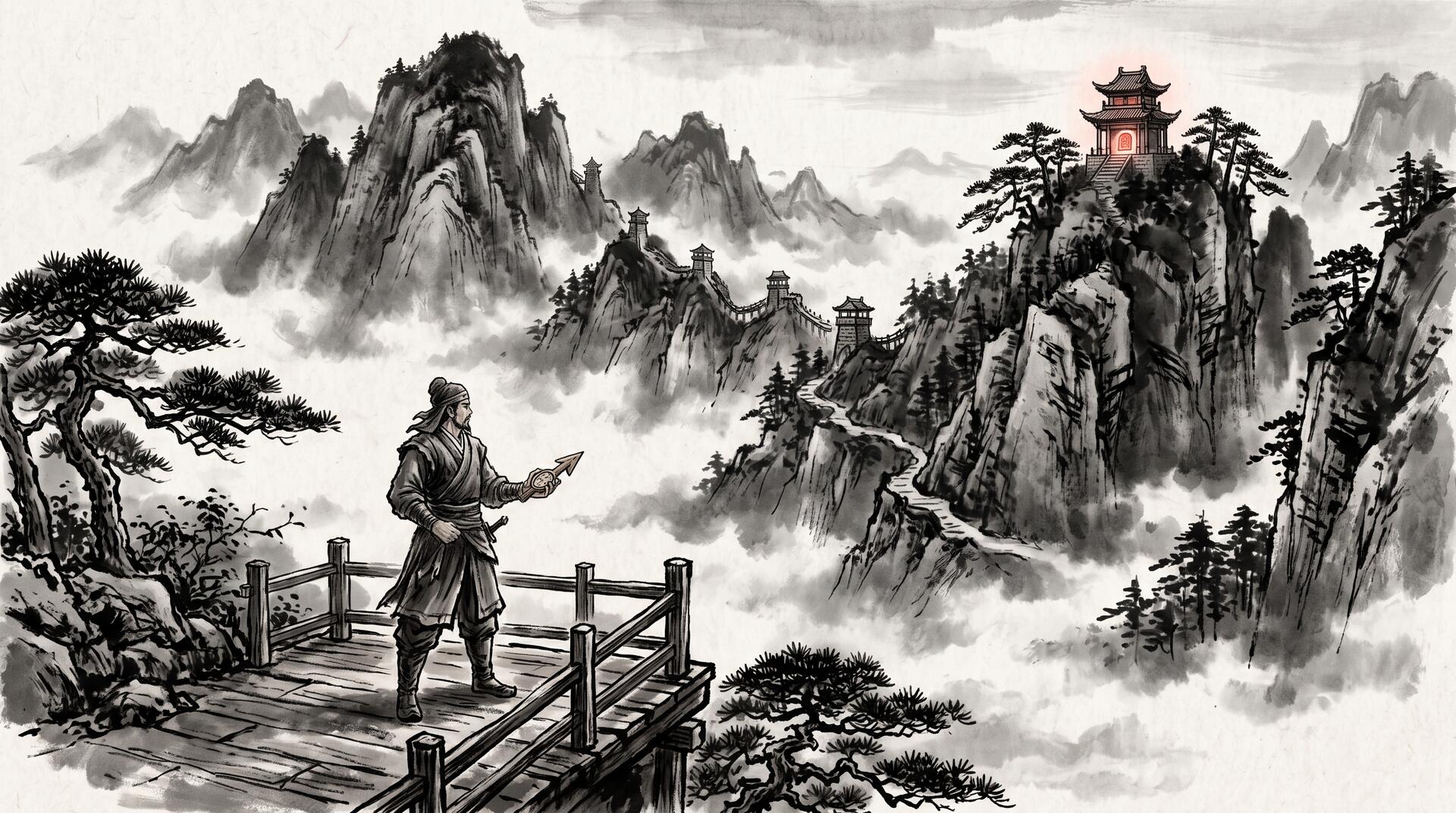
终南山脉云封雾锁,崇山峻岭间散布着数十座戍守栈道的石砌烟楼。
群峰之巅有一座千年药王神鼎,专供各楼守军熬炼祛瘴救命的“紫霄九还膏”。神鼎天规严苛:天地之间,任何时刻只准一处烟楼执符开炉。若有两处同时起火熬膏,药气相冲,神鼎便会彻底毁弃,整座山脉的守军都将无药可救。
为了防患于未然,山中立有一枚世代相传的玄铁巡峰古符。古符所在之处,方可启炉熬药。
早年间,山中守军全凭乱撞:哪座烟楼想熬药,便命健步如飞的信使向其余数十座烟楼各送一封急信。几十座险峰隔着深渊绝壁,信使攀藤附葛,山道上整日跑满了气喘吁吁的传令兵。每次动用神鼎,几十封信在群山间交错横飞;更要命的是,若两座偏远哨楼同时差人,信使在吊桥上撞个正着,谁也不知古符究竟在谁手,往往药材在鼎前放凉了,四面八方的回信还在绝壁悬崖间兜圈子。
直到后来,工部一位精通舆地机巧的雷典事来到山中,看罢地形,只是微微一笑。他取出一叠羊皮纸,在山中立下了三条看似不可思议的简规。
第一,云栈结树,各认邻舍。 雷典事严禁烟楼越界向远方哨所乱发飞信。他依着山势地貌,将全山数十座烟楼穿结成一张不见环路的“树状云栈”——每座烟楼只与近邻几座相连,绝无盘根错节的死循环。
第二,青铜罗盘,单指引路。 雷典事在每座烟楼的望台案几上,嵌下一面刻有箭头的小青铜罗盘。这罗盘不测子午,只做一件事:指向当前古符所在的方向。 倘若古符恰在自家楼中,罗盘上的箭头便稳稳指着正中案台;若古符不在本楼,箭头便精确指向“隔壁那座离古符更近的相邻烟楼”。全山数十座烟楼,谁也不需要知道古符究竟藏在千里之外哪座险峰,每一任哨兵只需认准自家案头这根小小的铜针,便知道古符在哪个方向。
第三,空囊排队,逐级转呈。 当某座烟楼需要熬药时,哨兵只需在自家木案下的竹筒里,投下一枚写有自己名号的“求符木牌”。 若本楼案头并无古符,哨兵便只向案头罗盘所指的那座邻楼,发出一只信鸽送去求符请求。
邻楼接信后,若案头也没有古符,哨兵绝不慌乱,只做两件事: 其一,将求信者的来处挂进自家案下的竹筒末尾排队; 其二,若自家此前尚未向罗盘所指的前方催符,便顺着罗盘指针,向下一座更靠近古符的烟楼也发出一道求符飞信。
最妙的玄机发生在古符沿途折返的时刻。 当古符持有楼熬完丹药,便从案下竹筒取出第一个排队的来客名号,将沉甸甸的巡峰古符装入锦囊,由近邻信使稳稳递过去。而每当古符穿过一座烟楼,该楼的案头罗盘便会“咔嗒”一声,顺着古符送出的反方向重新拨转——原本指向前方,此刻反转指向刚刚接走古符的邻楼!
就这样,古符在群山树枝间轻盈穿梭,宛如水流顺着渠沟自然滑行。哨楼求符,消息无需全山广播,只需顺着罗盘向上攀爬数个节点;古符送出,铜针翻转,整座大山的寻符路线在无声无息中完成了乾坤倒转。
从此,终南山绝壁上再无疲于奔命的信使大军。纵有百座烟楼,每次求药动用的信使平均不过寥寥数人,山道澄澈,神鼎长明。
读到这里,聪明的你或许已经认出:这套绝妙的机制,正是分布式互斥理论中大名鼎鼎的雷蒙德树状互斥算法(Raymond’s Tree-Based Mutual Exclusion Algorithm)。
这是什么
雷蒙德算法(Raymond’s Algorithm)由 Kerry Raymond 于 1989 年在《A Distributed Algorithm for Multiple Entries to a Critical Section》中提出,是分布式计算中最为优美且高效的基于逻辑树与权杖(Tree-Based Token)的分布式互斥(Distributed Mutual Exclusion)协议。
在分布式系统中,为防止并发写入冲突或保证临界区(Critical Section)的安全独占,系统通常需要互斥锁。传统的许可型算法(如 Lamport 算法需要 $3(N-1)$ 条消息,Ricart-Agrawala 算法需要 $2(N-1)$ 条消息)或广播权杖算法(如 Suzuki-Kasami 算法需要 $N$ 条广播消息)都需要在全网广播请求,通信开销随节点规模线性增长($O(N)$)。
雷蒙德算法打破了广播的思维定势:
- 逻辑树拓扑(Logical Spanning Tree):所有节点被组织成一棵逻辑树,节点间仅维护直连邻居的通信通道。
- 局部指针(Holder Variables / Directed Tree):每个节点只需维护一个指向父节点的局部指针
holder。如果当前节点持有权杖(Token),则holder指向自身;否则holder指向逻辑树上通往权杖持有者所在子树的邻居。整个逻辑树形成一个以权杖持有者为根的有向树(Directed Tree to Root)。 - 本地请求队列(FIFO Request Queue):每个节点维护一个先进先出队列
request_q,记录自身或相邻子节点传上来的请求意图。 - 沿树路由与指针动态反转(Pointer Reversal):请求沿
holder逐级向上传递;当权杖沿反方向下发给请求者时,沿途每个经过的节点自动将其holder指针反转指向新获得权杖的邻居。通过这一动态反转,整棵树自然而然地重新以新权杖持有者为根,系统始终保持无环且拓扑一致。
为什么重要
-
对数级消息开销($O(\log N)$ Message Complexity): 在平衡树拓扑下,每次进入临界区的平均网络消息复杂度仅为树的平均深度,即 $O(\log N)$(最坏在退化链表拓扑下为 $O(N)$)。相比全网广播的 $O(N)$ 算法,在规模达到数千乃至数万节点的超大规模对等网络中,通信量实现了数量级的削减。
-
极简局部状态(Zero Global State Knowledge): 在广播型算法中,每个节点必须知晓全集群所有节点的网络地址($O(N)$ 状态)。而在雷蒙德算法中,每个节点只需要知晓其直连邻居节点与本地罗盘指针,存储与拓扑维护成本完全解耦于全局规模,具备极佳的可扩展性(Scalability)。
-
天然公平与无死锁(Deadlock-Free & Starvation-Free): 依靠树状结构的单一路径保证与节点内部严格的 FIFO
request_q请求队列,每个请求都会被确定性地路由至权杖所在根节点,并在权杖巡回过程中得到按序满足。算法在理论上严格证明了无死锁(Deadlock-free)与无饥饿(Starvation-free)。 -
对现代分布式租约与拓扑路由的深远启发: 雷蒙德算法开创的“指针反转(Pointer Reversal)追踪动态根节点”范式,直接奠定了现代分布式自适应拓扑路由、分层分布式锁管理器(Hierarchical Lock Managers)、分布式租约接力(Lease Relaying)以及大规模集群共享缓存所有权协议(Cache Coherence Directory Protocols)的理论基石。
隐喻对应表
- 散布群峰的数十座烟楼 → 分布式系统中的网络节点 (Distributed Nodes)
- 熬炼九还膏的药王神鼎 → 需要独占访问的临界区资源 (Critical Section)
- 严禁双楼同炼药的天规 → 互斥安全不变式 (Mutual Exclusion Safety Invariant)
- 随处巡行方可启炉的玄铁古符 → 临界区访问特权令牌 (Privilege Token)
- 不见死循环的树状云栈 → 节点间组织的无环逻辑树拓扑 (Logical Spanning Tree)
- 每座案头的青铜罗盘指针 → 指向权杖方向的局部指针变量 (
holderVariable) - 木案下记录名号的排队竹筒 → 节点本地先进先出请求队列 (Local FIFO
request_q) - 仅向罗盘所指邻楼递送的飞鸽信件 → 沿树向根节点转发的求锁请求 (
REQUESTMessage) - 古符装入锦囊点对点送往邻楼 → 权杖沿树向请求者精确投递 (
TOKENMessage) - 古符过境时罗盘“咔嗒”倒拨 → 权杖移交时的局部指针反转 (Dynamic Pointer Reversal)
- 每次求药仅需翻越寥寥数峰 → 平衡树拓扑下极优的 $O(\log N)$ 平均消息复杂度
Shrouded in dense mountain mist, dozens of stone watchtowers guarded the high cliffside trails of the Zhongnan range.
At the highest summit stood the sacred Jade Crucible of the Medicine King, reserved for boiling the life-saving Nine-Turn Celestial Salve for the garrisons. The Crucible was bound by an unyielding celestial rule: across heaven and earth, at any given moment, only a single watchtower was permitted to kindle the flame. Should two watchtowers feed fuel simultaneously, the medicinal vapors would violently clash, destroying the Crucible beyond repair and leaving the mountain troops without salvation.
To safeguard this covenant, an ancient black-iron Patrolling Talisman had been handed down through generations. Wherever the Talisman rested, that tower alone possessed the privilege to boil the salve.
In earlier years, the garrisons operated by sheer chaos: whenever a watchtower wished to boil medicine, its sentries dispatched swift-footed couriers across treacherous ridges to every other tower in the mountain. Across deep chasms and sheer cliffs, runners scrambled along ropes and narrow ledges, filling the mountain passes with exhausted messengers. Each batch of medicine required dozens of letters crisscrossing the peaks. Worse still, if two remote outposts sent requests at the same time, their couriers met midway on rope bridges with neither knowing who truly held the talisman. Often the herbs chilled before the Crucible while replies remained hopelessly delayed along stormy precipices.
Then Master Raymond, a surveyor from the Ministry of Works renowned for his cunning geometric machines, arrived at the mountain pass. Observing the rugged terrain, he offered a tranquil smile. Unfolding a sheaf of parchment, he laid down three seemingly wondrous rules.
First: Weave the trails into an unlooped tree. Master Raymond forbade watchtowers from sending messages across long distances to far-flung bastions. Conforming to the natural ridgelines, he connected all towers into a hierarchical “cloud-ladder tree”—each tower communicated exclusively with its direct immediate neighbors, leaving zero circular paths or tangled loops.
Second: A bronze compass with a single guiding arrow. On the observation desk of every watchtower, Master Raymond embedded a bronze compass table carved with an arrow pointer. This compass did not track magnetic north; it performed one singular duty: pointing toward the current location of the Patrolling Talisman. If the Talisman rested right on the local desk, the arrow rested dead-center on the hearth. If the Talisman was elsewhere, the arrow pointed squarely toward the direct neighboring watchtower that stood closer to the Talisman. Across dozens of peaks, no sentry needed to know which remote precipice currently held the Talisman; every guard merely trusted the local bronze pointer on his desk.
Third: A waiting tube and step-by-step forwarding. When a watchtower needed to boil medicine, its sentry dropped a wooden token inscribed with his tower’s name into a hollow bamboo tube beneath his desk. If the Talisman was not on his desk, the sentry sent a single carrier pigeon with a request only to the immediate neighbor indicated by his compass arrow.
Upon receiving the request, if that neighbor did not possess the Talisman, its sentry remained entirely composed and performed two simple actions: First, he appended the requester’s identity to the tail of his local bamboo waiting tube; Second, if his tower had not already forwarded an active request upstream, he dispatched a request pigeon along his own compass pointer toward the next neighbor closer to the Talisman.
The supreme elegance unfolded when the Talisman made its return journey along the branches. When the holding tower finished boiling the salve, it withdrew the first waiting caller from its bamboo tube, placed the heavy Talisman into an embroidered pouch, and handed it directly to its neighboring courier. And as the Talisman traversed each watchtower along the way, that tower’s bronze compass clicked, snapping in reverse toward the direction from which the Talisman had just been delivered—the pointer that once faced forward now flipped backward toward the neighbor who had just received the Talisman!
In this manner, the Talisman danced gracefully along the mountain tree branches, gliding like clear water through prepared mountain flumes. When an outpost requested the Crucible, its message never flooded the entire mountain range; it ascended merely a handful of levels along the compass needles. As the Talisman was transferred down, the pointers dynamically inverted, reversing the routing paths across the peaks without a whisper of broadcast.
From that day forward, exhausted courier armies no longer stumbled across the ravines of the Zhongnan range. Even with a hundred watchtowers, each medicine request required only a few hops between adjacent peaks. The trails remained quiet, and the sacred Crucible burned undisturbed.
By now you have probably recognized it: this ingenious design is none other than the celebrated Raymond’s Tree-Based Mutual Exclusion Algorithm in distributed systems theory.
What it is
Raymond’s Algorithm, formulated by Kerry Raymond in her seminal 1989 paper “A Distributed Algorithm for Multiple Entries to a Critical Section”, is one of the most elegant and efficient tree-based token protocols for distributed mutual exclusion.
In distributed computing, ensuring safe exclusive access to a shared critical section (or protecting against conflicting concurrent writes) requires mutual exclusion locks. Traditional permission-based algorithms (such as Lamport’s algorithm requiring $3(N-1)$ messages or Ricart-Agrawala requiring $2(N-1)$ messages) and broadcast token algorithms (such as Suzuki-Kasami requiring $N$ broadcast messages) rely on cluster-wide broadcasts, imposing network communication costs that scale linearly ($O(N)$) with cluster size.
Raymond’s algorithm shatters the broadcast assumption through three foundational pillars:
- Logical Spanning Tree: All nodes are organized into an unlooped logical tree topology where communication occurs strictly between adjacent tree neighbors.
- Local Holder Pointer (
holder): Each node maintains only a single local variable pointing toward the current token holder. If the node holds the token itself,holderpoints toself; otherwise,holderpoints to the neighboring node on the path toward the subtree currently hosting the token. The entire tree constitutes a directed graph rooted at the token holder. - Local FIFO Queue (
request_q): Each node maintains an internal FIFO queue recording requests originating from itself or forwarded by adjacent child nodes. - Stepwise Routing and Dynamic Pointer Reversal: A lock request travels upstream along the
holderchain toward the root. When the token is transferred downstream to satisfy a request, every intermediate node along the path inverts itsholderpointer to point toward the recipient. This dynamic pointer reversal re-roots the tree at the new token holder, preserving acyclicity and consistency with zero global coordination.
Why it matters
-
Logarithmic Message Complexity ($O(\log N)$): In a balanced tree topology, the average number of messages required per critical section entry is proportional to the tree depth—yielding an outstanding $O(\log N)$ message complexity (degrading to $O(N)$ only in a fully skewed linear list). In large-scale peer networks spanning thousands or tens of thousands of nodes, this eliminates broadcast overhead by orders of magnitude.
-
Zero Global Topology Knowledge: Unlike broadcast algorithms where every node must store and maintain IP addresses or connection state for all $N$ peers ($O(N)$ state), a node in Raymond’s algorithm only knows its immediate tree neighbors and its local compass pointer. Storage and membership maintenance are completely decoupled from global cluster size, providing pristine horizontal scalability.
-
Inherent Safety, Deadlock-Freedom, and Starvation-Freedom: Because the logical spanning tree contains no cycles and each node processes its local
request_qin strict FIFO order, requests are deterministically routed to the token root and satisfied without circular waiting. The algorithm is mathematically proven to be deadlock-free and starvation-free. -
Foundational Paradigm for Hierarchical Locks and Routing: Raymond’s breakthrough—using dynamic pointer reversal to track mobile root capabilities—laid the theoretical groundwork for modern distributed lease relaying, hierarchical distributed lock managers, tree-based cache coherence directories, and adaptive mobile ad-hoc routing protocols.
Metaphor mapping
- Dozens of stone watchtowers across mountain peaks → Network nodes in a distributed system (Distributed Nodes)
- Sacred Jade Crucible for boiling medicine → Shared resource / critical section requiring exclusive access (Critical Section)
- Celestial rule forbidding concurrent boiling → Mutual exclusion safety invariant (Mutual Exclusion Safety Invariant)
- Ancient black-iron Patrolling Talisman → Exclusive privilege token (Privilege Token)
- Unlooped cloud-ladder tree connecting towers → Logical spanning tree topology (Logical Spanning Tree)
- Bronze compass arrow on each desk → Local pointer variable directed toward the token holder (
holderVariable) - Hollow bamboo waiting tube on the desk → Node’s local FIFO request queue (Local FIFO
request_q) - Carrier pigeon sent only to the compass neighbor → Request message routed step-by-step toward the root (
REQUESTMessage) - Talisman pouch handed point-to-point to neighbor → Token transferred along tree branches (
TOKENMessage) - Compass clicking and reversing when the talisman passes → Dynamic pointer reversal upon token transfer (Pointer Reversal)
- Crossing only a handful of peaks per request → $O(\log N)$ average message complexity in balanced trees